

This article was automatically translated from the original Turkish version.
+1 More
Family | Bovidae | ||||||||
|---|---|---|---|---|---|---|---|---|---|
Conservation Status | Near Threatened (IUCN) | ||||||||
Geographic Distribution | Uzbekistan Turkmenistan Tajikistan India Pakistan Afghanistan | ||||||||
Specie(s) | Capra falconeri | ||||||||
Genus | Capra | ||||||||
Subfamily | Caprinae | ||||||||
Taxon | Artiodactyla | ||||||||
Burma Horned Goat (Capra falconeri), widely known as Markhor, is a large wild goat species belonging to the family Bovidae and the subfamily Caprinae. Taxonomically, this species within the genus Capra is divided into several subspecies, including C. f. falconeri, C. f. cashmiriensis, C. f. megaceros, C. f. jerdoni, and C. f. heptneri, distinguished by horn morphology and geographic distribution. There are two primary linguistic theories regarding the origin of the common name Markhor: one suggests it derives from the Persian words mar (snake) and khor (eater), meaning snake-eater; the other proposes it comes from the Pashto expression for snake-horn, referring to the shape of its horns. The latter theory is generally considered more morphologically consistent, given the species’ entirely herbivorous diet.

Geographic Distribution of the Burma Horned Goat (Capra falconeri)
(AI-Generated Image)
Populations of this species are found in scattered regions of Afghanistan, India, Pakistan, Tajikistan, Turkmenistan, and Uzbekistan, particularly in the arid and steppe terrains of the western Himalayas. Markhors have adapted primarily to mountainous areas between 600 and 3,600 meters in elevation.
Habitat selection is strongly associated with scrub forests composed of oak, pine, and juniper trees, as well as open, steep rocky areas. The species is recognized as the most agile climber among wild Asian Capra species and is capable of inhabiting the steepest and most rugged terrain. During winter months, populations typically descend to lower elevations, favoring south-facing slopes where snow cover is minimal.
Capra falconeri exhibits pronounced sexual dimorphism; males weigh between 80 and 110 kg, while females range from 32 to 50 kg. Body length varies from 140 to 180 cm, and shoulder height ranges from 65 to 104 cm.
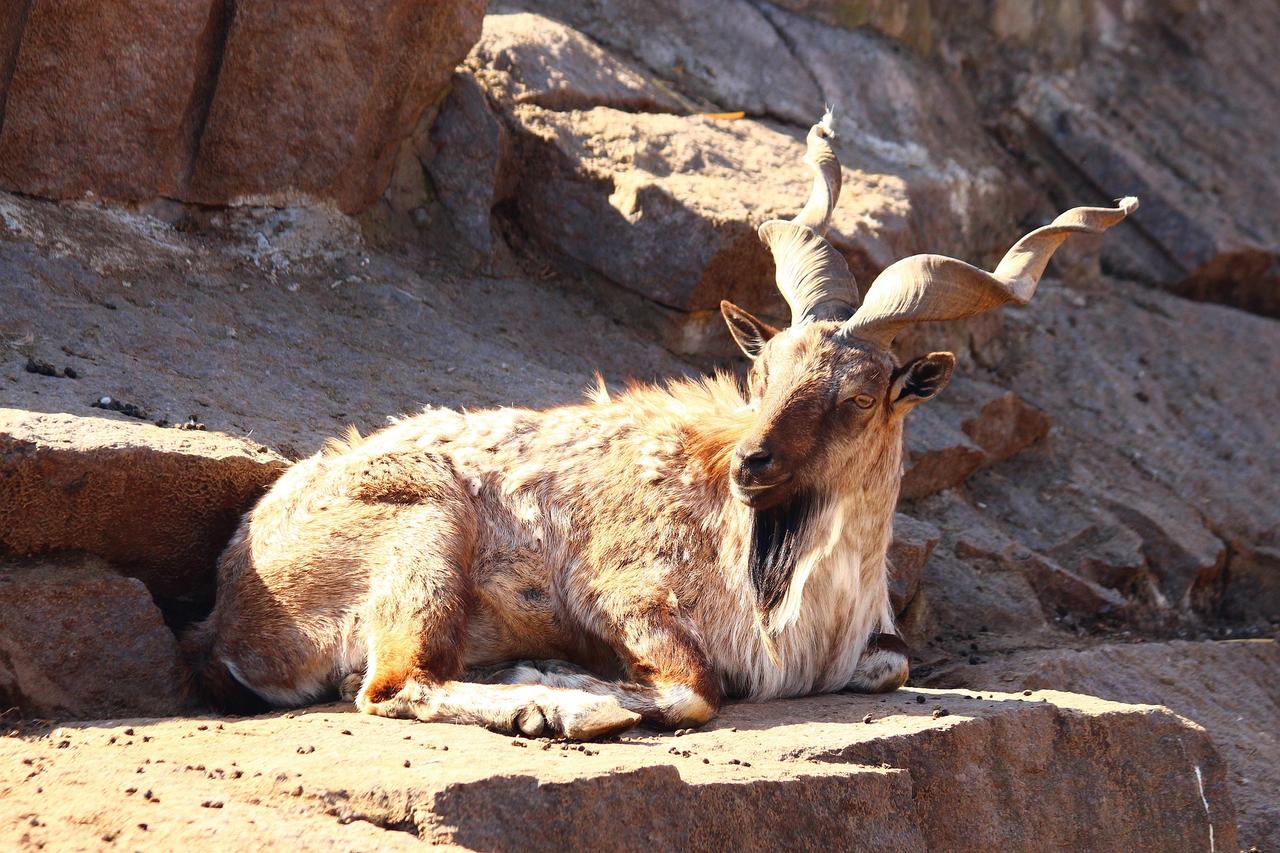
The most distinctive feature of the species is its large, corkscrew-shaped, outward-curving horns present in both sexes. In males, these horns can reach up to 160 cm in length, whereas in females they are typically limited to 24–35 cm. Coat color ranges from light brown to black and varies seasonally: individuals appear more yellowish-brown in summer and grayer in winter. Males possess long, shaggy, prominent beards and manes on the neck, shoulders, and upper legs. Unlike some other goat species, Markhors lack knee hair, inguinal glands, and suborbital glands.【1】

Burma Horned Goat (Capra falconeri)
Markhors are primarily diurnal, with peak activity occurring at dawn and dusk. Females and their young form social groups averaging 8 to 9 individuals, while adult males typically live solitarily outside the breeding season.
The species possesses highly developed vision and olfaction, which aid in predator avoidance and territorial awareness. Major natural predators include the snow leopard, wolf, Himalayan brown bear, and leopard; young are occasionally preyed upon by golden eagles. By dispersing seeds of the wild grasses they consume, Markhors play a significant ecological role in their habitats.
As an entirely herbivorous species, its diet varies seasonally. During spring and summer, it feeds primarily on various grasses and herbaceous plants; in winter, it shifts to leaves, shoots, branches, and shrubs. During the winter months, Markhors exhibit a tendency to climb trees in search of food; females have been recorded climbing to heights of 1 to 5 meters, and occasionally up to 9 meters, to feed on branches. Males, due to their greater body weight and horn structure, participate less frequently in tree climbing and often feed on leaves dislodged by other individuals.
The breeding season typically occurs in autumn and winter, during which males engage in aggressive competition for access to females. Gestation lasts between 135 and 175 days, with one or two kids usually born in spring or early summer. Kids are capable of walking shortly after birth and are weaned at 5 to 6 months of age. Females reach sexual maturity at 18 to 30 months, while males typically mature at around 36 months. In the wild, the average lifespan of Markhors is 11 to 13 years.【2】
Capra falconeri is classified as Near Threatened on the IUCN Red List and is listed under CITES Appendix I. Populations face serious pressures from illegal hunting, competition for pasture with domestic livestock, habitat fragmentation, and disease transmission from domestic goats.
In countries such as Pakistan and Tajikistan, controlled trophy hunting programs have been implemented to incentivize local community participation in conservation. A significant portion of the revenue generated from these programs is reinvested into community development and species protection, contributing to population increases in certain regions.
Ahmad, Riyaz, Charudutt Mishra, Navinder J. Singh, Rahul Kaul, and Yash Veer Bhatnagar. "Forage and Security Trade-Offs by Markhor *Capra falconeri* Mothers." *Current Science* 110, no. 8 (2016): 1559–1564. Accessed March 13, 2026. http://www.jstor.org/stable/24908114
Cothran, N. "Capra falconeri." Animal Diversity Web. Accessed March 13, 2026. https://animaldiversity.org/accounts/Capra_falconeri/
Haider, Jibran, Bushra Allah Rakha, Maqsood Anwar, Muhammad Zafar Khan, and Hussain Ali. "An Updated Population Status of Astor Markhor (Capra falconeri falconeri) in Gilgit-Baltistan, Pakistan." Global Ecology and Conservation 27 (2021): e01555. Accessed March 13, 2026. https://doi.org/10.1016/j.gecco.2021.e01555
Michel, Stefan, Tatjana Rosen Michel, Abdusattor Saidov, Khalil Karimov, Munavvar Alidodov, and Ismoil Kholmatov. "Population Status of Heptner’s Markhor *Capra falconeri heptneri* in Tajikistan: Challenges for Conservation." *Oryx* 49, no. 3 (2015): 506–513. Accessed March 13, 2026. https://doi.org/10.1017/S0030605313000860
Pixabay. "винторогий keçi мархур." Accessed March 13, 2026. https://pixabay.com/tr/photos/%d0%b2%d0%b8%d0%bd%d1%82%d0%be%d1%80%d0%be%d0%b3%d0%b8%d0%b9-ke%c3%a7i-%d0%bc%d0%b0%d1%80%d1%85%d1%83%d1%80-2232084/
Pixabay. "винторогий keçi мархур." Accessed March 13, 2026. https://pixabay.com/tr/photos/%d0%b2%d0%b8%d0%bd%d1%82%d0%be%d1%80%d0%be%d0%b3%d0%b8%d0%b9-ke%c3%a7i-%d0%bc%d0%b0%d1%80%d1%85%d1%83%d1%80-5324448/
[1]
N. Cothran, "Capra falconeri," Animal Diversity Web, accessed 12 March 2026, https://animaldiversity.org/accounts/Capra_falconeri/
[2]
N. Cothran, "Capra falconeri," Animal Diversity Web, accessed 12 March 2026, https://animaldiversity.org/accounts/Capra_falconeri/

Family | Bovidae | ||||||||
|---|---|---|---|---|---|---|---|---|---|
Conservation Status | Near Threatened (IUCN) | ||||||||
Geographic Distribution | Uzbekistan Turkmenistan Tajikistan India Pakistan Afghanistan | ||||||||
Specie(s) | Capra falconeri | ||||||||
Genus | Capra | ||||||||
Subfamily | Caprinae | ||||||||
Taxon | Artiodactyla | ||||||||
No Discussion Added Yet
Start discussion for "Burma Horned Goat (Capra falconeri)" article
Geographic Distribution and Habitat Preferences
Morphological Characteristics and Physical Description
Social Behavior and Ecology
Feeding Habits
Reproduction and Life Cycle
Conservation Status and Threats