
This article was automatically translated from the original Turkish version.
+2 More
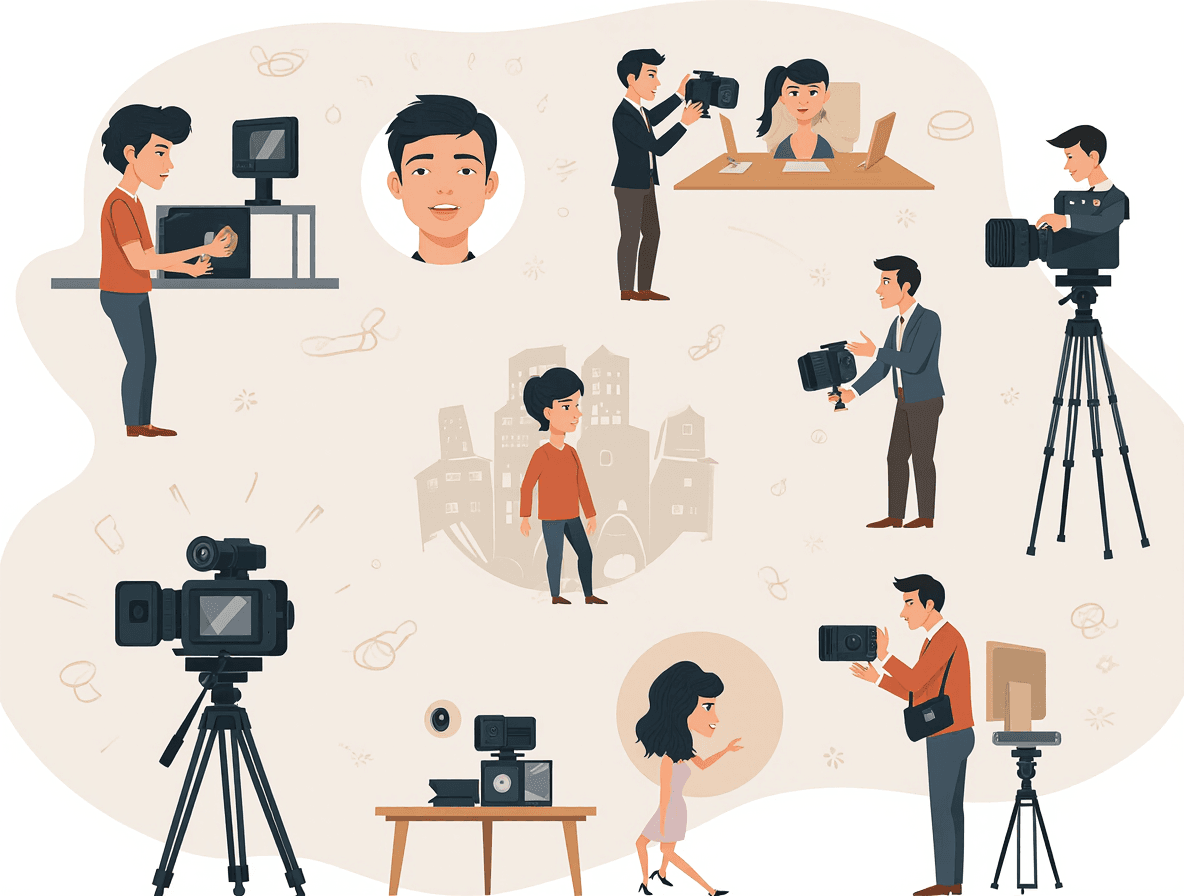
(Generated by Artificial Intelligence.)
Camera Shooting Techniques
Basic Categories | Camera Angle, Shot Scale, Camera Movement | ||||||||
|---|---|---|---|---|---|---|---|---|---|
Purpose(s) | Emotion Transfer Character Analysis Atmosphere Creation Storytelling | ||||||||
Lower Angle Effect | Power, Authority, Grandeur, Threat | ||||||||
Upper Angle Effect | Weakness, Helplessness, Smallness, Pressure | ||||||||
Basic Movements | Pan, Tilt, Dolly, Tracking Shot, Crane Shot | ||||||||
Basic Scales | Wide Shot, Medium Shot, Close-Up | ||||||||
Psychological Effect | Low Angle (unease), Dolly Zoom (vertigo), POV (empathy) | ||||||||
Camera shooting techniques are fundamental building blocks of visual storytelling in cinema and video production. These techniques encompass elements such as the camera’s position relative to the subject (angle), the area occupied by objects and characters within the frame (scale), and the manner of camera movement. Each shooting technique is part of the aesthetic and technical decisions that determine how visual storytelling is perceived.
Directors and cinematographers use shooting techniques not only as technical applications but also as tools for narrative construction. The chosen camera position determines the viewer’s perspective on the scene; scale highlights characters or objects in the foreground; and camera movements impart dynamism to the scene, conveying spatial relationships and the flow of events to the audience.
The application of these techniques enables filmmakers to direct the viewer’s attention to specific elements, provide indirect information about characters, and enhance the atmosphere of a scene. For instance, close-up shots increase emotional intensity, while wide angles can reflect the entire space and relationships between characters. Similarly, low-angle shots portray a character as powerful or dominant, whereas high-angle shots present the same character as vulnerable or powerless.
Shooting techniques determine not only the aesthetic dimension of the narrative but also its psychological impact on the viewer. These subconscious effects contribute to the dramatic structure of the scene and serve to convey the story in a clearer, more consistent, and more effective manner. Therefore, camera shooting techniques are regarded as the alphabet of cinematic storytelling and form essential components of cinema’s visual language.
Camera angle is one of the most important components of storytelling in cinema and video production. The camera’s position along the vertical and horizontal axes determines how events, characters, and space are conveyed to the viewer. The choice of angle is not merely an aesthetic preference but a fundamental tool that shapes the psychological impact of the scene and the dramatic structure of the narrative. Directors and cinematographers use camera angles to emphasize power dynamics between characters, the distance established with the viewer, the emotional intensity of events, and the tonal quality of the atmosphere.
In the low-angle technique, the camera is positioned below the subject’s eye level and shoots upward. This method makes the character or object appear larger, more powerful, and more authoritative than they are in reality. It is often preferred in heroic narratives, moments of triumph, or to emphasize the power of menacing characters. Through this angle, the viewer may feel respect, admiration, or occasionally a sense of being overwhelmed. The low-angle shot is an effective narrative tool that highlights a character’s determination, self-confidence, or dominance within the dramatic structure.
The high-angle shot is the opposite of the low-angle shot; the camera is placed above the subject’s eye level and looks downward. This technique is used to convey a character’s weakness, helplessness, or the pressure they are under. It is frequently chosen to express emotions such as defeat, loneliness, or fragility. It is also suitable for presenting the overall layout of expansive landscapes or crowded scenes. The high-angle shot diminishes the character, granting the viewer a dominant perspective over the events.
One of the most commonly used angles, the eye-level shot positions the camera at the character’s eye level. This angle creates a neutral effect, establishing a natural, egalitarian connection between the viewer and the character. Because it does not emphasize power relations or emotional direction, it is especially preferred in dialogue scenes. The viewer perceives the scene as if they are facing the character in real life, occupying the same plane.
In the Dutch angle technique, the camera is tilted to the right or left so that it is no longer parallel to the horizon. This method evokes a sense of unease, imbalance, or tension. It triggers feelings of discomfort, confusion, disorientation, or paranoia in the viewer. It is particularly favored in psychological thrillers, crime, or horror films to depict a character’s psychological instability or the unnatural quality of the environment.
In a bird’s-eye view shot, the camera is positioned directly above the subject, looking straight down. This technique presents the character or space as if viewed from a map. It offers the viewer an external, dominant perspective on the events. It is an ideal technique for showing the organization of crowded scenes, complex choreographies, or the structural integrity of a space. It can also symbolically express a character’s isolation, inescapable fate, or disconnection from their surroundings.
The over-the-shoulder shot is commonly used in dialogues between two characters. The camera is positioned behind one character’s shoulder to show the face or reactions of the other. This technique involves the viewer in the conversation and presents the scene from the perspective of one character. As a result, the viewer becomes a direct participant in the relationship between the characters. It is especially effective in emphasizing dramatic interactions and facial expressions.
Shot scale, or framing, is a fundamental element in cinematic language that determines how much of a character or object is visible within the frame. Different scales are used to direct the viewer’s attention to the spatial arrangement of the scene, the characters’ body language, or the subtlest emotional details on their faces. Directors and cinematographers carefully select these scales to determine the level of narrative focus. Thus, the scene transforms from merely a space where events are conveyed into a narrative tool that shapes the viewer’s emotional engagement and perception of the story.
In an extreme long shot, the character appears very small within their environment, with the primary emphasis placed on the setting and atmosphere. This shot is typically used at the beginning of a scene or film to introduce the location and establish context and time. Also known in cinematic language as an “establishing shot,” this technique highlights the relationship between the character and their surroundings. For example, a solitary figure in a natural landscape can emphasize human insignificance and helplessness before nature. In urban scenes, it may be used to convey an individual’s alienation within a crowded environment.
In a long shot, the character is framed from head to toe. Here, attention is directed less toward facial expressions and more toward body language and actions. The character’s physical interaction with the space, their movements, and their bodily expression are conveyed through this shot. It is widely used in action scenes or to show movements performed by the character within their environment. From this perspective, the long shot adds visual dynamism to the narrative flow and helps the viewer understand the spatial arrangement of the scene.
The American shot is a type of medium shot in which the character is framed slightly above the knees or hips. It derives its name from its frequent use in Western films to show cowboys’ holsters at waist level. This shot balances the portrayal of facial expressions and body language. It is also highly suitable for depicting interactions between two or more characters within the scene.
One of the most frequently used shot scales, the medium shot typically frames the character from the waist up. This shot provides the viewer with more comprehensive information about the character by presenting both facial expressions and body language. It is especially preferred in dialogue scenes because it conveys both emotional expressions and interactions with the environment. With its neutral and balanced structure, the medium shot bridges dramatic intensity and spatial context.
In a medium close-up, the character is framed from the chest or shoulder level upward. This shot focuses more on facial expressions than the medium shot but does not completely detach the character from their surroundings. It communicates the character’s emotional state more distinctly to the viewer while preserving the context of the scene. For this reason, directors frequently use it in scenes where they wish to heighten dramatic intensity.
The close-up frames the character’s face or a specific object significant to the scene. The aim is to convey emotions, thoughts, and reactions with maximum intensity to the viewer. A single tear, a faint smile, or a look filled with suspicion gains powerful dramatic impact through the close-up. This shot establishes a direct emotional bond between the viewer and the character and elevates the psychological intensity of the scene to its highest level.
A detail shot focuses on a very small part of a whole. Details such as only the eyes of a character, trembling lips, or a single word in a letter are brought to the foreground. This technique intensifies the dramatic tension of the scene by directing the viewer’s attention to a specific point. It is an effective method for generating suspense in tension scenes, strengthening emotional intensity, or highlighting a crucial detail in the story.
When the camera moves rather than remains static, it introduces fluidity, visual variety, and new layers of meaning to the scene in cinematic language. Camera movements are not merely aesthetic choices but fundamental techniques that determine the rhythm of the narrative, guide the relationship with the viewer, and reinforce the three-dimensional perception of space. Through these movements, the characters’ world is rendered more dynamically, the viewer is drawn into the scene, and the dramatic structure of the narrative deepens.
Pan movement occurs when the camera remains fixed on one point and rotates horizontally to the right or left. This method is used to introduce wide landscapes, gradually reveal the entirety of a space, or follow a moving object. The pan movement can also establish a visual link between two characters by shifting the gaze from one to the other.
In a tilt movement, the camera remains fixed on one point but moves vertically upward or downward. This technique is effective for showing the height of a building, examining a character from head to toe, or directing the viewer’s attention to different levels. Although simple, pan and tilt are fundamental camera movements that impart spatial coherence to the scene.
Dolly movement involves moving the camera forward, backward, or sideways on a dolly cart or rail system. This technique provides the viewer with a physical sense of approaching or distancing from the space, rather than a fixed perspective. A dolly-in typically increases dramatic intensity, while a dolly-out emphasizes the character’s isolation or detachment from their surroundings.
Tracking shot is usually recorded simultaneously alongside, behind, or in front of a moving character or object. This method integrates the viewer into the scene, adding three-dimensional depth to the narrative. Particularly in long sequence shots, dolly and tracking shots have the power to directly involve the viewer in the character’s journey.
Crane or jib shots involve moving the camera upward, downward, or along a wide arc using a crane or long arm. This technique is used to make a dramatic entrance into the scene or to conclude it in a grand manner. For example, it is effective for rising from a crowded area to reveal the entire landscape or descending from above to focus on a specific character. Crane shots are frequently chosen in large-scale productions because they add cinematic grandeur and epic aesthetics to the production.
Handheld shot is a technique in which the camera is recorded directly in the hand or on the shoulder without using stabilizers such as tripods or rail systems. The slight tremors and shakes resulting from this method impart a documentary aesthetic, raw energy, and a sense of realism to the scene. Handheld cameras are especially preferred in action scenes, chaotic moments, or to reflect a character’s subjective point of view. By giving the viewer a direct sense of witnessing the event, they make the scene more intense and realistic.
Aerial shots are high-angle shots captured using helicopters, airplanes, or, in contemporary practice, drones. This technique is suitable for conveying expansive landscapes, city silhouettes, or large-scale events from an epic perspective. Aerial shots provide the viewer with a comprehensive understanding of the space while adding an impressive aesthetic to the visual narrative. They play a significant role in films featuring battle scenes, large gatherings, or when natural landscapes are emphasized.

Camera Shooting Techniques (Generated by Artificial Intelligence.)
While basic camera angles, shots, and movements form the backbone of cinematic language, directors sometimes turn to more specialized and stylized techniques to strengthen the narrative, intensify specific emotions, or achieve a visually distinctive style. These techniques have become associated with specific films in cinema history and, in some cases, have become inseparable components of genre cinema.
The dolly zoom is one of the most famous stylized techniques in cinema history. The camera physically moves toward the subject (dolly in) while simultaneously zooming out optically, or vice versa. As a result, the central object remains the same size in the frame while the background either rapidly recedes or rushes toward the viewer. This creates a disruption in the perception of reality. This technique, iconicized in Alfred Hitchcock’s Vertigo (1958), is used to visually convey intense psychological states such as dizziness, shock, anxiety, fear, or sudden awareness.
A POV shot aims to show the scene directly from a character’s perspective. The camera presents to the viewer exactly what the character sees, allowing the viewer to experience the events from the character’s viewpoint. This technique is one of the most powerful ways to enter a character’s emotional world. Especially when used in horror, thriller, and action genres, it transforms the viewer into an active participant in the scene. Due to its ability to enhance empathy and deepen the sense of immersion, it is one of the key tools of subjective storytelling in cinema.
In the arc shot technique, the camera moves in a circular or semi-circular path around the subject. This movement places the subject at the center of the narrative and provides dramatic emphasis. It is particularly effective in scenes where a character experiences an internal epiphany, time seems to stand still, or a critical decision is made. One of the most well-known examples in popular culture is the iconic scene in The Matrix (1999), known as “bullet time,” in which the character dodges bullets.
A long take is achieved by recording a scene in a single, uninterrupted shot without editing. This technique creates a sense of real-time experience in the viewer by preserving the unity of time and space. The long take highlights the actor’s performance, the spatial arrangement, and the choreography of camera movements. It is preferred to heighten tension, present events in a continuous flow, or sustain the narrative rhythm without slowing it down. Although technically challenging, scenes shot in a single take have created unforgettable moments in cinema history when successfully executed.
The 180-degree rule is one of the fundamental principles of cinematography. In scenes where two characters are conversing, an imaginary line (axis line) is established. Keeping the cameras on only one side of this line ensures spatial continuity and consistent viewer perception of the scene. If the camera crosses to the other side of the line, the characters’ positions on screen reverse, potentially causing confusion for the viewer. This rule is often meticulously applied to guide the audience; however, some directors deliberately violate it for narrative purposes to create a dramatic effect.
Barrett, M. “Moving beyond the ‘Shot-Type List’ towards the ‘Meaning Model’: Placing Meaning at the Centre of Film Education.” *Film Education Journal* 3, no. 2 (2020): 218–230. Accessed September 9, 2025. https://doi.org/10.14324/FEJ.03.2.08.
Canini, Luca, Sergio Benini, and Riccardo Leonardi. “Classifying Cinematographic Shot Types.” *Multimedia Tools and Applications* 62 (November 1, 2011): 1–23. Accessed September 9, 2025. https://doi.org/10.1007/s11042-011-0916-9.
Cores Sarría, Lucía. *The Influence of Camera Angle in Film Narratives*. Master's thesis, October 1, 2015. Accessed September 9, 2025. https://doi.org/10.13140/RG.2.2.23950.69444.
Happer, Carter. “Visual Storytelling: How Camera Movement Shapes Emotional Engagement in Film and TV.” December 3, 2022. Accessed September 9, 2025. https://www.researchgate.net/publication/392082864_Visual_Storytelling_How_Camera_Movement_Shapes_Emotional_Engagement_in_Film_and_TV
Kraft, Robert N. “The Influence of Camera Angle on Comprehension and Retention of Pictorial Events.” *Memory & Cognition* 15 (1987): 291–307. Accessed September 9, 2025. https://doi.org/10.3758/BF03197032.
Morgan, Daniel, and Jordan Schonig. “Introduction: Camera Movement and the Necessity of Criticism.” *Film Criticism* 47, no. 1 (2023). Accessed September 9, 2025. https://doi.org/10.3998/fc.4730.

(Generated by Artificial Intelligence.)
Camera Shooting Techniques
Basic Categories | Camera Angle, Shot Scale, Camera Movement | ||||||||
|---|---|---|---|---|---|---|---|---|---|
Purpose(s) | Emotion Transfer Character Analysis Atmosphere Creation Storytelling | ||||||||
Lower Angle Effect | Power, Authority, Grandeur, Threat | ||||||||
Upper Angle Effect | Weakness, Helplessness, Smallness, Pressure | ||||||||
Basic Movements | Pan, Tilt, Dolly, Tracking Shot, Crane Shot | ||||||||
Basic Scales | Wide Shot, Medium Shot, Close-Up | ||||||||
Psychological Effect | Low Angle (unease), Dolly Zoom (vertigo), POV (empathy) | ||||||||
No Discussion Added Yet
Start discussion for "Camera Shooting Techniques" article
Shooting Techniques by Camera Angle
Low-Angle Shot
High-Angle Shot
Eye-Level Shot
Dutch Angle (Dutch Tilt)
Bird’s-Eye View and Top-Down Shot
Over-the-Shoulder Shot
Shooting Techniques by Scale (Shot Size)
Extreme Long Shot
Long Shot (Full Shot)
American Shot (Cowboy Shot)
Medium Shot
Medium Close-Up
Close-Up
Detail Shot (Extreme Close-Up)
Shooting Techniques by Camera Movement
Pan and Tilt Movements
Dolly and Tracking Shot
Crane/Jib Shot
Handheld Shot
Aerial Shot
Special and Stylized Shooting Techniques
Dolly Zoom (Vertigo Effect)
Point of View Shot (POV)
Arc Shot
Long Take
180-Degree Rule