


This article was automatically translated from the original Turkish version.
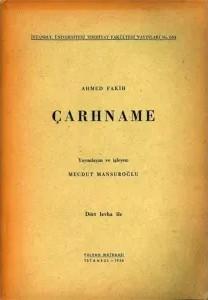
Çarhname (Ed. Mecdut Mansuroğlu)
Form of the Poem | Qasida | ||||||||
|---|---|---|---|---|---|---|---|---|---|
Meter | Mefāʿīlün mefāʿīlün faʿūlün | ||||||||
Number of Couplets | ~100 (Current Manuscripts: 83) | ||||||||
Collection Where the Work Is Found | Cāmiʿü’n-Nezāʾir (Beyazıt State Library, no. 5782) | ||||||||
Author(s) | Ahmed Fakih | ||||||||
Period of Composition | Late 13th Century - Mid 14th Century | ||||||||
Subject Headings | Tasavvuf Ahlâk Kulluk Tevbe Ahiret Fanilik | ||||||||
Çarhnâme is a didactic qasida composed in the first half of the 13th century in Anatolia by Ahmed Fakih and is one of the earliest known poetic examples in Old Anatolian Turkish. The work holds significance both for the history of the Turkish language and for the earliest expressions of Islamic-Sufi thought in Anatolia, offering an original text that reflects the socio-cultural structure, linguistic usage, and literary sensibility of its time. As a didactic piece, it warns individuals of the transience of worldly life, centers faith in the afterlife, and conveys Qur’anic teachings in simple language, placing it among the foundational texts of early Anatolian Turkish literature.
Knowledge about the life of Ahmed Fakih is limited and largely based on hagiographic accounts. He is said to have lived in Konya during the 13th century and to have been a disciple of Bahâeddîn Veled, the father of Mevlânâ Celâleddîn Rûmî; some sources even mention his participation in Rûmî’s conversational circles. Certain traditions suggest he originated from Horasan or Azerbaijan and migrated to Anatolia. In some sources, he is referred to by Sufi titles such as “Sultan Hâce” or “Hâce Fakih.”
Ahmed Fakih’s only surviving work is Çarhnâme. Although other works are mentioned in sources or attributed to him, no textual evidence of these has been found. There is no scholarly consensus on whether another work cited in sources, titled Kitâbü Evsâfı Mesâcidi'ş-Şerîfe, is genuinely his.
Çarhnâme derives its name from the Arabic word “çark” (meaning wheel, celestial sphere, or cycle of time), and as its title suggests, its central theme is the cyclical nature of time, the transience of the world, and the faithlessness of fate. It appears as an 83-line poem in the anthology Câmiʿü’n-nezâʾir, compiled by Eğridirli Hacı Kemal. However, some sources indicate the number of verses reaches 100. The full title of the work is “Çarhnâme-i Ahmed Fakîh der bîvefâ-i rûzgâr,” which encapsulates both its formal and thematic essence: the transience of worldly life, the cruelty of time toward humanity, and humanity’s place within this cycle.
The text has survived in a single manuscript copied in the 15th century, written in the old Arabic script. It was first introduced to scholarly circles by Köprülüzâde Mehmed Fuad and later published in detail by Mecdud Mansuroğlu.
The content of Çarhnâme is based on the principle of presenting classical Islamic teachings in simple language for the general public. It offers admonitions to remember death, cultivate the self, prepare for the afterlife, and avoid being deceived by worldly blessings. In this regard, the work exemplifies the classical nasihatname genre.
The themes are organized around the following:
Within this structure, emphasis is also placed on complaints about the world, the heedlessness of people of the age, and the corrupting tendencies of the ego. The poet aims to raise awareness among the public, sometimes through abstract advice and sometimes through direct religious references.

A Page from Çarhnâme (Mecdut Mansuroğlu)
The poem is composed in the aruz meter “mefâîlün mefâîlün feûlün,” a pattern commonly used in classical hece-based bahirs and particularly favored in didactic nasihatname texts. Although occasional metrical irregularities and violations of aruz rules appear in Çarhnâme, these can be explained by the fact that aruz had not yet been fully established in literary circles of the 13th century.
Some formal shortcomings are also evident in the poetic technique. The choice of refrain and rhyme is sometimes weak; however, the strength of the poem’s spiritual content renders it valuable within the context of didactic-ethical poetry.
Çarhnâme is an original example reflecting the characteristics of Old Anatolian Turkish. As one of the earliest texts in which Turkish was used as a written language in Anatolia, it is of considerable importance for historical Turkish linguistic studies in terms of vocabulary, morphology, and syntax.
In the text:
In style, the poet adopts a clear and direct mode of expression, avoiding elaborate literary devices. Rather than using ornate or metaphorical language, he employs a direct address to the reader. This simplicity serves both the purpose of accessibility to the general public and the direct transmission of Sufi teachings.
Çarhnâme was composed during a period of social upheaval in Anatolia following the Mongol invasions. In an era marked by material hardship and spiritual void, there arose a need to guide the masses through religious and moral instruction. Ahmed Fakih’s work, written in this context, seeks to redirect people toward worship, trust in divine providence, and ethical conduct.
At the same time, its composition coincides with the spread of Sufism in Anatolia, particularly within the Mevlevi, Yesevi, and Ahilik circles, which helps explain the Sufi tone of its content. Some motifs in the text closely correspond to instructional practices conducted in the tekkes of the period.
Çarhnâme is among the earliest examples in Turkish literary history documenting the emergence of religious-didactic poetry in early Anatolian Turkish verse. In this regard, Ahmed Fakih is recognized as one of the pioneers of the metrical moral and advisory tradition in Anatolian Turkish literature.
The work:
Çarhnâme occupies an important place among early texts illustrating how the popular Sufism influenced by Ahmed Yesevi evolved into the Anatolian Islamic understanding shaped by the Mevlevi and Ahî traditions.
The sole surviving manuscript of the work was copied in the 15th century and is preserved in the Beyazıt State Library. This manuscript is contained within the anthology Câmiʿü’n-nezâʾir, compiled by Eğridirli Hacı Kemal.
Çarhnâme was first introduced to the scholarly world by Köprülüzâde Mehmed Fuad and later published by Mecdud Mansuroğlu with a transcription, linguistic analysis, glossary, and facsimile. This edition enabled detailed philological, historical, and literary study of the text. All contemporary evaluations of the work are based on this publication.
Ak, Murat. “Çarh-nâme’de Yer Alan Âyet ve Hadisler.” *İstem: Journal of Turkic World Studies* 6, no. 11 (2008): 279–303. https://dergipark.org.tr/tr/download/article-file/260747.
Koç, Fatma. "Çarh-Nāme’de Geçen Din ile İlgili Söz Varlığının Tematik İncelemesi Üzerine Bir Değerlendirme." Hikmet-Akademik Edebiyat Dergisi 10, no. 20 (Spring 2024): 330–345. https://dergipark.org.tr/tr/download/article-file/3432528.
Kılıçarslan, Orhan. "Çarh-Nâme'nin Eksik Beyitleri Üzerine." *Türk Dili Araştırmaları Yıllığı-BELLETEN* 76 (2023): 101–122. https://tdkbelleten.gov.tr/tam-metin-pdf/1093/tur
Mansuroğlu, Mecdut. Ahmed Fakih: Çarhnâme. İstanbul: İstanbul Üniversitesi Edebiyat Fakültesi Yayınları, 1956.
Merhan, Aziz. “Anadolu’daki İlk Türkçe Eser Üzerine Tartışmalar.” *Türkbilig - Türkoloji Araştırmaları* 2011, no. 2 (2011): 253–269. https://dergipark.org.tr/tr/download/article-file/378480.
Sertkaya, Osman F. "Ahmed Fakih." *İslâm Ansiklopedisi*, Volume 2, 2nd edition (İstanbul: Türkiye Diyanet Vakfı Yayınları, 1994): 618–619. https://cdn2.islamansiklopedisi.org.tr/dosya/2/C02000618.pdf.
Sertkaya, Osman Fikri. "Ahmed Fakih: Anadolu'da Türkçe Eserler Veren Mutasavvıf Şair." *İlmi Araştırmalar* 2 (1996): 131-140. Accessed https://dergipark.org.tr/en/download/article-file/73153.
Çarhname (Ed. Mecdut Mansuroğlu)
Form of the Poem | Qasida | ||||||||
|---|---|---|---|---|---|---|---|---|---|
Meter | Mefāʿīlün mefāʿīlün faʿūlün | ||||||||
Number of Couplets | ~100 (Current Manuscripts: 83) | ||||||||
Collection Where the Work Is Found | Cāmiʿü’n-Nezāʾir (Beyazıt State Library, no. 5782) | ||||||||
Author(s) | Ahmed Fakih | ||||||||
Period of Composition | Late 13th Century - Mid 14th Century | ||||||||
Subject Headings | Tasavvuf Ahlâk Kulluk Tevbe Ahiret Fanilik | ||||||||
Author
General Features and Content
Structural Content
Meter and Verse Form
Linguistic and Stylistic Features
Historical and Cultural Context
Literary Value and Place in Turkish Literature
Transmission and Publication History