


This article was automatically translated from the original Turkish version.
+1 More
Casein is the primary component of milk proteins. It constitutes a major portion of the total protein content in milk, particularly from ruminant animals. Approximately 76–86% of milk protein consists of casein. This property makes it a fundamental protein source in the dairy industry, especially in cheese production. In milk, casein exists as large colloidal structures called micelles, along with calcium and phosphate ions. These micelles determine the biochemical and functional properties of casein. While casein accounts for about 80% of milk proteins, the remainder is composed of whey proteins.
Casein exhibits amphoteric properties due to the presence of both acidic and basic groups in its chemical structure. When the pH of milk decreases, casein precipitates and forms curds. This characteristic renders casein indispensable in cheese production. During cheese manufacturing, casein separates from whey proteins and forms the curd, which constitutes the primary protein structure of cheese.

Chemical Structure of Casein (Ersöz, 2024)
【1】
In milk, casein exists as a colloidal dispersion known as casein micelles. The diameter of these micelles typically ranges from 20 to 600 nanometers. The structure of micelles determines the functional properties and digestibility of milk proteins. Approximately 93% of casein micelles consist of protein, while the remaining 7% comprises inorganic substances including calcium, phosphate, magnesium, sodium, and citrate. Calcium and phosphate are present in the highest concentrations and form complexes with casein as colloidal calcium phosphate. These complexes are referred to as calcium caseinate-phosphate.
Casein micelles are composed of smaller submicelles, usually 10–15 nanometers in diameter, linked together by calcium bridges. The core of the micelle structure is formed primarily by αS1-casein and β-casein, while κ-casein predominates on the surface. This structural arrangement influences casein’s solubility, coagulation properties, and digestion behavior.
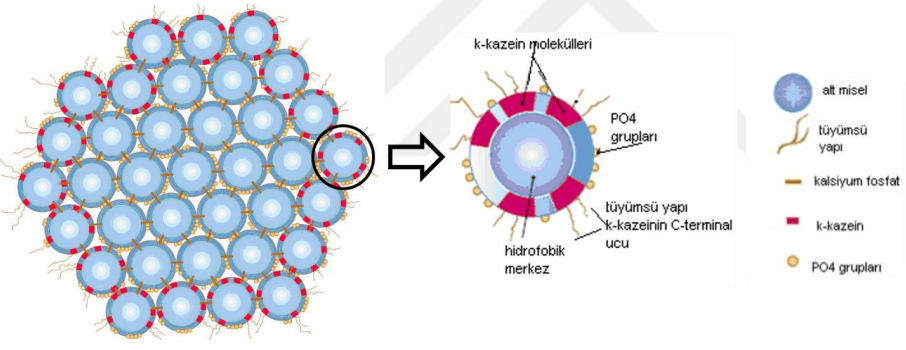
Casein Micelles and Submicelle Groups (Demirel, 2019)
【2】
Casein is divided into four main fractions with distinct characteristics: αS1-casein (αS1-casein), αS2-casein (αS2-casein), β-casein (β-casein), and κ-casein (κ-casein). These fractions differ in quantity and biological properties.
It is the most abundant among milk proteins, accounting for approximately 40% of total casein. αS1-casein consists of 199 amino acids and has a hydrophobic structure rich in proline. It is encoded by the CSN1S1 gene and has nine variants designated A through I. The B and C variants are the most common. Genetic variations influence milk yield, protein content, and cheese-making properties.
It constitutes approximately 14% of total casein and contains 207 amino acids. Variants A, B, C, and D are classified based on the number of bound phosphate groups. These variants are breed-specific. For example, variant A is common in European cattle, variant B in Taurus and Indicus cattle, variant C in yak cattle, and variant D is more frequent in certain French dairy breeds.
It is the second most abundant casein fraction after αS1-casein and plays a crucial role in milk coagulation. β-casein accounts for approximately 20% of total casein. Composed of 209 amino acids, β-casein has 13 variants: A1, A2, A3, A4, B, C, D, E, F, H1, H2, I, and G. The A1 and A2 variants are the most prevalent. A1 β-casein produces a biologically active peptide called beta-casomorphin-7 (BCM-7) during digestion. It has been suggested that BCM-7 may affect the nervous, immune, and endocrine systems and could be associated with certain chronic diseases. A2 β-casein produces BCM-7 at very low levels. Human milk, goat milk, and sheep milk generally contain proteins similar to A2 β-casein.
It constitutes approximately 13% of total casein and plays a critical role in micelle stability. As a glycoprotein, κ-casein is insensitive to calcium and resides on the micelle surface, maintaining the colloidal stability of milk. κ-Casein is one of the key components in milk coagulation. It consists of approximately 169 amino acids and has variants A through J. Variants A and B are the most common. Genetic variations influence milk yield, protein content, cheese-making time, and milk composition.
Casein is a slowly digested protein. Its gradual breakdown in the digestive system provides a sustained release of amino acids. This property helps prevent muscle protein breakdown over extended periods, exerting a muscle-protective effect. Peptides formed during casein digestion possess antioxidant, antihypertensive, and immunomodulatory properties. Additionally, casein plays a vital role in the transport of calcium and phosphorus, enhancing their bioavailability.
Casein has the capacity to bind soluble salts of heavy metals. Complexes formed with mercury, lead, copper, zinc, and aluminum facilitate the elimination of these toxins from the body. Therefore, casein consumption has been associated with protective effects against metal poisoning.
The health significance of casein proteins, particularly regarding β-casein variants, remains a subject of debate. It has been suggested that dairy products containing A1 β-casein may be associated with certain chronic diseases, including type 1 diabetes, cardiovascular diseases, neurological disorders, and Sudden Infant Death Syndrome (SIDS). However, further scientific research is needed to confirm these associations.
A2 β-casein significantly reduces these potential risks. Consequently, some dairy producers prefer to produce milk containing A2 β-casein. The presence of A2 β-casein-like proteins in human milk and other animal milks suggests potential advantages of these milks in infant nutrition.
Dietary sources of casein play a significant role in meeting protein requirements. Casein intake is particularly recommended for athletes, elderly individuals, and those in prolonged fasting states due to its muscle-protective effects. However, excessive consumption of casein-containing foods may carry certain risks. High protein intake can impose additional strain on the kidneys and liver, lead to unwanted mineral losses, and negatively affect skeletal health. Therefore, casein-derived protein intake should be integrated into a balanced diet.
Casein-containing foods should also be consumed with caution in certain health conditions. In individuals with lactose intolerance, casein-containing dairy products may cause digestive issues. Additionally, literature reports suggest possible associations between β-casein variants, particularly A1, and certain chronic diseases. Therefore, the source and quantity of casein intake should be carefully evaluated.
Casein proteins serve essential functions in cheese production, including curd formation, texture development, and flavor influence. Due to these properties, casein is regarded as a fundamental protein in the dairy industry, both technologically and nutritionally. Casein is considered a high-quality protein source and plays a significant role in nutrition due to its slow digestion. In the stomach environment, casein gradually coagulates, enabling controlled release of amino acids into the bloodstream. This feature is advantageous for individuals with prolonged protein needs. Key nutritional attributes of casein include:
Due to its slow digestion, casein is especially beneficial when consumed before sleep, as it helps suppress muscle protein breakdown over extended periods and supports muscle development. However, its relatively low branched-chain amino acid (BCAA) content and lactose content may pose disadvantages in certain contexts. In individuals with lactose intolerance, casein-containing products can cause digestive discomfort.
Casein is found primarily in milk and dairy products. The amount and quality of casein vary depending on the milk source, processing method, and animal species.
Some plant-based products and alternative protein sources do not contain casein; therefore, casein intake is derived exclusively from milk and dairy products. In individuals with lactose intolerance, consumption of casein-containing dairy products may lead to digestive issues.
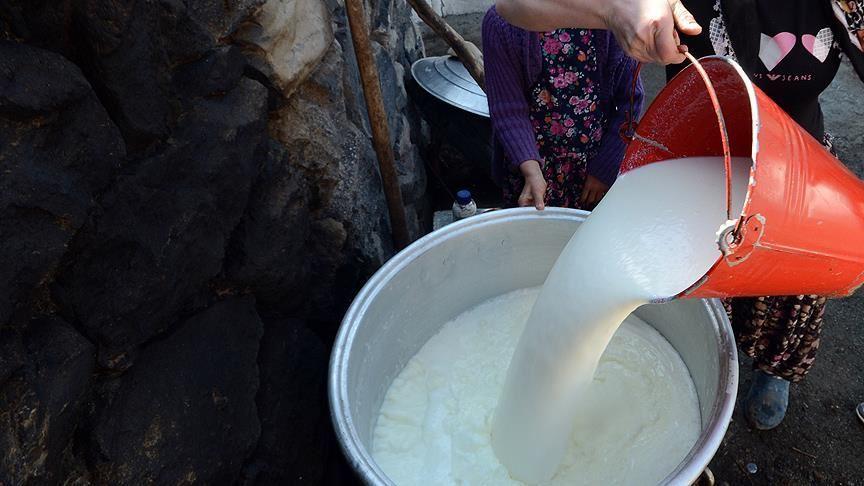
Milk as a Food Source Rich in Casein (Anadolu Agency)
Casein proteins vary according to genetic variants, which directly influence milk yield, protein content, cheese-making time, and milk composition. For example, the κ-casein BB genotype increases milk yield and shortens cheese-making time. Variants of the αS1-casein gene affect milk protein concentration and yield.
Industrially, casein is used not only in the production of cheese, yogurt, ice cream, and other dairy products but also as a food additive, nutritional supplement, and technical material. Due to its film-forming properties, casein is also employed as a packaging material and adhesive.
Anadolu Ajansı. "Süt Fiyatlarında Üretici Lehine Gelişmeyi Yakın Zamanda Göreceğiz." Accessed September 28, 2025. https://www.aa.com.tr/tr/ekonomi/sut-fiyatlarinda-uretici-lehine-gelismeyi-yakin-zamanda-gorecegiz/1597431
Anadolu Ajansı. "Toplanan İnek Sütü Miktarı Mayısta Azaldı." Accessed September 28, 2025. https://www.aa.com.tr/tr/ekonomi/toplanan-inek-sutu-miktari-mayista-azaldi/1529665
Bilal, Tanay, and Ayşen, Altıner. "Peynir Altı Suyunun İnsan ve Hayvanlarda Metabolizma Üzerindeki Etkileri." Bahri Dağdaş Hayvancılık Araştırma Dergisi 6, no. 1 (2017): 29–42. Accessed September 28, 2025. https://dergipark.org.tr/en/pub/bdhad/issue/35010/388387
Demirel, Ahmet Fatih. *Siyah Alaca Sığırlarda Alfa-Kazein, Beta-Kazein ve Kappa-Kazein Gen Polimorfizminin Süt Verimi ve Süt Bileşenlerine Etkisinin PCR-RFLP Yöntemiyle Araştırılması*. PhD thesis, Van Yüzüncü Yıl Üniversitesi, 2019. Accessed September 28, 2025. https://tez.yok.gov.tr/UlusalTezMerkezi/TezGoster?key=aEzj_IdWAsjiSAfK3qwrBsWg6DG47yPnu0Pcg3n3Grkp4qnGR_NlrB8-mlAxDULr
Ersöz, Elmas. *Bitki Tozlarıyla Geliştirilen Glutensiz ve Kazeinsiz Ürünlerin Besin Bileşimlerinin ve Duyusal Özelliklerinin Değerlendirilmesi*. PhD thesis, Gazi Üniversitesi, 2024. Accessed September 28, 2025. https://tez.yok.gov.tr/UlusalTezMerkezi/TezGoster?key=UjlM15wKZGQW6TLC0pvCtxfoAJIWCbCEN_-4w-jkQIFeDPJc6b10TuGbIgCwUuMa
Fırıncıoğlu, Sema Yaman, and Hatice Nur Kılıç. "Sütteki A1-A2 β-Kazeinin Özellikleri ve İnsan Sağlığına Etkileri." *Turkish Journal of Agriculture-Food Science and Technology* 9, no. 11 (2021): 1973-1979. Accessed September 28, 2025. https://agrifoodscience.com/index.php/TURJAF/article/view/4869
Kaya, Şeyda. "Besinsel Ergojenik Yardımcılardan Protein Suplemanları." *IV. Uluslararası Battalgazi Bilimsel Çalışmalar Kongresi Tam Metin Kitabı* (2020): 79-92. Accessed September 28, 2025. https://www.researchgate.net/profile/Seyda-Kaya-5/publication/340133164_Besinsel_Ergojenik_Yardimcilardan_Protein_Suplemanlari/links/5e7a69c092851cdfca2f55cd/Besinsel-Ergojenik-Yardimcilardan-Protein-Suplemanlari.pdf
[1]
Elmas Ersöz. Bitki Tozlarıyla Geliştirilen Glutensiz ve Kazeinsiz Ürünlerin Besin Bileşimlerinin ve Duyusal Özelliklerinin Değerlendirilmesi. Doktora Tezi, Gazi Üniversitesi, (2024): 1-197. Erişim 28 Eylül 2025. https://tez.yok.gov.tr/UlusalTezMerkezi/TezGoster?key=UjlM15wKZGQW6TLC0pvCtxfoAJIWCbCEN_-4w-jkQIFeDPJc6b10TuGbIgCwUuMa
[2]
Ahmet Fatih Demirel. Siyah Alaca Sığırlarda Alfa-Kazein, Beta-Kazein ve Kappa-Kazein Gen Polimorfizminin Süt Verimi ve Süt Bileşenlerine Etkisinin PCR-RFLP Yöntemiyle Araştırılması. Doktora Tezi, Van Yüzüncü Yıl Üniversitesi, (2019): 1-149. Erişim 28 Eylül 2025. https://tez.yok.gov.tr/UlusalTezMerkezi/TezGoster?key=aEzj_IdWAsjiSAfK3qwrBsWg6DG47yPnu0Pcg3n3Grkp4qnGR_NlrB8-mlAxDULr

Structural Properties and Casein Micelles
Casein Fractions
αS1-Casein
αS2-Casein
β-Casein
κ-Casein
Biological Functions of Casein
Casein and Health
Casein and Nutrition
Casein-Containing Foods
Casein Genetics and Industrial Importance