
This article was automatically translated from the original Turkish version.
Explorer | Giuseppe Piazzi | ||||||||
|---|---|---|---|---|---|---|---|---|---|
Year of Discovery(ies) | 1801 | ||||||||
Average Distance | 2.8 AU (≈413 million km) | ||||||||
Radius | 476 km (1/13 of Earth) | ||||||||
Axial Tilt | 4° | ||||||||
Ceres is the largest celestial body in the asteroid belt between Mars and Jupiter and the only dwarf planet located within the inner Solar System. Discovered in 1801 by Giuseppe Piazzi, Ceres holds a significant place in the history of astronomy as the first member of the asteroid belt to be identified. Initially classified as an asteroid, Ceres was reclassified as a dwarf planet in 2006 by the International Astronomical Union due to its distinct size and structural properties compared to neighboring asteroids.
This celestial body, named after Ceres, the Roman goddess of agriculture and harvest, also shares its name with the word “Cegleta,” which derives from the same root.【1】
Ceres has a radius of approximately 476 kilometers, which is about one-thirteenth the radius of Earth. If Earth were the size of a nickel, Ceres would be about the size of a poppy seed. Its average distance from the Sun is 2.8 astronomical units (approximately 413 million kilometers), and it takes sunlight about 22 minutes to reach Ceres from the Sun.

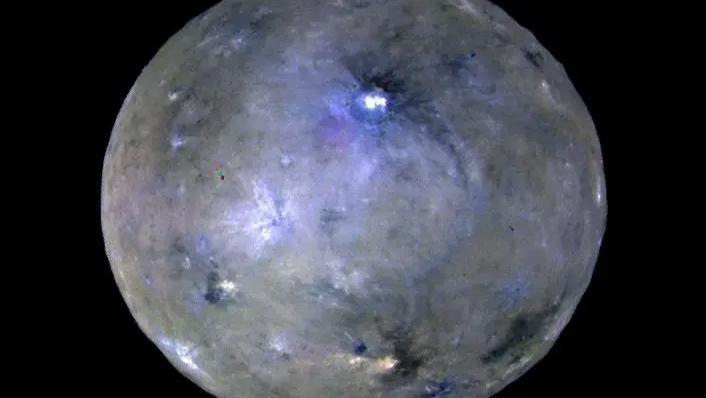
Ceres (Anadolu Agency)
Ceres completes one orbit around the Sun in 1,682 Earth days, or approximately 4.6 Earth years. Its rotation period is about 9 hours, making it one of the celestial bodies in the Solar System with the shortest day length. Because its rotational axis is tilted only 4 degrees relative to its orbital plane, Ceres does not experience seasonal variations like those seen on more tilted planets.
Ceres has a layered internal structure, likely consisting of a solid core and a mantle composed of water ice. The dwarf planet’s crust is rocky and dusty and contains large salt deposits, typically made of minerals such as magnesium sulfate. It is estimated that up to 25 percent of Ceres’ total mass may be composed of water ice, a proportion significantly higher than the amount of water on Earth.
Ceres’ surface is covered with numerous small and young craters, but no crater exceeds 280 kilometers in diameter. This scarcity of large craters may be explained by the gradual smoothing of surface features due to ice or salt layers beneath the crust. Past hydrothermal activity may also have contributed to the erosion of some large craters. Some craters on Ceres contain permanently shadowed regions known as “cold traps,” which are suitable for preserving water ice.
Ceres has a very thin atmosphere with evidence of water vapor. This vapor may originate from ice volcanoes or the sublimation of surface ice. Scientists believe Ceres does not have a significant magnetosphere.
NASA’s Dawn spacecraft detected methyl and methyl-like organic compounds around the Ernutet crater on Ceres’ northern hemisphere. Previous observations have revealed the presence of water ice, salts, carbonates, and ammonia-rich clays on the dwarf planet. These findings suggest that Ceres may have the potential to support simple life forms such as microbes due to its complex chemical composition. Although no signs of life are currently observed on Ceres, the possibility that it once harbored life is under investigation.
Ceres formed approximately 4.5 billion years ago during the early stages of the Solar System, when a small clump of rotating gas and dust collapsed under its own gravity to become a dwarf planet. Scientists describe Ceres as an “embryonic planet,” indicating that its planetary formation process was never completed. The strong gravitational influence of nearby Jupiter prevented Ceres from growing into a full-fledged planet.
Ceres has no moons or rings.
Ceres is frequently referenced in science fiction works. In the TV series The Expanse, humans live on Ceres; it is also mentioned in the PC game Descent and the video game Destiny.
Dwarf planets orbit the Sun and are massive enough to assume a nearly round shape but have not cleared their orbital paths of other debris. Ceres is the only object in the asteroid belt that has achieved a round shape due to its own gravity. In 2006, it was classified as a dwarf planet because it has not cleared its orbit.
Anadolu Ajansı. "Asteroit Kuşağı’nda Mars ve Jüpiter arasında yer alan cüce gezegen Ceres’te yaşanabilirlik ihtimali." Accessed August 24, 2025. https://www.aa.com.tr/tr/bilim-teknoloji/asteroit-kusaginda-mars-ve-jupiter-arasinda-yer-alan-cuce-gezegen-cereste-yasanabilirlik-ihtimali/3342614
Anadolu Ajansı. "Cüce gezegen Ceres organik madde açısından zengin olabilir." Accessed August 16, 2025. https://www.aa.com.tr/tr/bilim-teknoloji/cuce-gezegen-ceres-organik-madde-acisindan-zengin-olabilir/1335961.
Anadolu Ajansı. “Cüce gezegen Ceres’te organik bileşkeler bulundu.” Accessed August 16, 2025. https://www.aa.com.tr/tr/bilim-teknoloji/cuce-gezegen-cereste-organik-bileskeler-bulundu/752536.
Geçmiş, Gülnur. “Ceres: Bir asteroit mi yoksa bir cüce gezegen mi?” TÜBİTAK e-dergi. Accessed August 16, 2025. Erişim adresi
NASA. “Ceres Facts.” *science.nasa.gov.* Accessed August 16, 2025. https://science.nasa.gov/dwarf-planets/ceres/facts/.
Sarıgül, Tuba. “Ceres: Bir asteroit mi yoksa bir cüce gezegen mi?” TÜBİTAK Bilim Genç. Accessed August 16, 2025. https://bilimgenc.tubitak.gov.tr/makale/ceres-bir-asteroit-mi-yoksa-bir-cuce-gezegen-mi.
[1]
NASA, “Ceres Facts,” science.nasa.gov, Erişim 16 Ağustos 2025. https://science.nasa.gov/dwarf-planets/ceres/facts/

Explorer | Giuseppe Piazzi | ||||||||
|---|---|---|---|---|---|---|---|---|---|
Year of Discovery(ies) | 1801 | ||||||||
Average Distance | 2.8 AU (≈413 million km) | ||||||||
Radius | 476 km (1/13 of Earth) | ||||||||
Axial Tilt | 4° | ||||||||
Size and Distance
Orbit and Rotation
Structure and Composition
Surface Features
Atmosphere and Magnetosphere
Potential for Life and Organic Compounds
Formation and Evolution
Satellites and Rings
Ceres in Popular Culture
Asteroid or Dwarf Planet?