


This article was automatically translated from the original Turkish version.
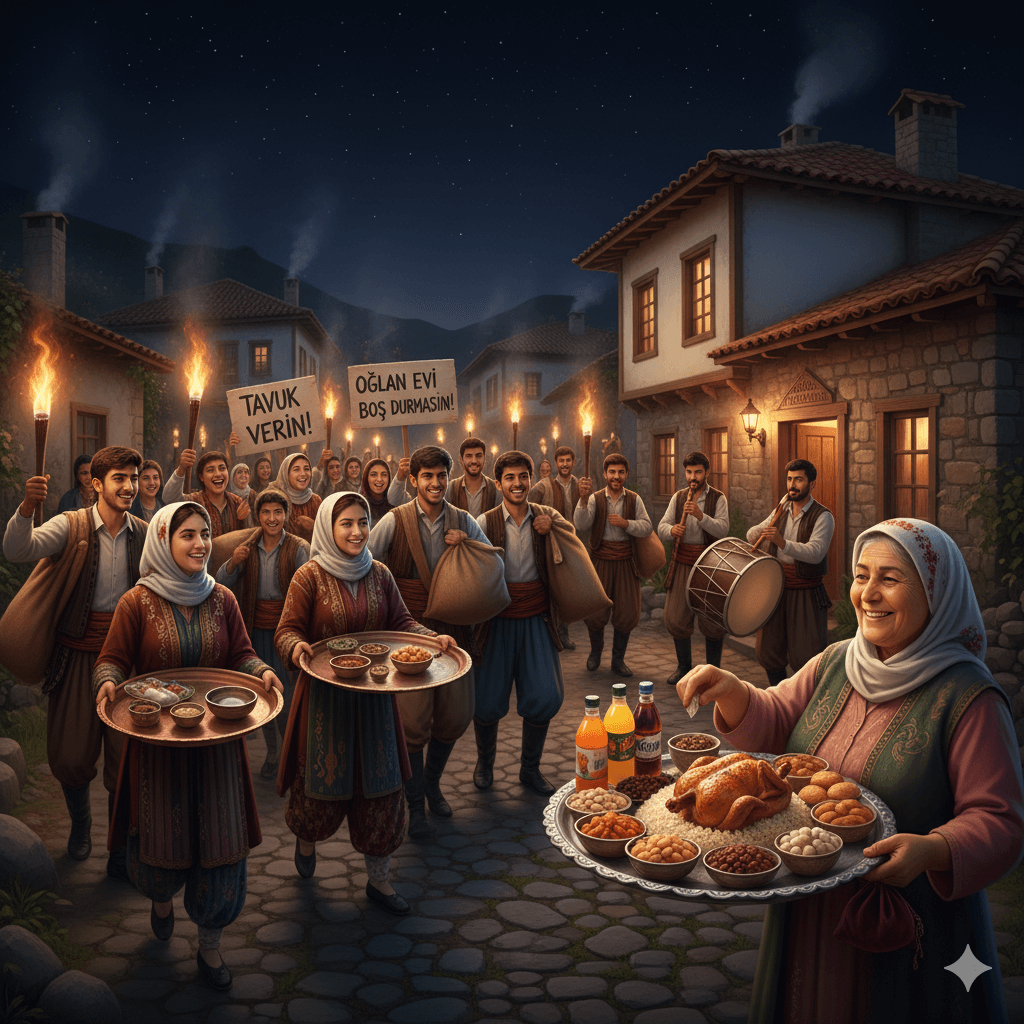
Chicken Picking Frequency (Generated with Artificial Intelligence.)
Type(s) | Wedding custom | ||||||||
|---|---|---|---|---|---|---|---|---|---|
Origin(s) | Bursa Türkiye | ||||||||
Common Locations | Orhaneli, Keles, Mustafakemalpaşa, Osmangazi, İznik, Harmancık and surrounding villages | ||||||||
Time of Application | After the henna night | ||||||||
Symbolic Elements | Chicken, Pilaf, Red ribbon | ||||||||
Oral Culture Elements | Maniler, exchanges of verses, local folk songs, humorous stage plays | ||||||||
One of the wedding traditions unique to the Bursa region is the “tavuk alma âdeti”, which has survived to the present day as an example of pre-wedding festivities. This custom is especially carried out after the henna night. The region’s civilizational history, cosmopolitan structure, and social fabric have all played a role in shaping this tradition.
The term “tavuk alma” derives from the roasted chicken served at the end of the henna night at the groom’s house. Although similar practices exist in various parts of Anatolia, the Bursa tradition of tavuk alma distinguishes itself through its unique form. This custom remains actively practiced in districts and villages such as Orhaneli, Keles, Mustafakemalpaşa, İznik, Osmangazi, and Harmancık.
After the henna night concludes, the bride’s family, close relatives, friends, and village youth gather together. Songs are sung to the rhythm of davul, darbuka, or zurna. The bride’s side prepares a “fake bride” and a “fake groom”. This pretend couple is typically chosen from the bride’s close friends: one girl dresses as the groom, while another girl, dressed in bridal attire, plays the bride. The real bride is usually hidden away during this time. The groom symbolically takes on the task of “finding the bride.” Once the bride is found, games are played accompanied by music, maniler are sung, and celebrations ensue.
The core of the ceremony begins when the bride’s side travels to the groom’s house. Young women and men set off toward the groom’s house carrying torches, sacks, or trays known as sini. During this procession, songs such as “Tavuk verin, tavuk!” (“Give us chicken, chicken!”) and “Oğlan evi boş durmasın!” (“Let the groom’s house not stand empty!”) are chanted. The groom’s household welcomes the group with music. A tray prepared in advance at the groom’s house is filled with roasted chicken, pilaf, snacks, drinks, and sweets. Sometimes, small gifts or money are added to the tray by the groom’s mother or father-in-law. Symbolically, the tray represents the wish that “the bride’s household be satisfied.” After receiving the food, the bride’s side returns home with the same enthusiasm. Later in the night, the groom’s side visits the bride’s house under the pretext of “taking sweets.” A reciprocal cycle of visits and offerings is thus established. In some villages, these exchanges may occur two or three times.
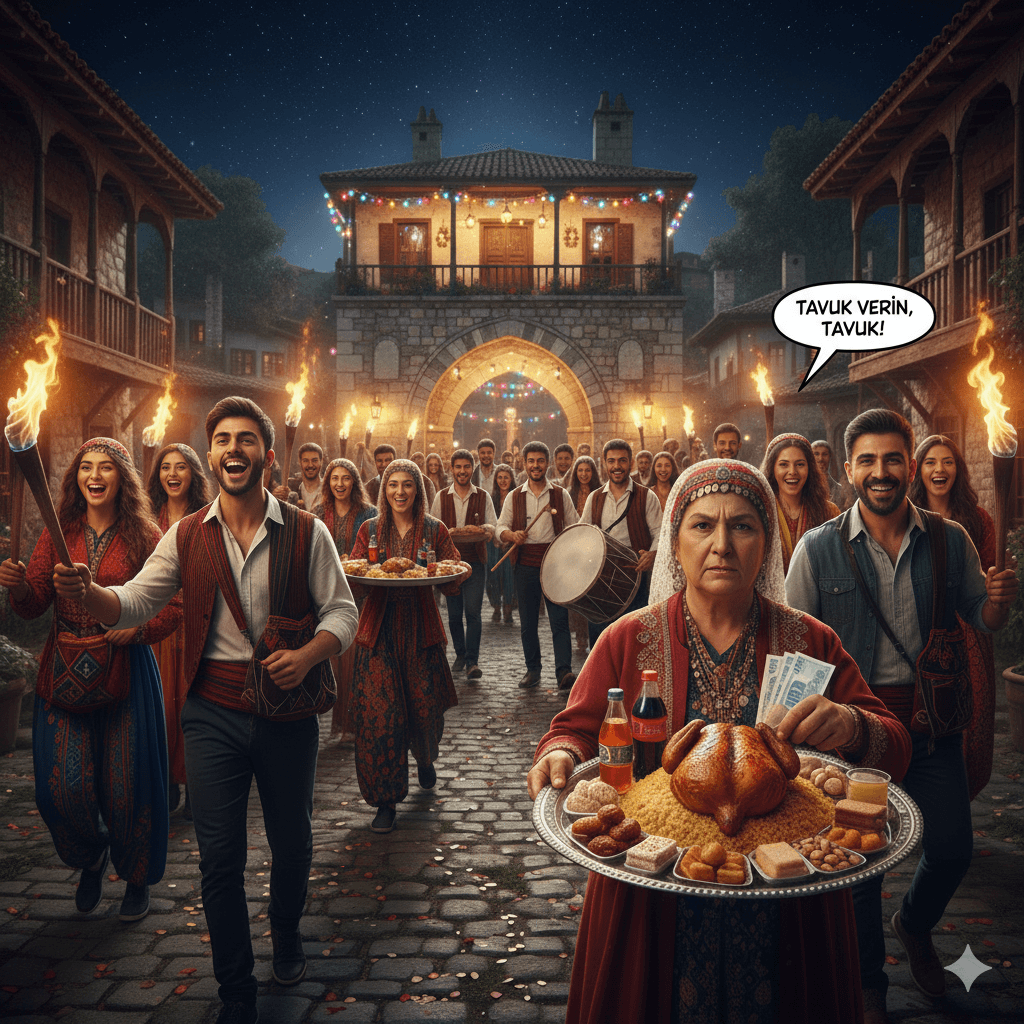
Procedure of the Tavuk Alma Ceremony (Generated by Artificial Intelligence.)
The “tavuk alma” tradition expresses social solidarity and unity. Its fundamental purpose is to integrate the couple into their surrounding community, bring the two families closer, and ensure the participation of the entire village in the wedding. This ritual, experienced as a collective celebration in which everyone contributes, strengthens social bonds within the village.
Tavuk alma is also regarded as a rite of passage, marking the final festive occasion before marriage. While the henna night symbolizes the bride’s last night in her father’s home, tavuk alma aims to conclude that night with joy, unity, and blessings of abundance. For this reason, parents typically do not participate in the festivities, allowing the young people to enjoy themselves freely.
Some studies suggest that the origins of the tavuk alma custom lie in the wish for the bride and groom’s stomachs to be filled, ensuring a prosperous and fertile marriage. The bride’s side later reciprocating with baklava or sweets reflects the belief that “the new life should be sweet.”
This custom is a living example of the Bursa community’s centuries-old folkloric understanding and represents a local reflection of Anatolia’s shared cultural heritage. The songs, maniler, games, symbols, and costumes central to the tradition contribute to the continuity of local music, dance, and theatrical traditions.
Tavuk alma functions as a social instrument of solidarity and unity, reinforcing the community’s shared values by bringing individuals together. Participation in this celebration around the bride and groom is not limited to family members but includes neighbors, friends, and the entire village population.
From the perspective of intergenerational transmission, tavuk alma also serves an important function. A large portion of the Bursa population sustains this tradition “as they saw it done by their elders.” Younger generations, by participating in the custom, experience their ancestors’ way of life and become links in the chain of cultural memory. Since Bursa has historically been a city where diverse communities coexisted, local traditions such as tavuk alma have become symbols that solidify the city’s cultural identity.
Each element used in the ritual carries symbolic meanings connected to popular beliefs. The chicken represents the wish for abundance and fertility in marriage. Pilaf symbolizes unity and sharing, while sweets express the hope that the marriage will be sweet. Red ribbons signify protection from the evil eye; the game of the fake bride and groom aims to reduce social tension through humor. At the same time, by enabling active participation of women and youth in the wedding process, the tradition imbues social gender roles with symbolic meaning.
Tavuk alma also holds cultural value in terms of folk art. Songs, maniler, improvised exchanges, and spontaneous performances reveal the community’s cultural understanding. The rhythmic use of musical instruments such as zurna and darbuka contributes to the transmission of regional musical traditions from one generation to the next.
The tavuk alma practice exhibits minor variations across different districts of Bursa. In the areas of Orhaneli and Keles, young people roam the village throughout the night collecting live chickens from in-laws, which are then cooked and eaten together the next morning. In Ayaz Mahallesi of Mustafakemalpaşa, the bride’s house sends an empty sini to the groom’s house; the chicken and sweets placed inside are delivered by the groom as he lifts the bride’s veil. In Dağakça Mahallesi of Osmangazi, “fake brides and bravado youths” visit the groom’s house to playfully tease them.【1】
Today, in urban centers, this tradition is largely maintained at a symbolic level. In some weddings, the serving of chicken and sweets is performed not at home but in a salon setting or as part of musical entertainment. However, in rural areas, the gathering of live chickens, the singing of maniler, and all-night games continue to be preserved as core elements of the tradition.
Akgün, Sibel. “Geleneğin Geleceğe Aktarımında Evlilik Öncesi Âdetler: Bursa Şehri Kına Gecesi Tavuk Alma Örneği.” *Selçuk Üniversitesi Türkiyat Araştırmaları Dergisi (SUTAD)*, no. 48 (April 2020): 155–171. Accessed November 10, 2025. https://dergipark.org.tr/en/download/article-file/1496184
Ministry of Culture and Tourism of the Republic of Türkiye. "Bursa Evlilik Gelenekleri." *Kültür Portalı*. Accessed November 10, 2025. https://www.kulturportali.gov.tr/turkiye/bursa/kulturatlasi/evlenme-gelenekleri
Ministry of Culture and Tourism of the Republic of Türkiye. "Somut Olmayan Kültürel Miras Çalışmaları." Bursa İl Kültür ve Turizm Müdürlüğü web sitesi. Accessed November 10, 2025. https://bursa.ktb.gov.tr/TR-272395/somut-olmayan-kulturel-miras-calismalari.html
[1]
Akgün, Sibel, “Geleneğin Geleceğe Aktarımında Evlilik Öncesi Âdetler: Bursa Şehri Kına Gecesi Tavuk Alma Örneği,” Selçuk Üniversitesi Türkiyat Araştırmaları Dergisi (SUTAD), no. 48 (Nisan 2020): 155–171, sayfa 162, erişim 10 Kasım 2025, https://dergipark.org.tr/en/download/article-file/1496184
Chicken Picking Frequency (Generated with Artificial Intelligence.)
Type(s) | Wedding custom | ||||||||
|---|---|---|---|---|---|---|---|---|---|
Origin(s) | Bursa Türkiye | ||||||||
Common Locations | Orhaneli, Keles, Mustafakemalpaşa, Osmangazi, İznik, Harmancık and surrounding villages | ||||||||
Time of Application | After the henna night | ||||||||
Symbolic Elements | Chicken, Pilaf, Red ribbon | ||||||||
Oral Culture Elements | Maniler, exchanges of verses, local folk songs, humorous stage plays | ||||||||
No Discussion Added Yet
Start discussion for "Chicken Picking Habit" article
Origins and General Characteristics
Procedure of the Ceremony
Symbolic and Social Meaning
Cultural Value
Regional Variations and Current Status