


This article was automatically translated from the original Turkish version.
+1 More
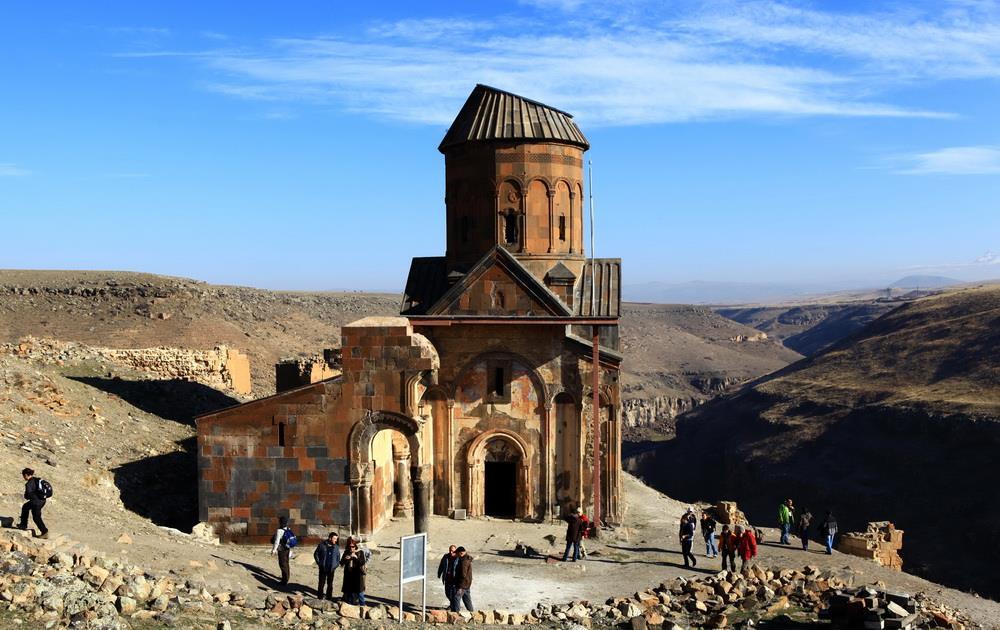
Tigran Honents Church is located within the boundaries of Türkiye’s Kars in the historical region known as Ani Archaeological Site. Ani was a significant Armenian settlement during the Middle Ages, and this church is part of that historic landscape. The church is situated on elevated ground at the point where the Mığmığ Stream flows into the Arpaçay River. Located to the east of Ani, the church occupies a strategic position, commanding a dominant view of its surroundings—a feature that enhances both its historical and geographical significance.

Tigran Honents Church (Culture Portal)
The Tigran Honents Church was constructed in 1215. The patron who oversaw its construction was Tigran Honents, an Armenian merchant belonging to the Honents family. Tigran Honents was a local resident of Ani and played a pivotal role in the church’s development. The church is dedicated to Saint Gregory the Illuminator, a figure of profound significance in Armenian Christian tradition. Saint Gregory the Illuminator is renowned for spreading Christianity among the Armenians, and the church’s dedication to him carries both religious and social importance.

Interior of the Church (Culture Portal)
The church’s architecture reflects distinctive characteristics of Armenian ecclesiastical design of the period, adapted to local environmental conditions. The structure is built upon a three-tiered platform. Regularly cut stones in shades of red, black and brownish tones were used in its construction, providing both structural durability and visual aesthetic appeal.
The church has a rectangular plan enclosed by a robust perimeter wall. The exterior decorations are particularly striking. Relief animal figures adorn the eaves of the roof. The building features a single entrance on its western façade, positioned to harmonize with the overall symmetrical design. The western façade and the eastern façade are similarly composed, resulting in a balanced and symmetrical exterior appearance.
The arch surfaces throughout the building are decorated with geometric interlace motifs. The patterns on the arches are supported by vegetal designs influenced by Seljuk art, including curled vines, palmettes and rumi motifs that closely resemble Seljuk decorative elements. Additionally, animal figures such as eagles, roosters, partridges, lions and griffins are placed at the corners of the arches, often depicted in scenes of animal combat.
One of the most remarkable features of the Tigran Honents Church is its interior frescoes. The walls and dome are adorned with scenes depicting the life of Jesus Christ and key events from the Bible. These frescoes present a sequence of important religious episodes, from the Nativity to the Crucifixion and Resurrection.
The complete coverage of interior surfaces with frescoes is a rare feature in Armenian architecture, elevating the church to the status of a major artistic masterpiece. The figures and narratives in the frescoes function as a visual language of religious belief. In particular, scenes illustrating the life of Saint Gregory the Illuminator stand out prominently. These scenes not only depict events from the Bible but also portray the lives of local saints who contributed to the spread of Armenian Christianity. This underscores the church’s significant religious and cultural role.

Frescoes (Culture Portal)
The iconography within the church’s interior frescoes is deeply interwoven with religious themes. These include fundamental biblical scenes such as the Nativity, the Life of Christ, his miracles, the Crucifixion and the Resurrection. Scenes depicting the life of Saint Gregory the Illuminator are also prominently featured. In Armenian culture, Saint Gregory the Illuminator is revered as the figure who propagated Christianity and disseminated its teachings among the people. Thus, the church is not merely a religious structure but also an important historical document of Armenian Christian heritage.
The scenes in the frescoes reflect local beliefs and traditions. Alongside biblical and Old Testament narratives, the religious figures depicted serve both an instructional function and foster a sense of religious identity among the local population.
The architecture of the Tigran Honents Church reflects not only contemporary Armenian ecclesiastical styles but also other cultural influences present in the region. The decorative elements of the building reveal a synthesis of Seljuk art and other Middle Eastern traditions. In particular, the vegetal motifs and animal figures on the exterior walls bear clear traces of Seljuk decorative art.
In the frescoes, influences from Georgian and Byzantine art are observable. Such influences demonstrate the coexistence of diverse cultural traditions during the church’s construction and illustrate how they were integrated into Armenian artistic expression. Moreover, the visual language used in the interior decorations reveals the uniqueness and depth of Armenian art.

Frescoes (Culture Portal)
The Tigran Honents Church has been officially registered by the Ministry of Culture and Tourism as a protected immovable cultural heritage site. The structure is also known as the Painted Church or the Ornamented Church. It lies within the boundaries of the Ani Archaeological Site and is preserved as part of the UNESCO World Heritage List. This registration is of great importance for ensuring the church’s protection at both national and international levels and for its transmission to future generations.
The interior frescoes and exterior decorations of the Tigran Honents Church position it as a vital cultural heritage beyond its function as a religious building. Its preservation holds great significance for both the local community and international visitors, maintaining its unique identity as an integral part of Ani’s historical fabric.
T.C. Kars İl Kültür ve Turizm Müdürlüğü. "Camiler ve Kiliseler." Accessed May 2, 2025. https://kars.ktb.gov.tr/TR-54874/camiler-ve-kiliseler.html.
T.C. Kültür Portalı. "Tigran Honents Resmî Kilisesi." Accessed May 2, 2025. https://www.kulturportali.gov.tr/turkiye/kars/gezilecekyer/tgran-honents-resml-klses.
Özyurt Özcan, Hatice. “Tigran Honents (Aydınlatıcı Aziz Gregorios) Klisesinin Freskoları Ne Kadar Bizans’lı?” Hacettepe Üniversitesi Edebiyat Fakültesi Dergisi 25, no. 1 (2008): 29-48. https://dergipark.org.tr/tr/download/article-file/607135

No Discussion Added Yet
Start discussion for "Church of Tigran Honents" article
Construction Date and Patron
Architectural Features
Interior Space and Frescoes
Iconography and Religious Themes
Artistic and Cultural Influences
Conservation Status and Registration