


This article was automatically translated from the original Turkish version.
Kardaş Kömeği, 20th century’s early years symbolized the solidarity and aid movement initiated by Azerbaijani Turks toward their kin communities in Anatolia. This movement intensified particularly during the Balkan Wars and the First World War, establishing itself on the historical stage as a tangible manifestation of national, religious, and cultural ties.
Assistance ranged widely from food and clothing distribution to medical support, prisoner rescue, and refugee sheltering, organized by charitable societies alongside individual contributions. Spearheaded especially by the Baku Muslim Charity Society, these efforts strengthened the brotherhood bridge between Azerbaijan and Anatolia despite the repressive policies and censorship of the Russian Empire.
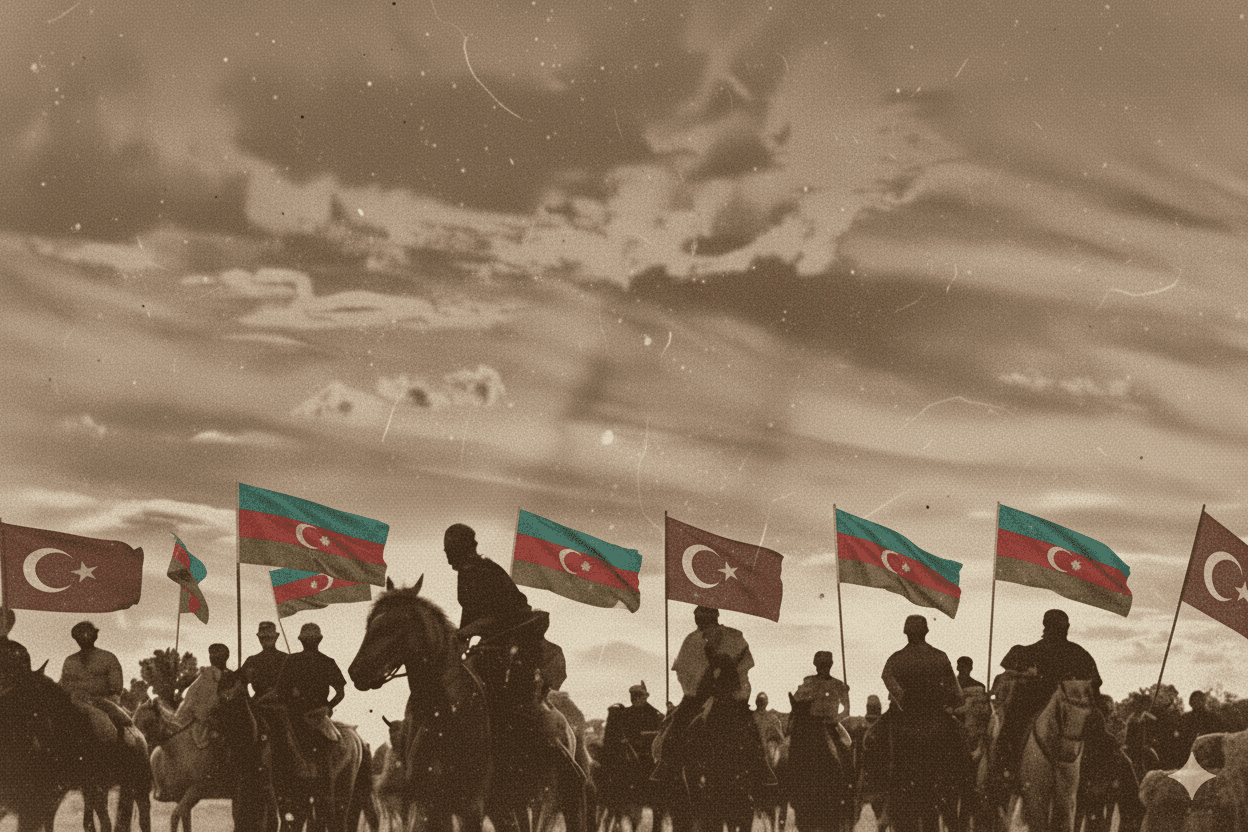
Visual Symbolizing Solidarity (Generated by Artificial Intelligence)
The foundations of Kardaş Kömeği rest on the deep historical ties between Azerbaijani and Anatolian Turks. In the late 19th and early 20th centuries, Pan-Turkist and Pan-Islamist currents fostered a strong spirit of solidarity between the two communities. These ideas found strong resonance in Azerbaijan following the Ottoman Empire’s defeats in the Balkan Wars, triggering widespread relief campaigns. Azerbaijani intellectuals viewed these efforts as a national and religious duty, sustaining them through clandestine or semi-official channels despite Russia’s strict censorship and obstruction.
The outbreak of the First World War elevated relief activities to their peak, particularly due to the conflicts on the Caucasus Front. The Sarıkamış Campaign (22 December 1914 – 5 January 1915) marked a turning point, as the Ottoman army suffered heavy losses due to extreme cold, disease, and combat conditions. According to official records, 7,200 soldiers were taken prisoner during this campaign, with the total number on the Caucasus Front reaching 15,000. According to a report prepared by Yusuf Akçura for the Hilal-i Ahmer Society, there were approximately 60,000 Turkish prisoners in Russia, of whom 20,000 to 30,000 were held in Northern Caucasus and the remainder scattered across various regions of Russia. Prisoners were distributed to camps in cities such as Omsk, Tomsk, Irkutsk, Uralsk, Samara, Kazan, Nijniy Novgorod, Kharkov and Baku. Notably, Nargin Island opposite Baku was used as a natural prison, where prisoners struggled against starvation, cold, and epidemics. 【1】
Under Russian occupation, Muslim-Turkish populations in Erzurum, Kars, Ardahan and surrounding areas suffered massacres, forced displacement and destitution. The Russian occupation of Erzurum on 16 February 1916 initiated a two-year period of suffering for the local population. In this context, Azerbaijani Turks mobilized their fraternal bonds to extend aid. This solidarity, which began during the Balkan Wars, acquired institutional structure with the onset of the First World War.
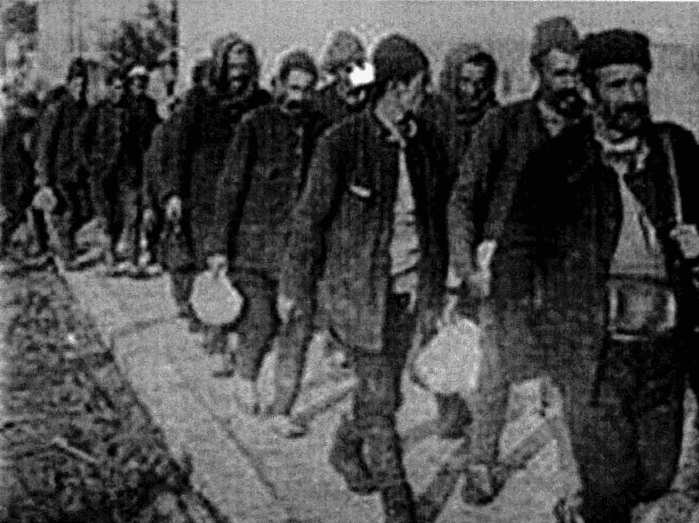
Prisoners transported on foot.(Bingür Sönmez)
【2】
The heart of the aid movement beat in the Baku Muslim Charity Society, established in 1905. Under the presidency of Haji Zeynalabidin Tagiyev, the society initially provided material support and educational initiatives to the poor, shifting its focus during the war to relief efforts on the Caucasus Front. Its membership included the leading intellectuals of the era: Ahmet Ağayev, Ali Bey Hüseynzade, Hasan Bey Zerdabi, Ali Merdan Bey Topçubaşov, İsrafil Hacıyev and many others. According to its bylaws, the society was open to all without distinction of gender; members supported its administration through monthly dues. Its building, named “İsmailiyye,” was completed in 1913 and served as a hospital during the war, but was destroyed in an Armenian attack in 1918.
The society, despite difficulties obtaining permission from Russian authorities, opened branches and established supply points. In 1915, the Committee for Aid to War Victims was formed, delivering assistance to regions such as Kars, Ardahan, Kağızman, Batum and Iğdır.
During the Erzurum occupation, society representatives General Major Han Talişinski and İlyasov traveled to the region in June 1916, compiling a list of 16,000 war victims and providing essential supplies such as flour, barley and lentils. Appeals were made to Russian commanders against Armenian attacks, and community organization was encouraged. Other organizations also joined the effort: the Difai Organization, the Ganja Muslim Committee and the Society for Aid to the Needy, transforming aid into a vehicle of national awakening under the influence of Pan-Turkism and Pan-Islamism. Haji Zeynalabidin Tagiyev’s personal contributions were decisive; he shouldered the society’s financial burden, founded schools, supported newspapers and provided material aid to the Ottoman Empire during the Balkan Wars.
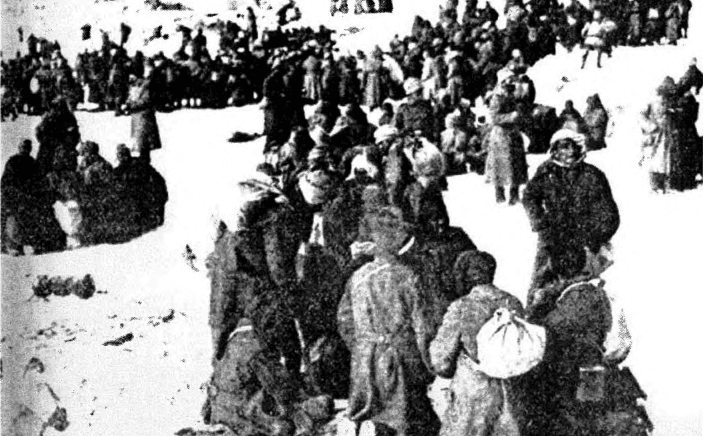
Local civilians kept for days in snow awaiting deportation to Siberia.(Bingür Sönmez)
【3】
Nargin Island served as a major camp center for Turkish soldiers captured by the Russians on the Caucasus Front during the First World War. Located in the Baku Bay, the island functioned as a natural prison and became one of the central hubs for the influx of prisoners following the Sarıkamış Campaign. Conditions were extremely harsh: water shortages, food scarcity and diseases such as typhus and dysentery decimated the prisoners.
The cruel treatment by Armenian soldiers further worsened the situation. The Baku Muslim Charity Society provided food and clothing, arranged weekly transports of prisoners to Baku, and assumed responsibility for burial rites. Escape operations were organized; in 1915, eight officers and in 1916, sixteen officers were successfully smuggled to Anatolia via Iran. 【4】 Burials of prisoners who died on the island were funded by philanthropists, demonstrating the humanitarian dimension of Kardaş Kömeği.
Assistance became systematic from the Balkan Wars onward. Financial aid was sent from Azerbaijan to the Ottoman Empire, and volunteer fighters joined the front lines. During the First World War, Nargin Island became one of the focal points of relief efforts. The island was converted into a camp in 1915 with barracks constructed, yet conditions remained inadequate: water shortages, epidemics and hunger broke the prisoners’ spirits. The society covered burial expenses and organized escapes. Escapes via Iran enabled prisoners to return to Anatolia.
In Erzurum, the delegation sent in June 1916 distributed 62,000 telis of food and 13,252 telis of clothing. 【5】 Orphaned children were relocated to Baku and Tbilisi, and protective measures were taken against Armenian massacres. In 1917, the magazine Gardaş Kömeği emerged as a product of these efforts. This 80-page single-issue journal, printed with the support of Haji Zeynalabidin Tagiyev, was presented as a gift to war victims, with its proceeds (1,300 manats) delivered to Kars and Ardahan. 【6】 The journal featured works by Mehmet Emin Resulzade, Ömer Faik Numanzade, Hüseyin Cavid and others. Numanzade’s article “Who Am I?” criticized sectarian divisions and emphasized a shared Turkish identity; Resulzade condemned the exploitation of Turks in Russia and advocated a republican system; İshaki argued for the importance of a common literary language and promoted the overcoming of sectarian divisions through marriage and educational programs.
Relief efforts generally encompassed 40 kilograms of gold, grain, food supplies and medical equipment. Intellectuals published appeals in newspapers and organized theatrical performances and meetings. For example, in 1915, “Kardaş Kömeği Day” was declared, with women and youth collecting aid. These activities became not merely humanitarian assistance but also a tool for strengthening national consciousness.
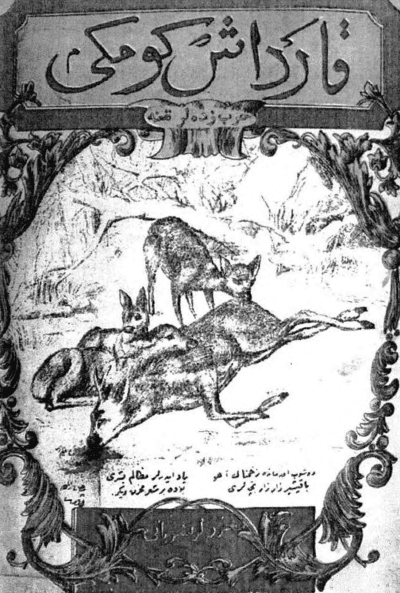
Gardaş Kömeği Magazine(Bingür Sönmez)
【8】
Published in February 1917 amid the relatively freer atmosphere following the Russian Revolution, the Gardaş Kömeği magazine stands as a significant document of national awakening. Enriched with poetry, stories, plays and articles, it was printed with the support of Haji Zeynalabidin Tagiyev. The magazine criticized traditional medrese education as an obstacle to modernization and rejected the superiority of Arabic and Persian over Turkish. The emphasis on a common language and culture accelerated the process of nation-building. While influenced by Pan-Turkism and Pan-Islamism, its central focus was national unity.
Haji Zeynalabidin Tagiyev stands out as the financial architect of the movement. Yusuf Akçura contributed through his reports on prisoners; Dr. Hüsrev Paşa Bey Sultanov managed coordination by securing official permissions. Representatives such as Seyidov were martyred in Erzurum. These individuals transformed aid into a national ideal.
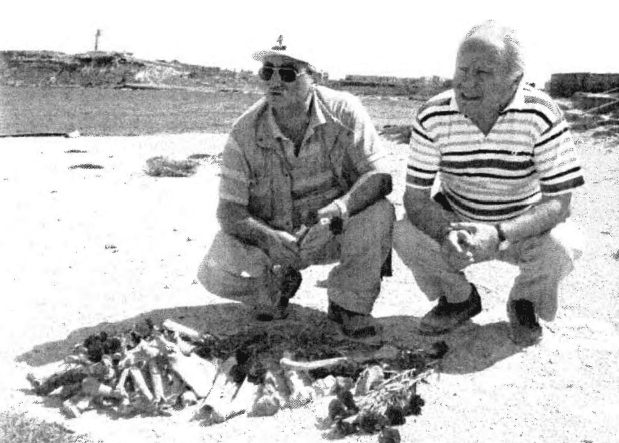
Bones of soldiers who died as prisoners on Nargin Island. In 2007, Prof. Dr. Bingür Sönmez and Prof. Dr. İbrahim Yıldırım, granted special permission, visited Nargin Island and recovered some of the exposed bones to be reburied at the Sarıkamış Martyrs’ Memorial.(Bingür Sönmez)
【9】
Kardaş Kömeği deepened the ties between Azerbaijan and Anatolia and laid the groundwork for the construction of national identity. Sustained despite Russian repression, this movement stands as a historical example of mutual solidarity. It helped establish the foundations of the Azerbaijan People’s Republic (1918–1920) and accelerated its modernization process. Even today, this spirit of brotherhood forms the bedrock of relations within the Turkish world.
Aslan, Betül. "I. Dünya Savaşı Esnasında Azerbaycan Türkleri’nin Erzurum Ahalisine Yaptığı ‘Kardaş Kömeği (Yardımları).’" *Atatürk Üniversitesi Türkiyat Araştırmaları Enstitüsü Dergisi* 6 (1996). Accessed October 1, 2025. https://dergipark.org.tr/tr/pub/ataunitaed/issue/2854/39519.
Heyet, M. Rıza. “’Gardaş Komeği’ Mecmuasında Türklük ve Milletleşme Meseleleri.” *Modern Türklük Araştırmaları Dergisi* 21, no. 3 (September 2024): 571–583. Accessed October 1, 2025. https://www.academia.edu/126236572/_Garda%C5%9F_Kome%C4%9Fi_Mecmuas%C4%B1nda_T%C3%BCrkl%C3%BCk_ve_Milletle%C5%9Fme_Meseleleri_Issues_of_Turkishness_and_Nationalization_in_Garda%C5%9F_Komegi_Magazine_.
Mirzaliyeva, Fatima. “Hacı Zeynelabidin Tagiyev ve Bakü Hayriyye Cemiyeti.” İnsamer, March 17, 2017. Accessed October 1, 2025. https://www.insamer.com/tr/haci-zeynelabidin-tagiyev-ve-baku-hayriyye-cemiyeti_618.html.
Sönmez, Bingür. “Bakü Halkının 1915-1917 Sarıkamış Esirlerine Kardeş Kömeği.” *Karadeniz Uluslararası Bilimsel Dergi* 6 (2010): 9-23. Accessed October 1, 2025. https://dergipark.org.tr/tr/pub/kdeniz/issue/16869/175600.
Süleymanlı, Mübariz. “Balkan ve I. Dünya Savaşı Dönemlerinde Azerbaycan Türklerinin Anadolu’ya Kardeşlik Yardımları.” Türk Tarih Kurumu, 2022. Accessed October 1, 2025. https://www.ttk.gov.tr/wp-content/uploads/2022/04/36-MubarizSuleymanli.pdf.
[1]
Bingür Sönmez, “Bakü Halkının 1915-1917 Sarıkamış Esirlerine Kardeş Kömeği,” Karadeniz Uluslararası Bilimsel Dergi 6 (2010): 9, erişim 1 Ekim 2025, https://dergipark.org.tr/tr/pub/kdeniz/issue/16869/175600.
[2]
Bingür Sönmez, “Bakü Halkının 1915-1917 Sarıkamış Esirlerine Kardeş Kömeği,” Karadeniz Uluslararası Bilimsel Dergi 6 (2010): 18, erişim 1 Ekim 2025, https://dergipark.org.tr/tr/pub/kdeniz/issue/16869/175600.
[3]
Bingür Sönmez, “Bakü Halkının 1915-1917 Sarıkamış Esirlerine Kardeş Kömeği,” Karadeniz Uluslararası Bilimsel Dergi 6 (2010): 19, erişim 1 Ekim 2025, https://dergipark.org.tr/tr/pub/kdeniz/issue/16869/175600.
[4]
Bingür Sönmez, “Bakü Halkının 1915-1917 Sarıkamış Esirlerine Kardeş Kömeği,” Karadeniz Uluslararası Bilimsel Dergi 6 (2010): 17, erişim 1 Ekim 2025, https://dergipark.org.tr/tr/pub/kdeniz/issue/16869/175600.
[5]
Betül Aslan, "I. Dünya Savaşı Esnasında Azerbaycan Türkleri’nin Erzurum Ahalisine Yaptığı ‘Kardaş Kömeği (Yardımları),’” Atatürk Üniversitesi Türkiyat Araştırmaları Enstitüsü Dergisi 6 (1996): 165, erişim 1 Ekim 2025, https://dergipark.org.tr/tr/pub/ataunitaed/issue/2854/39519.
[6]
Bingür Sönmez, “Bakü Halkının 1915-1917 Sarıkamış Esirlerine Kardeş Kömeği,” Karadeniz Uluslararası Bilimsel Dergi 6 (2010): 15, erişim 1 Ekim 2025, https://dergipark.org.tr/tr/pub/kdeniz/issue/16869/175600.
[7]
Bingür Sönmez, “Bakü Halkının 1915-1917 Sarıkamış Esirlerine Kardeş Kömeği,” Karadeniz Uluslararası Bilimsel Dergi 6 (2010): 17, erişim 1 Ekim 2025, https://dergipark.org.tr/tr/pub/kdeniz/issue/16869/175600.
[8]
Bingür Sönmez, “Bakü Halkının 1915-1917 Sarıkamış Esirlerine Kardeş Kömeği,” Karadeniz Uluslararası Bilimsel Dergi 6 (2010): 22, erişim 1 Ekim 2025, https://dergipark.org.tr/tr/pub/kdeniz/issue/16869/175600.
[9]
Bingür Sönmez, “Bakü Halkının 1915-1917 Sarıkamış Esirlerine Kardeş Kömeği,” Karadeniz Uluslararası Bilimsel Dergi 6 (2010): 21, erişim 1 Ekim 2025, https://dergipark.org.tr/tr/pub/kdeniz/issue/16869/175600.

No Discussion Added Yet
Start discussion for "Coal of the Brother" article
Historical Origins and Context
Organization and Institutional Structures
The Situation of Prisoners on Nargin Island
Details of Relief Activities
Societies Providing Aid to Prisoners
The Role of Gardaş Kömeği Magazine and National Awakening
Key Figures and Their Impact
Enduring Legacy