

This article was automatically translated from the original Turkish version.
+1 More
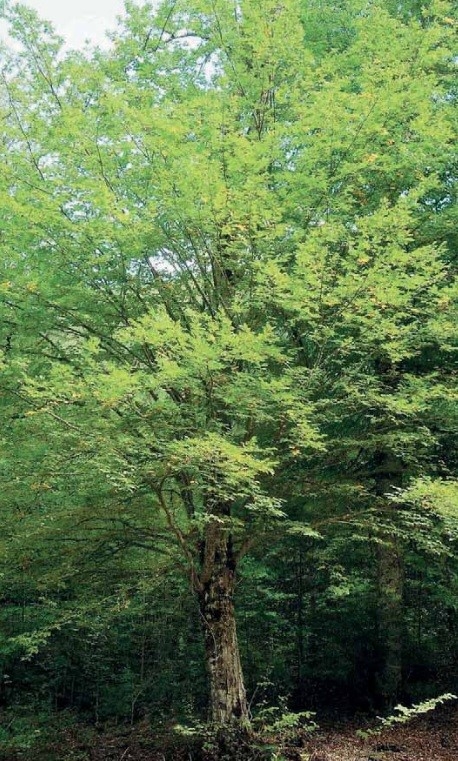
Common hornbeam(Carpinus betulus), is a deciduous broadleaf tree species. It typically reaches a height of 20–25 m; its trunk is grooved and uneven. The bark is gray, thin and smooth, remaining uncracked throughout the tree’s life. Buds are pointed, reddish-brown in color, arranged obliquely along the shoots, with margins of the scales ciliate. Young shoots and leaf stalks are hairy.

Common Hornbeam (Monumental Trees)
Leaves are 7–14 cm long, alternately arranged and wedge-shaped at the base. Margins are sharply double-toothed with 11–15 pairs of lateral veins. Young leaves are silky-hairy but lose their hairs as they mature; the underside shows prominent veins that form raised ridges. The fruit bract is three-lobed; the central lobe is longer than the lateral lobes. The stigma is dark red and filamentous.
Naturally distributed throughout Europe, Türkiye, the Caucasus and Iran. In Türkiye it is found particularly in the Black Sea Region, within the Europe-Siberia floristic region, and locally in the Amanos Mountains. In the Trakya region around Demirköy, dense stands with straight, uniform trunks are encountered.
Common hornbeam is a species that prefers moist, deep soils and occurs in mixed broadleaf forests. It thrives in temperate climates and is typically a component of forest communities.
An individual common hornbeam recorded in Türkiye’s monumental trees database is located in the Feke district of Giresun Province.
These measurements are specific to this individual specimen and may differ from the species’ general average dimensions.
The common hornbeam plays a vital role in ecosystems as an important component of natural forests, contributing to carbon storage and habitat provision. In Türkiye, specimens designated as monumental trees are significant both for the conservation of biological diversity and for cultural heritage.
The common hornbeam plays a key role in forest ecosystems. It provides shade in the understory, supports plant diversity, and helps retain soil moisture. Its root system prevents soil erosion and contributes significantly to slope and streambank stabilization. Its leaves and seeds serve as a food source for birds and insects, while its trunk and branches offer shelter.
Its wood is hard and durable, used in furniture, parquet flooring and firewood production. In urban landscapes, it provides shade and aesthetic value while enhancing urban biodiversity. Additionally, its carbon sequestration capacity helps mitigate the effects of climate change.

No Discussion Added Yet
Start discussion for "Common Hornbeam (Carpinus betulus)" article
Leaf and Fruit Morphology
Geographic Distribution and Ecology
Monumental Tree Records (Individual Specimen)
Significance and Conservation Status