
This article was automatically translated from the original Turkish version.
Parties | Russian Federation Iran Islamic Republic | ||||||||
|---|---|---|---|---|---|---|---|---|---|
Signature Date | 2015-01-17 | ||||||||
Place of Signature | Moscow | ||||||||
Entry into Force Date | 2025-10-02 | ||||||||
Duration | 20 years | ||||||||
The Comprehensive Strategic Partnership Agreement between Iran and Russia is a comprehensive intergovernmental agreement regulating long-term cooperation between the Islamic Republic of Iran and the Russian Federation. The agreement was signed on 17 January 2025 at the Kremlin Palace in Moscow and was ratified by the Russian Federal Assembly in April 2025 and by the Iranian Parliament on 21 May 2025. It officially entered into force on 2 October 2025.

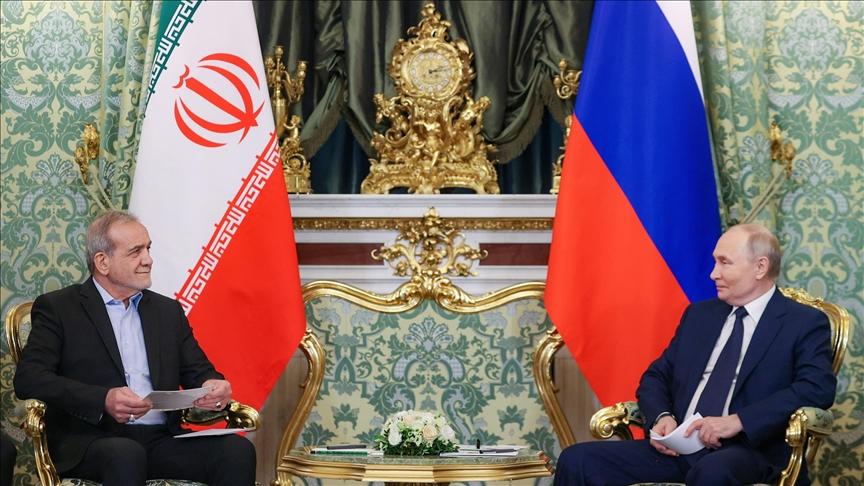
Iranian President Masoud Pezeshkian and Russian President Vladimir Putin at the Kremlin Palace in Moscow on 17 January 2025 – (Anadolu Agency)
The agreement is valid for a period of 20 years and will be automatically extended in five-year increments unless one party notifies the other of its intention to terminate it at least one year in advance. The agreement consists of 47 articles and provides for cooperation in numerous areas including political, economic, military, security, cultural, scientific, environmental, energy and transport sectors.
The parties have defined the agreement as “comprehensive long-term and strategic” and emphasized the goal of strengthening the institutional and legal framework of relations between the two countries. The agreement is situated within the historical continuity of previous treaties signed between the two countries during the twentieth century, including the 1921 Treaty of Friendship between Iran and the Soviet Union, the 1940 Trade and Navigation Agreement, and the 2001 Agreement on Principles of Mutual Relations and Cooperation.
In this context, the agreement has been prepared with the objective of elevating bilateral relations to a new level based on long-term cooperation grounded in mutual sovereignty, territorial integrity and non-interference in internal affairs under the framework of international law.
Preparations for the Comprehensive Strategic Partnership Agreement between Iran and Russia began in 2021. This process was undertaken with the aim of renewing and expanding the 2001 Agreement on Principles of Mutual Relations and Cooperation previously signed between the two countries.

Iranian President Masoud Pezeshkian and Russian President Vladimir Putin at the Kremlin Palace in Moscow on 17 January 2025 – (Anadolu Agency)
The signing ceremony took place on 17 January 2025 at the Kremlin Palace in Moscow. Iranian President Masoud Pezeshkian and Russian President Vladimir Putin attended the ceremony and signed the agreement. Following the signing, the two leaders held a joint press conference.
At the signing ceremony, Russian President Vladimir Putin described the agreement as a document that “deepens bilateral cooperation in the long term” and creates new opportunities in economic and strategic fields. Iranian President Pezeshkian stated that relations had entered a new phase, particularly aiming to expand trade.
In a statement issued by the Kremlin, it was indicated that the agreement would strengthen military-political and commercial-economic relations. It was also emphasized that during the drafting process, the 2001 agreement served as the foundation and its scope was further expanded.
Shortly after the signing of the agreement, issues such as the direct use of national currencies in economic relations between Iran and Russia, integration of payment systems, and the development of the North-South Transport Corridor projects came to the forefront.
The Comprehensive Strategic Partnership Agreement signed between Russia and Iran underwent approval procedures in the legislative bodies of both countries following the signing ceremony. First, the Russian State Duma approved the agreement in April 2025, followed by the Federation Council, which gave its consent in the same direction. Thus, all necessary legal procedures on the Russian side were completed.

The Iranian Parliament approves the “Comprehensive Strategic Partnership Agreement” with Russia on 21 May 2025 – (Anadolu Agency)
In Iran, the agreement was approved by the Islamic Consultative Assembly on 21 May 2025. According to a statement by the Iranian Parliament News Agency (ICANA), the agreement encompasses comprehensive cooperation in areas such as military defense, counter-terrorism, economy, trade, energy, transport, agriculture and culture. Since the agreement had already been approved by Russia, its entry into force process was nearing completion.
The agreement entered into force thirty days after both parties formally notified each other in writing that they had completed their respective domestic procedures. On 2 October 2025, the Iranian Ministry of Foreign Affairs officially announced that the agreement had entered into force. On the same day, the Russian Ministry of Foreign Affairs described the development as an “important turning point in interstate relations.” The entry into force of the agreement occurred shortly after the reimposition of United Nations sanctions against Iran.
The Comprehensive Strategic Partnership Agreement between Iran and Russia consists of a total of forty-seven articles. These articles contain broad provisions covering political, security, economic, energy, cultural and environmental areas.
The Comprehensive Strategic Partnership Agreement between Iran and Russia officially entered into force on 2 October 2025. In a written statement, the Iranian Ministry of Foreign Affairs described this development as a turning point in bilateral relations and stated that the agreement would elevate friendly ties to a higher level across various fields. On the same day, the Russian Ministry of Foreign Affairs also characterized the entry into force as an “important turning point” and stated that joint efforts in a multipolar international order would be strengthened.
In September 2025, during the 25th Shanghai Cooperation Organization Summit held in Tianjin, China, Iranian President Masoud Pezeshkian and Russian President Vladimir Putin met and reaffirmed their commitment to implementing the agreement. At the summit, the parties emphasized that the agreement must not only be signed but also actively implemented through intensified joint efforts.
A day after the agreement entered into force, the Iranian Ministry of Foreign Affairs stated that the document provides a clear framework for cooperation across wide areas including defense, energy, finance, agriculture, science and technology. It also noted that the agreement establishes mechanisms contributing to international peace and security and supports multilateralism based on the principles of the United Nations Charter.
In a Russian statement, it was also indicated that the agreement would contribute to strengthening stability in the region and enable coordinated responses to common threats and challenges. Particular emphasis was placed on increased coordination between the parties in the fields of security, economy and diplomacy.
These developments were celebrated through joint statements, diplomatic engagements and official ceremonies. Iran and Russia have characterized the agreement as a long-term and strategic choice and confirmed that mutual relations have been institutionalized into a durable structural framework.
Al Jazeera. “Russia and Iran Presidents Sign Partnership Treaty in Moscow.” Al Jazeera. Accessed October 3, 2025. https://www.aljazeera.com/news/2025/1/17/russia-and-iran-presidents-sign-partnership-treaty-in-moscow
Anadolu Ajansı. “Rusya ile İran Arasında Stratejik Ortaklık Anlaşması İmzalandı.” Accessed October 3, 2025. https://www.aa.com.tr/tr/dunya/rusya-ile-iran-arasinda-stratejik-ortaklik-anlasmasi-imzalandi/3453813#
Anadolu Ajansı. “İran Meclisi, Rusya ile Kapsamlı Stratejik Ortaklık Anlaşmasını Onayladı.” Accessed October 3, 2025. https://www.aa.com.tr/tr/dunya/iran-meclisi-rusya-ile-kapsamli-stratejik-ortaklik-anlasmasini-onayladi-/3575117
Anadolu Ajansı. “İran ile Rusya Arasında Uzun Vadeli Kapsamlı Stratejik Ortaklık Kuran Anlaşma Yürürlüğe Girdi.” Anadolu Ajansı. Accessed October 3, 2025. https://www.aa.com.tr/tr/dunya/iran-ile-rusya-arasinda-uzun-vadeli-kapsamli-stratejik-ortaklik-kuran-anlasma-yururluge-girdi/3706165
President of Iran. “Full text of Iran-Russia Comprehensive Strategic Partnership Treaty.” President.ir. Accessed October 3, 2025. https://president.ir/en/156874
PressTV. “Iran celebrates implementation of strategic partnership treaty with Russia.” PressTV. Accessed October 3, 2025. https://www.presstv.ir/Detail/2025/10/03/756165/Iran-hails-implementation-of-strategic-partnership-treaty-with-Russia
Reuters. “Iran Parliament Approves Strategic Pact with Russia.” Accessed October 3, 2025. https://www.reuters.com/business/aerospace-defense/iran-parliament-approves-strategic-pact-with-russia-2025-05-21/

Parties | Russian Federation Iran Islamic Republic | ||||||||
|---|---|---|---|---|---|---|---|---|---|
Signature Date | 2015-01-17 | ||||||||
Place of Signature | Moscow | ||||||||
Entry into Force Date | 2025-10-02 | ||||||||
Duration | 20 years | ||||||||
No Discussion Added Yet
Start discussion for "Comprehensive Strategic Partnership Agreement between Iran and Russia" article
Negotiation and Signing Process
Parliamentary Approval Processes
Key Provisions of the Agreement
Entry into Force of the Agreement