


This article was automatically translated from the original Turkish version.
+1 More
Container shipping is an intermodal freight transport system based on the movement of goods using standardized reusable containers. This method enables door-to-door service by facilitating the transfer of cargo between different modes of transport such as ships trucks and trains. Approximately 80 percent of global trade by volume is conducted via sea routes with container shipping forming the backbone of this system. This system is also described as the industrialization of maritime transport.
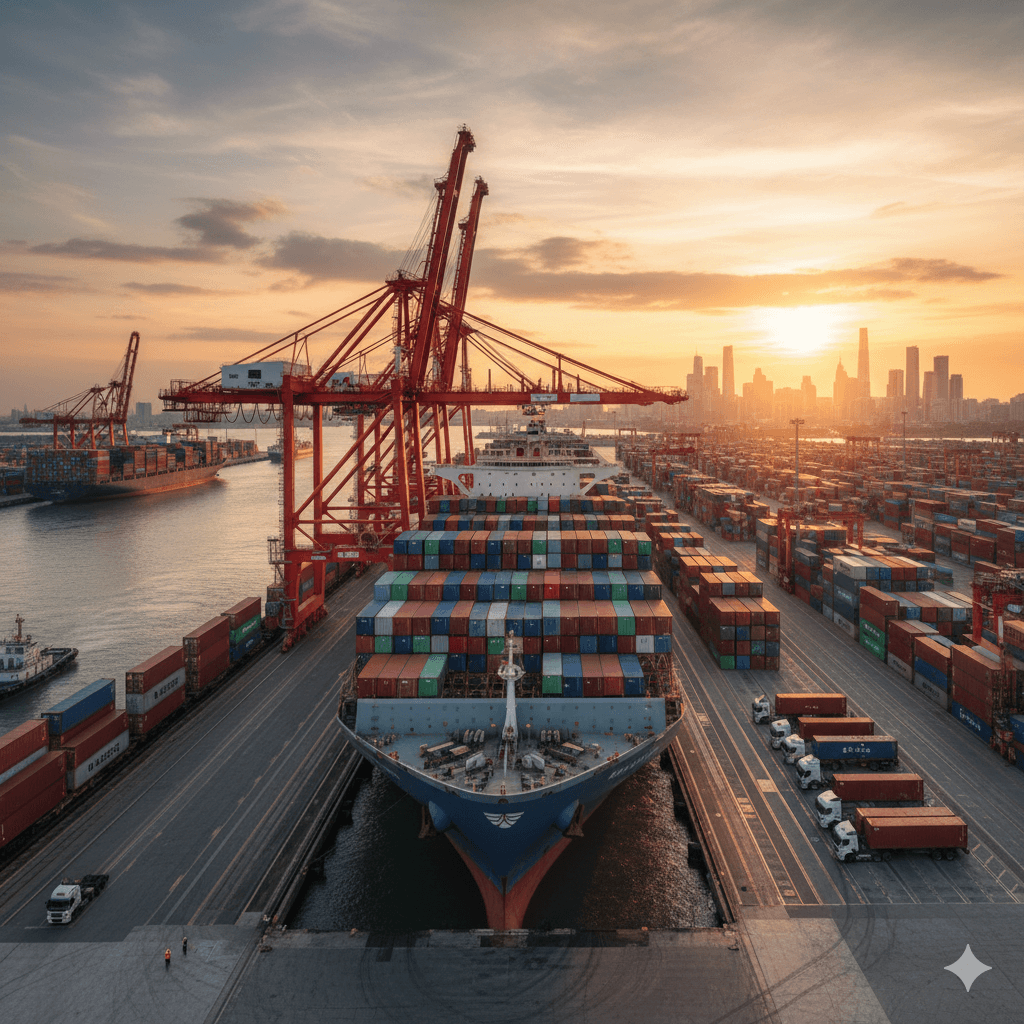
The Critical Role of Container Shipping in Global Trade (Generated by Artificial Intelligence.)
Before the widespread adoption of container shipping maritime trade was largely conducted using the break-bulk method. Under this system cargo was loaded individually onto ships in non-standardized units such as sacks barrels or wooden pallets. The process required high labor input and caused ships to spend up to two-thirds of their total voyage time waiting in ports. The lengthy loading and unloading operations led to congestion uncertainty and additional costs at ports. Moreover risks such as damage and theft of cargo were common during this period. Longshoremen were organized through powerful unions that controlled hiring practices and working conditions.
The precursor to the modern container shipping system was Malcom P. McLean a trucking company owner who designed a system integrating road and sea transport to enable more efficient cargo movement. The first practical application of this approach occurred on 26 April 1956 when the vessel Ideal X transported 58 containers from Newark Port to Houston Port. This event is widely recognized as the beginning of container shipping. The first ship specifically designed to carry only containers was the Maxton a 60-container capacity vessel converted from a tanker in 1956.
The system initiated by McLean began to spread globally in the following years. One of the key steps that enhanced its efficiency was the standardization of container dimensions. In 1964 the International Organization for Standardization (ISO) adopted 20-foot and 40-foot containers as international standards. In Türkiye container shipping emerged approximately 20 years after its global inception during the second half of the 1980s.
The container shipping system consists of various interrelated components.
Ships specifically designed for this system belong to the dry cargo vessel category. Over the years the size and carrying capacity of these vessels have increased significantly. Ship capacity is measured in TEU (Twenty-foot Equivalent Unit) a unit equivalent to one 20-foot container. For vessels such as the Emma Maersk with a capacity exceeding 15000 TEU to operate effectively ports must be equipped with specialized Ultra Post Panamax quay cranes.
Container terminals are facilities where containers are transferred between maritime transport and other modes such as road or rail. Their core functions include:
Historically ports have evolved from simple loading and unloading centers into logistics hubs offering value-added services. According to the port evolution model developed by UNCTAD ports have progressed from first- and second-generation ports performing traditional functions toward third-generation ports that deliver logistics and value-added services. Today the concept of fourth-generation ports or agile ports has emerged referring to flexible structures capable of adapting to market uncertainties.
The container shipping industry is among the first sectors to develop inter-firm cooperation. These collaborations primarily take two forms:
The primary objectives of forming strategic alliances include reducing unit costs through economies of scale sharing capital investments and risks expanding service networks to enter new markets and increasing service frequency to enhance operational efficiency. Today a large share of market capacity in the sector is controlled by three major global alliances: 2M Alliance Ocean Alliance and The Alliance. These three alliances hold up to 98 percent market share on major trade routes such as Asia-Europe.
Container shipping has created transformative effects on the global economy and international trade.
The COVID-19 pandemic which emerged at the end of 2019 had significant effects on the container shipping industry. The pandemic disrupted global supply chains and led to declines in global trade volume and container shipping demand in 2020. In response global alliances canceled numerous voyages to manage capacity. This situation caused service instability on one hand and led to sharp increases in freight rates on the other. Congestion at ports during the pandemic caused delays in cargo handling operations. Institutions such as the International Maritime Organization (IMO) issued various guidelines and measures to ensure the continuity of maritime operations.
Atalay, Murat, and Duygu Aydın Ünal. “Konteyner Taşımacılık İttifakları.” *Stratejik Yönetim Araştırmaları Dergisi* 5, no. 1 (2022): 17–35. Accessed October 19, 2025. https://dergipark.org.tr/tr/pub/syad/issue/69245/1062819
Ateş, Alpaslan, Şengül Karadeniz, and Soner Esmer. “Dünya Konteyner Taşımacılığı Pazarında Türkiye’nin Yeri.” *Dokuz Eylül Üniversitesi Denizcilik Fakültesi Dergisi* 2, no. 2 (2010): 83–98. Accessed October 19, 2025. https://dergipark.org.tr/en/download/article-file/53089
Candela, Rosolino A., Peter J. Jacobsen, and Keith Reeves. “Malcom McLean, Containerization and Entrepreneurship.” *Review of Austrian Economics* 35, (2022): 445–65. Accessed October 19, 2025. https://doi.org/10.1007/s11138-020-00529-2
Ece, Nur Jale. “Covid-19 Salgınının Konteyner Taşımacılığı ve Limanlarına Etkisi.” *Mersin Üniversitesi Denizcilik ve Lojistik Araştırmaları Dergisi* 2, no. 2 (2020): 47–66. Accessed October 19, 2025. https://dergipark.org.tr/tr/download/article-file/1446034
Öçal, Bora. “Türkiye'de Konteyner Taşımacılığı Alanında Hazırlanan Lisansüstü Tezlerin Bibliyometrik Analizi.” *Elektronik Sosyal Bilimler Dergisi* 22, no. 85 (2023): 340–60. Accessed October 19, 2025. https://dergipark.org.tr/en/download/article-file/2761133
[1]
Rosolino A. Candela, Peter J. Jacobsen ve Keith Reeves, “Malcom McLean, Containerization and Entrepreneurship,” Review of Austrian Economics 35 (2022): syf 25, erişim 19 Ekim 2025, https://www.peter-jacobsen.com/uploads/1/3/0/9/130939280/ssrn-id3577383.pdf

No Discussion Added Yet
Start discussion for "Container Transport" article
Historical Development
The Pre-Containerization Era
The Birth of Containerization
Expansion and Standardization
Components of Container Shipping
Container Ships
Container Ports and Terminals
Organizational Structures and Strategic Alliances
Economic and Commercial Impacts
Recent Developments and Challenges
Impacts of the COVID-19 Pandemic