

This article was automatically translated from the original Turkish version.
+1 More
Entry into Service | 15 March 1960 | ||||||||
|---|---|---|---|---|---|---|---|---|---|
Length(s) | 29.50 metres (96 ft 10 in) | ||||||||
Height(s) | 8.90 metres (29 ft 11 in) | ||||||||
Type(s) | Strategic Supersonic Bomber Aircraft | ||||||||
Producer(s) | Convair (General Dynamics) | ||||||||
First Flight(s) | 11 November 1956 | ||||||||
Maximum Speed | 2124 km/h (Mach 2.0) | ||||||||
Engine Type | 4 × General Electric J79-GE-5A turbojet | ||||||||
Maximum Takeoff Weight | 73,900 kg | ||||||||
Wingspan | 17.30 metres (56 ft 10 in) | ||||||||
Crew | 3 (Pilot-Bomber-Navigator-Defense Systems Operator) | ||||||||
Unit Cost | 12.44 million US dollars (1960 data) | ||||||||
Primary User | United States Air Force (USAF) | ||||||||
Retirement | 16 January 1970 | ||||||||
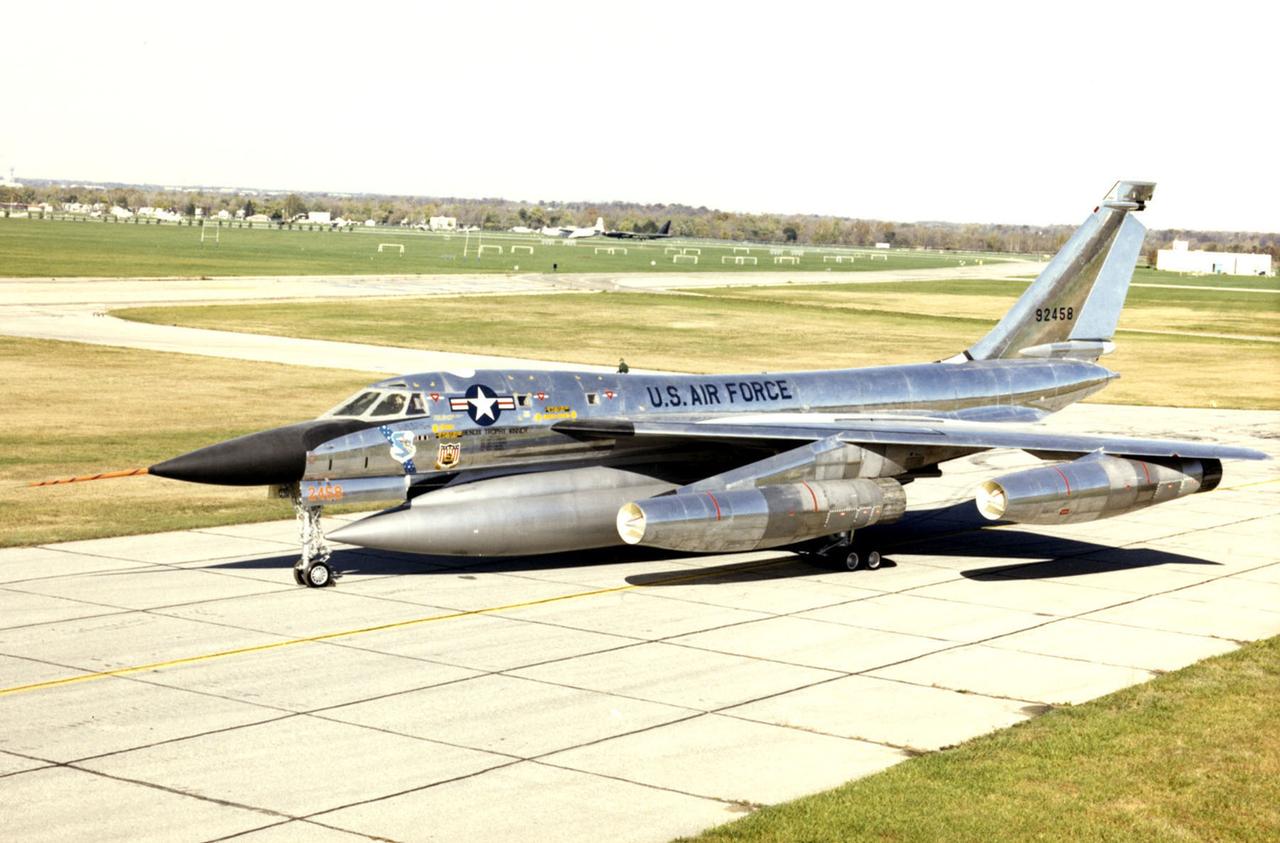
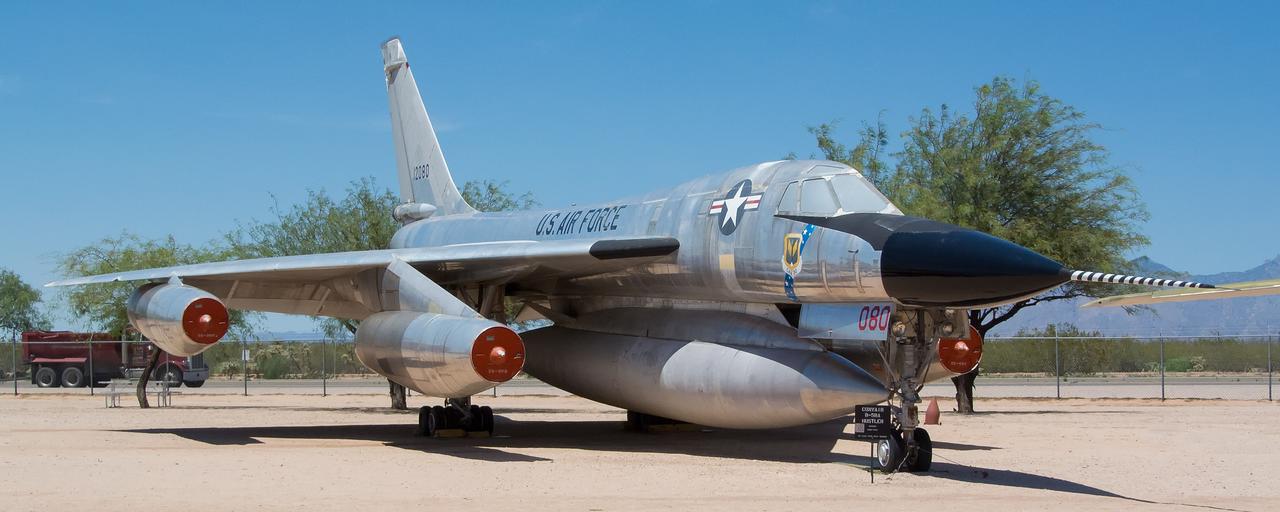
Convair B-58 Hustler is the world’s first operational supersonic jet bomber to serve in the United States Air Force (USAF) during the Cold War. Designed by Convair for strategic nuclear deterrence, this aircraft is regarded as a milestone in aerospace engineering due to its delta wing configuration and ability to fly at twice the speed of sound (Mach 2) at high altitude. Unlike traditional bombers, the B-58 was equipped with an external munitions and fuel pod system to maximize aerodynamic efficiency and held numerous speed and altitude records throughout its service life.
Convair B-58 Hustler (Mark Mauno)
The development of the Convair B-58 Hustler stemmed from the United States Air Force’s (USAF) need in the late 1940s for a long-range bomber capable of supersonic flight. Initiated under the technical requirements known as “GEBO II,” the project was undertaken by Convair with a radical design philosophy. The aircraft’s aerodynamic shape was formulated according to the “Area Rule” principle, discovered by aerospace engineer Richard Whitcomb, which significantly reduced drag during transonic and supersonic flight. As per this principle, the fuselage narrowed at the wing junctions, giving the aircraft a shape reminiscent of a “coke bottle.”
The most distinctive structural feature of the aircraft is its wide delta wing with a 60-degree sweep angle. To withstand the frictional heat generated at high speeds, the wing structure employed “honeycomb” sandwich panels made of stainless steel and aluminum. This technology ensured the aircraft was both lightweight and structurally extremely rigid. The traditional internal bomb bay, which would have increased the fuselage cross-sectional area and drag, was eliminated. Instead, a large external pod system known as the “MB-1” was adopted to carry both nuclear ordnance and additional fuel beneath the fuselage.
In terms of engine placement, the B-58 was designed to carry four General Electric J79 turbojet engines mounted in underwing pods. These engines were among the first powerful afterburning jet engines capable of propelling the aircraft beyond Mach 2. During development, it was determined that standard ejection seats were inadequate for crew escape at Mach 2 speeds, leading to the development of individual enclosed “escape capsules” for each crew member. Due to technical challenges and high costs encountered during the project, production was meticulously managed; the first prototype, the XB-58, made its maiden flight on 11 November 1956【1】.
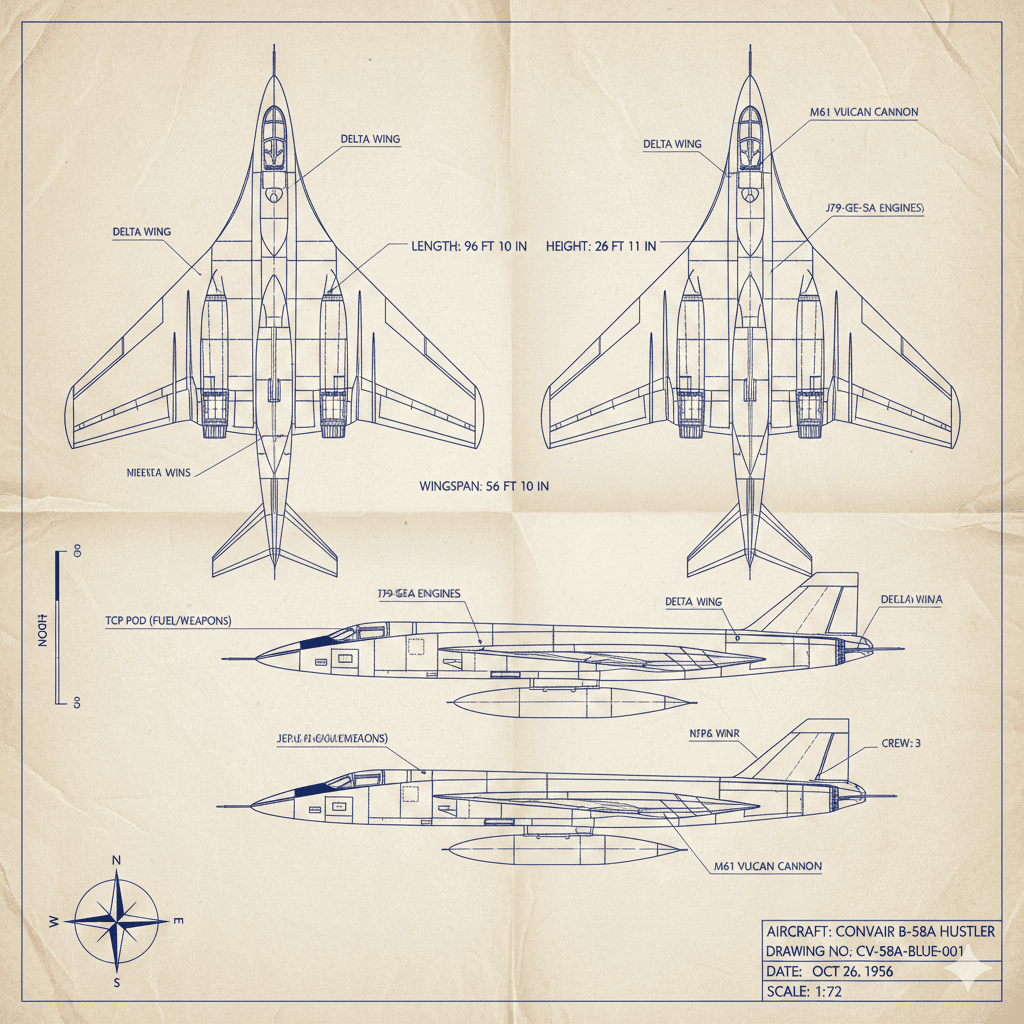
Convair B-58 Hustler Technical drawing (generated by artificial intelligence)
Unlike traditional bombers, the Convair B-58 Hustler was designed as a platform focused on speed rather than defensive armament. Its sole defensive weapon was a 20 mm M61 Vulcan rotary cannon mounted in the tail, remotely aimed and fired by the Defense Systems Operator (DSO), who occupied the rearmost of the aircraft’s three-man crew. The cannon was controlled via the AN/ASG-15 fire-control radar housed inside the fuselage. In terms of electronic warfare capabilities, the B-58 was equipped with the AN/ALQ-16 jamming system, among the most advanced of its era, designed to disrupt enemy radar and break missile locks【2】.
The Hustler’s primary offensive capability resided in the external pods carried beneath the fuselage: the “MB-1” or later the “TCP” (Two-Component Pod). These pods enabled the aircraft to carry nuclear ordnance at high altitude without compromising its aerodynamic profile. The TCP system consisted of two components: the upper section typically carried fuel, while the lower section housed the nuclear warhead. During missions, the warhead in the lower section was released first, followed by jettisoning the empty fuel tank (upper section), which was no longer needed for the return flight. This modular design reduced the aircraft’s weight after weapon release, enabling a faster return to base.
Despite its short operational lifespan, the Convair B-58 Hustler had several variants and proposed but unimplemented derivatives adapted from its basic design for different mission profiles. While the majority of the 116 produced aircraft were standard operational models, specific versions developed during the technical evolution expanded the aircraft’s capabilities.
XB-58: This variant represented the prototype phase of the program, with only two units built. The first prototype flew on 11 November 1956 and was used to test the aircraft’s fundamental aerodynamic characteristics, particularly the performance of the “Area Rule” and delta wing configuration at supersonic speeds.
B-58A: The main production and standard operational model of the Hustler series. A total of 86 units were produced, and these served in the Strategic Air Command (SAC) inventory to fulfill nuclear deterrence missions. Unlike earlier test models, the B-58A was equipped with the more advanced AN/ASQ-42 navigation and bombing system.
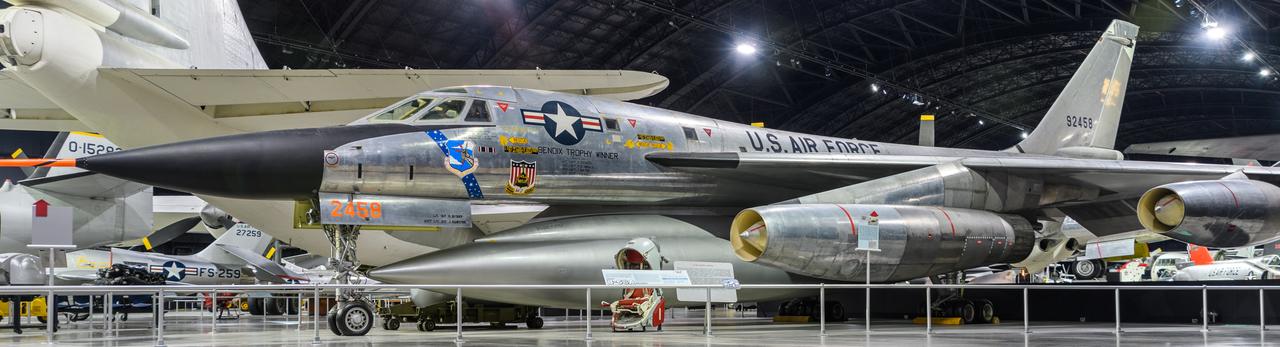
Convair B-58A Hustler (Peter Miller)
TB-58A: An instructional variant created by modifying eight B-58A aircraft. Specifically designed to train pilots due to the aircraft’s challenging flight characteristics at Mach 2 speeds and during takeoff and landing, this model featured an additional instructor cockpit immediately behind the front pilot’s seat and added windows in the fuselage to improve external visibility for the trainee.
NB-58A: This variant was a specially modified test platform used to evaluate the YJ93 jet engine developed by General Electric. The YJ93 engine, designed for the XB-70 Valkyrie project, was mounted in the B-58’s external pod section and subjected to high-speed in-flight tests.
B-58B and B-58C (Cancelled Projects): Convair proposed more advanced versions to address the aircraft’s range and performance limitations. The B-58B model envisioned an elongated fuselage and the use of more powerful J79-GE-9 engines. The B-58C, known as the “Super Hustler,” was planned to be powered by four J58 engines (the same engines used in the SR-71) and achieve Mach 3 speeds. However, both projects remained on paper due to high costs and the rising prominence of intercontinental ballistic missiles (ICBMs).
The Convair B-58 Hustler officially entered service with the Strategic Air Command (SAC) on 15 March 1960 and served throughout its operational life as the fastest component of the nuclear deterrent force. Upon entering service, a series of record-setting flights were conducted to demonstrate the aircraft’s exceptional high-altitude speed capabilities. Between 1961 and 1962, the B-58 broke 19 international speed and altitude records, including the Bleriot and Harmon trophies. The most notable achievement was a flight on 26 May 1961, during which the aircraft flew from New York to Paris in 3 hours 19 minutes and 58 seconds, achieving an average speed of 1,752 kilometers per hour and establishing a new standard for transatlantic flight【3】.
The B-58’s operational capabilities were supported by its integrated AN/ASQ-42 bombing and navigation system, which employed Doppler radar principles to analyze ground radar echoes—an advanced technology for its time that enabled high accuracy even while flying at Mach 2. However, the aircraft’s narrow fuselage and high fuel consumption limited its range, making in-flight refueling mandatory for operational continuity. From the mid-1960s onward, advances in Soviet surface-to-air missile (SAM) technology rendered high-altitude aircraft like the B-58 increasingly vulnerable. This forced a shift in mission profiles toward low-altitude penetration flights, but the delta wing design proved unsuitable for the intense aerodynamic pressures and turbulence at low altitudes, leading to structural fatigue issues.
Convair B-58 Hustler (US Military Power)
Maintenance of the B-58 fleet reached extremely high costs due to its complex subsystems and specialized fuel requirements. By 1970, its operating costs were significantly higher than those of the B-52 fleet, and its limited conventional bombing capacity further diminished its utility. As a result, the decision was made to retire the aircraft. The last B-58 was removed from service on 16 January 1970, replaced by the more modern General Dynamics FB-111A with advanced avionics and variable-sweep wings. Of the 116 B-58s produced, several are now on display in various aviation museums across the United States【4】.
The B-58 contributed significant innovations to aviation not only in speed but also in materials science and design discipline. The production of heat-resistant honeycomb panels used in its fuselage helped pioneer the widespread adoption of composite and sandwich structures in the aerospace industry. However, this advanced technology made maintenance extremely difficult. For example, chronic fuel leaks became a persistent problem, and accessing the complex internal fuel tank system within the delta wing became one of the most challenging procedures for ground crews.
The aircraft’s legacy is measured not only by its physical structure but also by the doctrinal changes it inspired. The B-58’s Mach 2 performance provided critical data for civil supersonic transport (SST) projects such as the Concorde and Boeing 2707. NASA used the B-58 in programs such as “Project Little Guy” to measure the effects of sonic booms on civilian populations. Today, aerodynamic data derived from the B-58 project remains a fundamental reference point in the development of stability and control systems for supersonic aircraft.
Castle Air Museum. "Convair B-58 Hustler #55-0666." Accessed February 23, 2026. https://castleairmuseum.org/collections/convair-b-58-hustler/
Collection, Gary Danvers. "B-58 Convair Hustler." December 7, 2015. Flickr, https://www.flickr.com/photos/gcdnz/23997123155/.
Flank, Lenny. "Convair B-58." September 14, 2014. Flickr, https://www.flickr.com/photos/lennyflank/15217884146/.
Miller, Peter. "Convair B-58A Hustler." May 24, 2019. Flickr, https://www.flickr.com/photos/pmillera4/51667317162/.
National Museum of the United States Air Force. "Convair B-58A Hustler." Accessed February 23, 2025. https://www.nationalmuseum.af.mil/Visit/Museum-Exhibits/Fact-Sheets/Display/Article/196439/convair-b-58a-hustler/
Orr, Christian. “The B-58 Hustler Supersonic Bomber Was a Failure (That Set 19 World Records).” National Security Journal, July 27, 2025. Accessed February 23, 2026. https://nationalsecurityjournal.org/the-b-58-hustler-supersonic-bomber-was-a-failure-that-set-19-world-records/
Polhemus, Capt. William L., "THE B-58 AS A COMPETITOR IN SAC'S BOMBING-NAVIGATION CONTEST," *NAVIGATION: Journal of The Institute of Navigation*, Vol. 8, No. 1, Spring 1961, pp. 40–47. https://www.ion.org/publications/abstract.cfm?articleID=101556
Polhemus, William L. “Navigating the Supersonic B-58.” *Journal of Navigation* 13, no. 4 (1960): 406–18. https://www.cambridge.org/core/journals/journal-of-navigation/article/abs/navigating-the-supersonic-b58/E85AD5058B0EDB1FD210488719C76373
US Military Power. "The B-58 Hustler: The Fastest Bomber Ever Built." YouTube. Accessed February 23, 2026. https://youtu.be/BNF9-4f6My8?si=KdVxy_IOQM7eHfSN
mark6mauno. "Convair B-58 Hustler." July 29, 2013. Flickr, https://www.flickr.com/photos/mark6mauno/9455261326/.
[1]
National Museum of the United States Air Force. "Convair B-58A Hustler." Access date: 23 February 2025. https://www.nationalmuseum.af.mil/Visit/Museum-Exhibits/Fact-Sheets/Display/Article/196439/convair-b-58a-hustler/.
[2]
National Museum of the United States Air Force. "Convair B-58A Hustler." Access date: 23 February 2025. https://www.nationalmuseum.af.mil/Visit/Museum-Exhibits/Fact-Sheets/Display/Article/196439/convair-b-58a-hustler/.
[3]
Castle Air Museum. "Convair B-58 Hustler #55-0666." Access date: 23 February 2026. https://castleairmuseum.org/collections/convair-b-58-hustler/.
[4]
Orr, Christian. “The B-58 Hustler Supersonic Bomber Was a Failure (That Set 19 World Records).” National Security Journal, 27 July 2025. Access date: 23 February 2026.https://nationalsecurityjournal.org/the-b-58-hustler-supersonic-bomber-was-a-failure-that-set-19-world-records/.


Entry into Service | 15 March 1960 | ||||||||
|---|---|---|---|---|---|---|---|---|---|
Length(s) | 29.50 metres (96 ft 10 in) | ||||||||
Height(s) | 8.90 metres (29 ft 11 in) | ||||||||
Type(s) | Strategic Supersonic Bomber Aircraft | ||||||||
Producer(s) | Convair (General Dynamics) | ||||||||
First Flight(s) | 11 November 1956 | ||||||||
Maximum Speed | 2124 km/h (Mach 2.0) | ||||||||
Engine Type | 4 × General Electric J79-GE-5A turbojet | ||||||||
Maximum Takeoff Weight | 73,900 kg | ||||||||
Wingspan | 17.30 metres (56 ft 10 in) | ||||||||
Crew | 3 (Pilot-Bomber-Navigator-Defense Systems Operator) | ||||||||
Unit Cost | 12.44 million US dollars (1960 data) | ||||||||
Primary User | United States Air Force (USAF) | ||||||||
Retirement | 16 January 1970 | ||||||||
No Discussion Added Yet
Start discussion for "Convair B-58 Hustler" article
Design and Development
Defensive Systems and Armament
Variants and Modifications
Operational History and Records
Legacy and Technical Challenges in Aviation History