This article was automatically translated from the original Turkish version.
+1 More
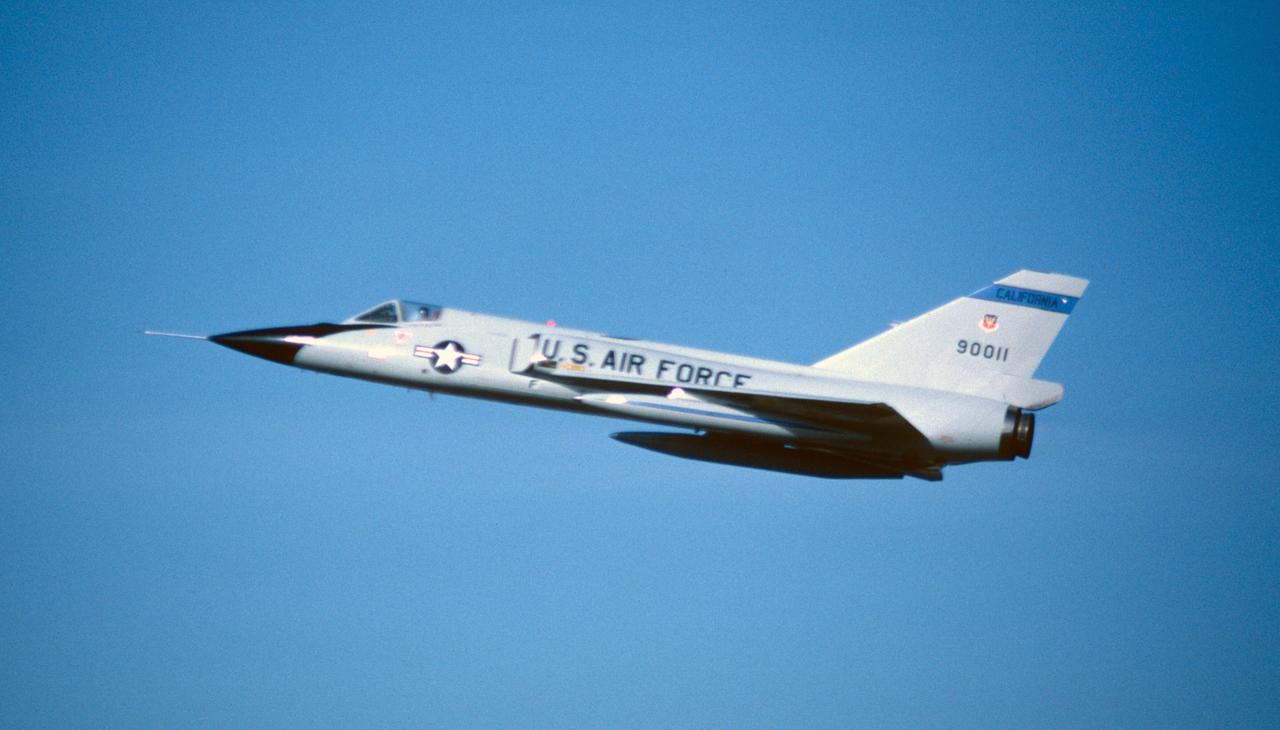
The Convair F-106 Delta Dart is one of the most advanced and capable pure interception aircraft to have served in the inventory of the United States Air Force (USAF). Developed in the mid-1950s as a comprehensive upgrade of the F-102 Delta Dagger, the aircraft was initially designated F-102B but received a new model number due to the radical nature of the structural and technological changes made. Designated the “Ultimate Interceptor,” the F-106 was specifically engineered during the Cold War to detect and destroy Soviet strategic bomber aircraft before they could enter American airspace.
The F-106 is regarded as a successful application of the Area Rule in aerodynamic design. The narrowing of the fuselage in its midsection, forming an hourglass shape, minimized wave drag during supersonic flight, enabling the aircraft to exceed Mach 2.0. Its endurance of the single-engine jet speed record—2,455 kilometers per hour (1,525 mph)—set in 1959 for many years stands as tangible proof of its aerodynamic efficiency.【1】
The F-106 was equipped with the Hughes MA-1 fire control system. This system operated in integration with the ground-based SAGE (Semi-Automatic Ground Environment) air defense network, enabling automated guidance of the aircraft from takeoff to target interception, trajectory calculation, and even weapons firing without pilot intervention. Designed as a pure interceptor, the Delta Dart remained in service until the late 1980s, playing a critical role in safeguarding American airspace.
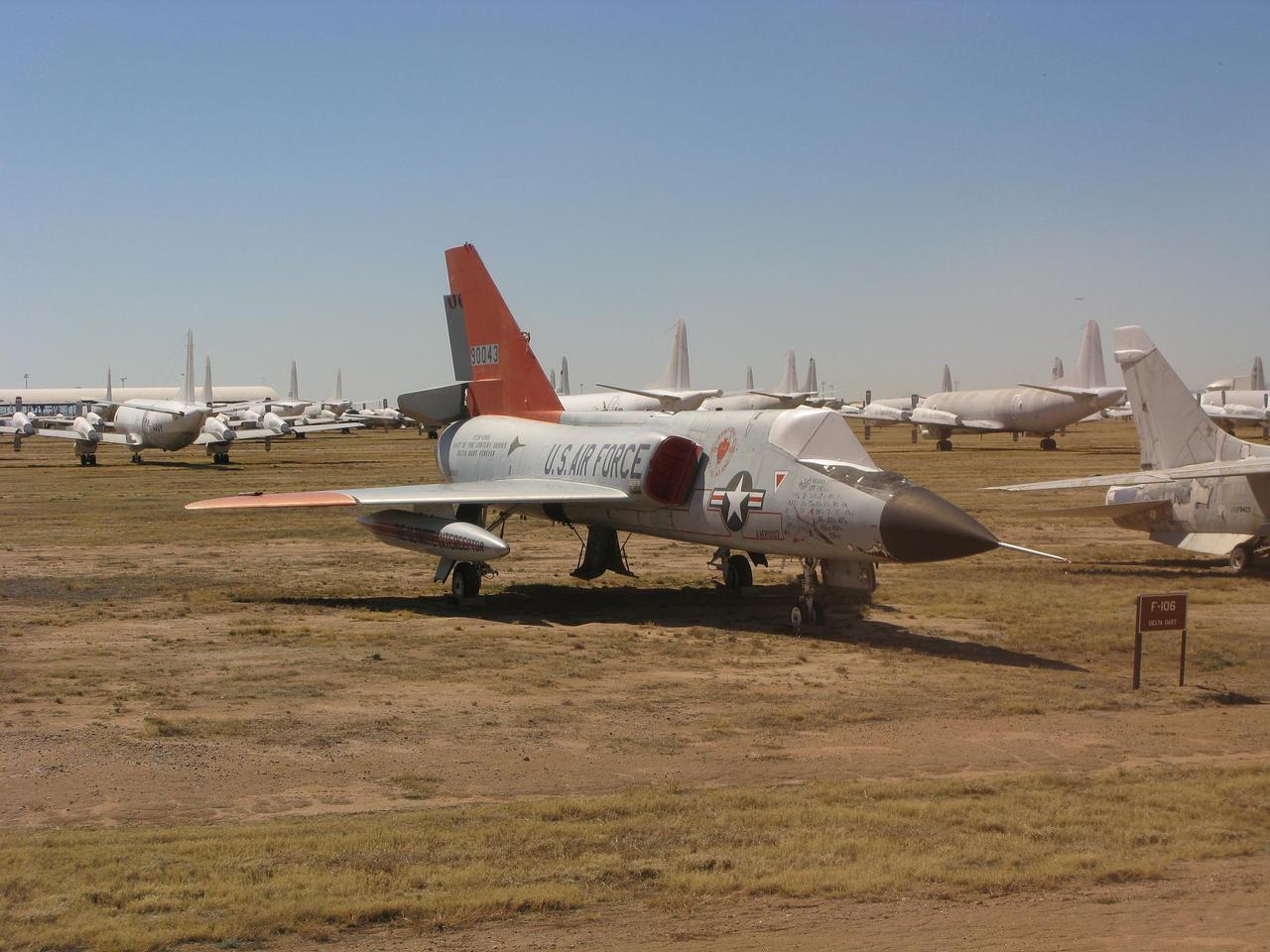
Convair F-106 Delta Dart (Will Prescott)
The design and development of the Convair F-106 Delta Dart emerged in response to the advanced air defense requirements articulated by the United States Air Force in the 1950s. This process was initiated with the goal of developing an effective interception platform capable of operating at high altitudes and supersonic speeds against Soviet strategic bombers. The F-106 originated from an extensive improvement program launched after the earlier F-102 Delta Dagger was deemed performance inadequate. The new design developed by Convair was initially designated F-102B, but due to extensive aerodynamic and systemic modifications, it was reclassified as an entirely new aircraft and given the designation F-106.【2】
During development, the fuselage design was specifically shaped to conform to the Area Rule principle to enhance supersonic performance. This approach reduced drag and enabled the aircraft to achieve speeds up to Mach 2. The delta wing configuration was retained, but the integration between wing and fuselage was reconfigured. A more powerful turbojet engine was installed to increase thrust and improve high-altitude performance. Aerodynamic testing, wind tunnel trials, and prototype flights refined the design’s stability and control capability at high speeds.
In the development of the F-106, not only aerodynamics but also avionics played a decisive role. The aircraft was equipped with the Hughes MA-1 fire control system, the most advanced automatic interception system of its era. This system enabled integration with the ground-based SAGE air defense network. Thanks to this integration, the F-106 was designed to receive target data from ground control centers and carry out semi-automatic or fully automatic interception missions. This transformed the F-106 from merely a fighter aircraft into a component of an integrated defense system.【3】
The first prototype flight took place in 1956, but the development process encountered various technical issues related to the engine and avionics systems. Resolving these problems and maturing the systems took several years, and the aircraft finally reached operational status in 1959. Despite these delays, the F-106 served for many years after entering service as one of the USAF’s most advanced interception aircraft.
The Convair F-106 Delta Dart was designed with a focus on aerodynamic efficiency and high-speed performance, shaping its fuselage and wing structure accordingly. The aircraft measures approximately 21.56 meters in length, 11.67 meters in wingspan, and 6.18 meters in height. The delta wing planform was chosen to provide low drag and high stability at supersonic speeds. A smooth transition was created between the wing roots and fuselage, achieving a body geometry compliant with the Area Rule. With an empty weight of approximately 10,800 kilograms, the aircraft’s maximum takeoff weight is around 17,300 kilograms. The single-pilot cockpit features a pressurized cabin and an advanced design providing excellent visibility.【4】
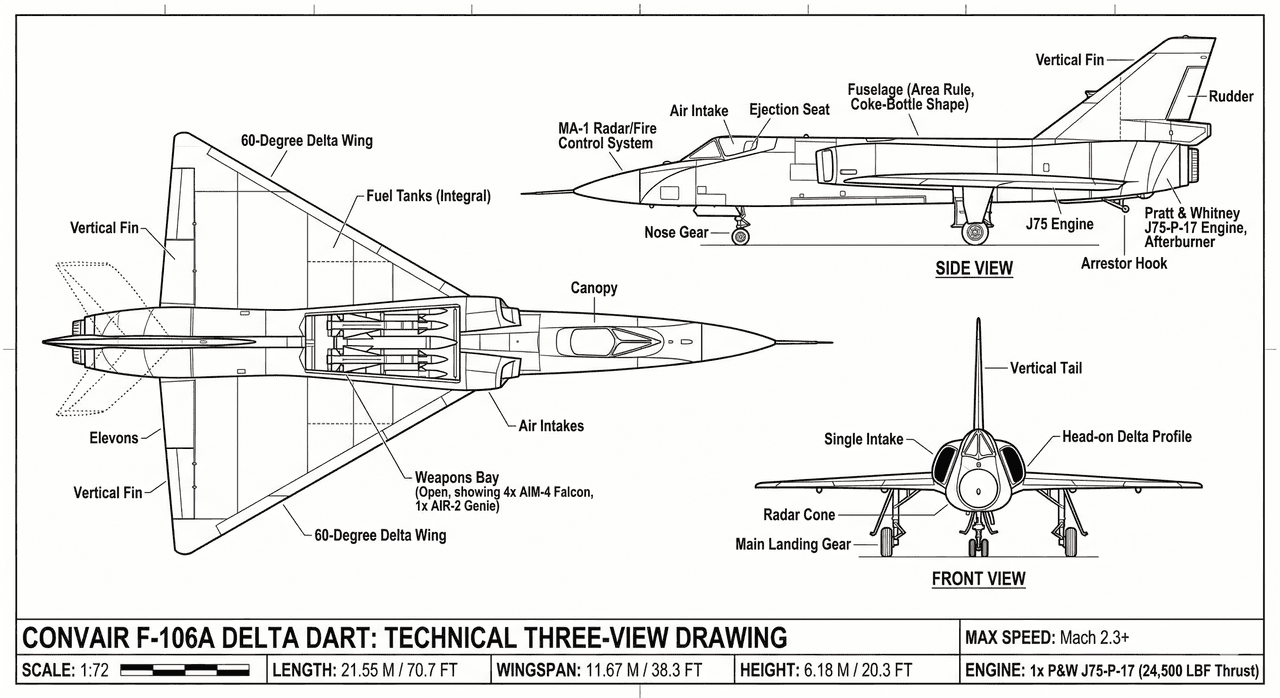
Convair F-106 Delta Dart Technical Drawing (Generated by Artificial Intelligence)
The F-106’s propulsion system is based on the Pratt & Whitney J75-P-17 turbojet engine. This engine generates approximately 24,500 lbf (about 109 kN) of thrust in afterburner mode, enabling the aircraft to reach Mach 2.3. Its maximum speed is approximately 2,450 km/h. The aircraft’s service ceiling is around 16,700 meters, and its rate of climb can reach approximately 14,000 meters per minute. These performance characteristics are critical for high-altitude rapid interception missions.【5】
The fuel system consists of internal tanks integrated into the fuselage, providing a fuel capacity of nearly 7,000 liters. External fuel tanks could be added to extend range. The operational range reaches approximately 2,900 kilometers, though this varies depending on mission profile. The aircraft’s fuel consumption characteristics are optimized to support long-duration high-speed flight.
In terms of armament, the F-106 is equipped with an internal weapons bay located within the fuselage. This bay typically carried four AIM-4 Falcon guided air-to-air missiles. Additionally, integration of the AIR-2 Genie nuclear-tipped rocket was achieved, a system developed specifically for engaging large formations of strategic bombers. The internal weapons carriage eliminated aerodynamic drag from external stores, preserving the aircraft’s high-speed performance.【6】
In avionics, the F-106 offered an advanced level of integration for its time. The Hughes MA-1 fire control system unified radar, data link, and automatic targeting components into a single integrated architecture. This system enabled the aircraft to operate in conjunction with the SAGE air defense network, allowing semi-automatic or fully automatic interception missions based on data received from ground control centers. The radar system was designed to detect targets at long range and high altitude.【7】
The landing gear is a tricycle configuration, reinforced to support high-speed takeoff and landing operations. The aircraft also features speed brakes and aerodynamic surfaces to enhance control during landing. The flight control system is designed to maintain stability at high speeds and is equipped with hydraulic systems to assist pilot inputs.
Powered by the Pratt & Whitney J75-P-17 turbojet engine, the aircraft can reach a maximum speed exceeding Mach 2, approximately Mach 2.3 (about 2,450 km/h). This speed capability was decisive for interception missions requiring rapid target acquisition. The aircraft’s service ceiling is approximately 16,700 meters, and it remains effective at this altitude.【8】
Convair F-106 Delta Dart Flight Video (jaglavaksoldier)
The F-106’s climb performance is a critical feature for air defense missions. With a climb rate reaching approximately 14,000 meters per minute, the aircraft could rapidly ascend to high altitudes during alert conditions. This capability provided rapid response against high-altitude bombers. The aircraft’s acceleration profile, enhanced by afterburner use, was optimized for swift transition into supersonic speeds.【9】
The aerodynamic structure directly influenced flight capabilities. The delta wing design provided stability at high speeds but imposed limitations in maneuverability at low speeds. Consequently, the F-106 was not designed as a traditional dogfighting fighter but as a platform optimized for high-speed, high-altitude linear interception missions. Nevertheless, control surface effectiveness was maintained at high speeds, ensuring flight stability.
The flight control system was designed with hydraulic assistance to ensure stable control under high-speed and high-altitude conditions. Additionally, automated flight control systems and ground-based guidance support reduced pilot workload. These systems played a vital role in directing the aircraft toward targets and establishing optimal engagement geometry, particularly within the SAGE air defense network integration.
The F-106’s takeoff and landing performance presents unique requirements due to its high-speed characteristics. The delta wing design limits lift generation at low speeds, resulting in relatively high landing speeds. This necessitated long runways. Speed brakes and a parachute system were incorporated to reduce landing distance and ensure safe touchdown.
Operationally, the F-106 focused on rapid launch, rapid climb, and swift target acquisition rather than prolonged patrol missions. In this context, the aircraft was deployed in accordance with the Continental Air Defense Doctrine of the Cold War, positioned to respond quickly during alert conditions.
The avionics systems of the Convair F-106 Delta Dart were developed as an integrated architecture to support its primary mission: high-altitude interception. At the core of these systems is the Hughes MA-1 fire control system. The MA-1 system unified radar, computer, data link, and weapons control components into a single system, automating target detection, tracking, and engagement. This architecture, given the technological constraints of the era, is regarded as an advanced example of integration combining analog and early digital computing elements.
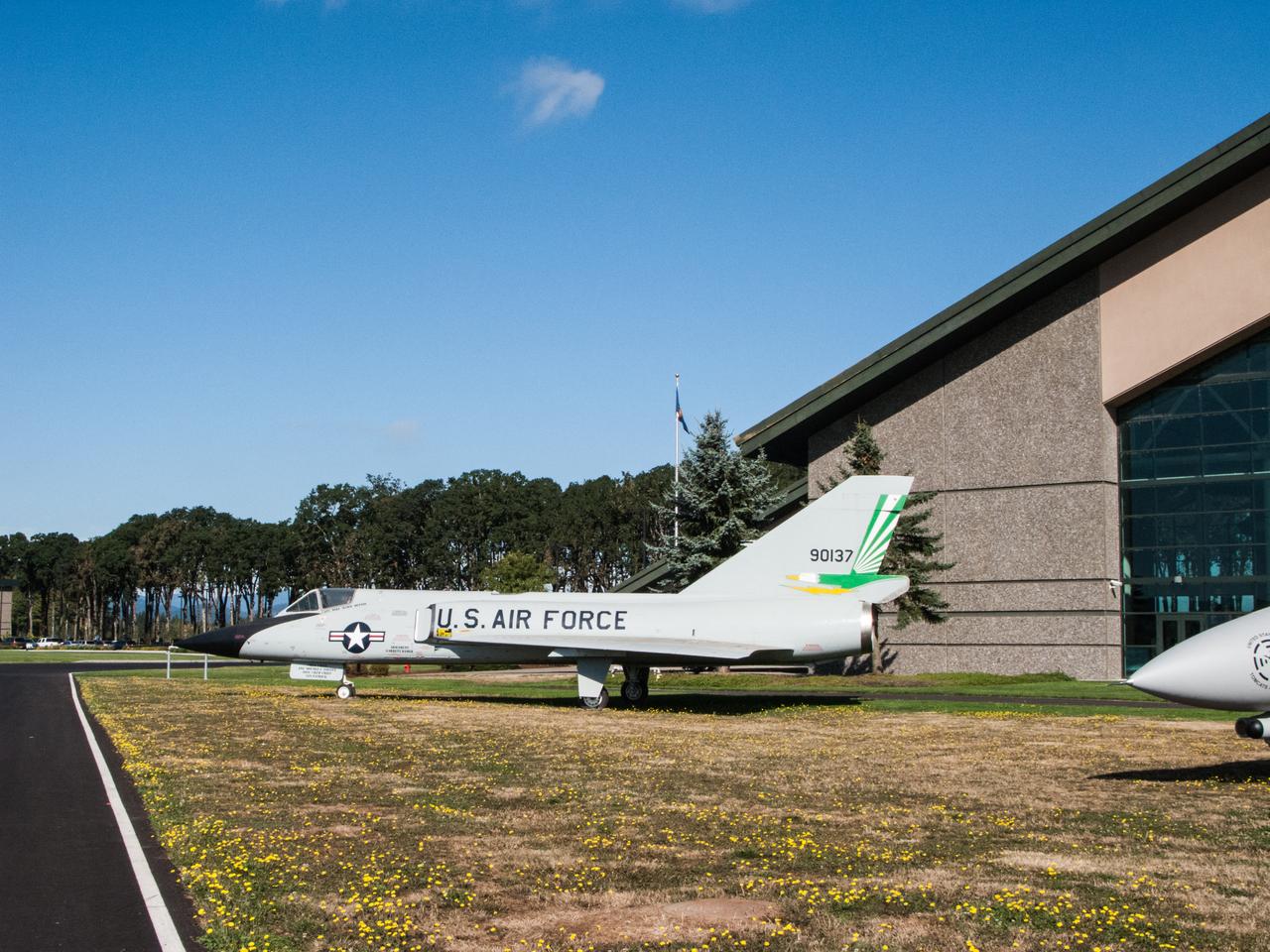
F-106 Delta Dart (Cindy MC)
The aircraft’s radar system, mounted in the nose, was designed to detect targets at long range and high altitude. It was optimized to identify strategic bombers with large radar cross-sections at early stages. Radar data was processed directly by the MA-1 system, which calculated target position, velocity, and approach parameters to determine an optimal interception solution. During this process, the pilot followed system-provided guidance to execute engagement.【10】
A defining feature of the F-106’s avionics architecture was its data link with the SAGE (Semi-Automatic Ground Environment) air defense network. Through this integration, the aircraft could receive target information directly from ground-based radar stations and be automatically vectored accordingly. The SAGE system provided critical data such as target location, velocity vector, and intercept point, centralizing the interception process under unified command. This structure transformed the F-106 from an independent platform into a component of a comprehensive defense network.
The MA-1 fire control system was designed to deliver automatic interception capability. Under suitable conditions, it could largely automate target vectoring, altitude and speed adjustments, and weapons preparation for engagement. The pilot followed system-recommended solutions and could assume manual control when necessary. This semi-automatic structure reduced pilot workload and shortened reaction time.
The avionics systems also supported flight control and navigation. Onboard inertial navigation systems, radio navigation equipment, and autopilot systems ensured safe navigation and stable flight during long-range missions and adverse weather conditions. These systems played a vital role in precise control and positioning during high-speed, high-altitude operations.
The F-106’s avionics infrastructure is regarded as a reflection of the integrated air defense concepts developed during the Cold War. The coordinated operation of radar, data links, and fire control systems enhanced the aircraft’s mission effectiveness and secured its prominent position within the air defense doctrines of the era.
The armament systems of the Convair F-106 Delta Dart were designed to suit high-speed, high-altitude interception missions and were integrated internally into the fuselage to preserve aerodynamic efficiency. The aircraft features an internal weapons bay located beneath the fuselage, which eliminated the drag caused by external stores and preserved supersonic performance. The bay opened during mission execution to release munitions and closed afterward to restore aerodynamic integrity.
The F-106’s primary air-to-air armament consisted of AIM-4 Falcon guided missiles. These missiles were available in both semi-active radar-guided and infrared-guided variants, offering flexibility against different target profiles. The aircraft was designed to carry four Falcon missiles in standard configuration. This munition was optimized for engagement of high-altitude bombers and operated in conjunction with the MA-1 fire control system for target guidance.
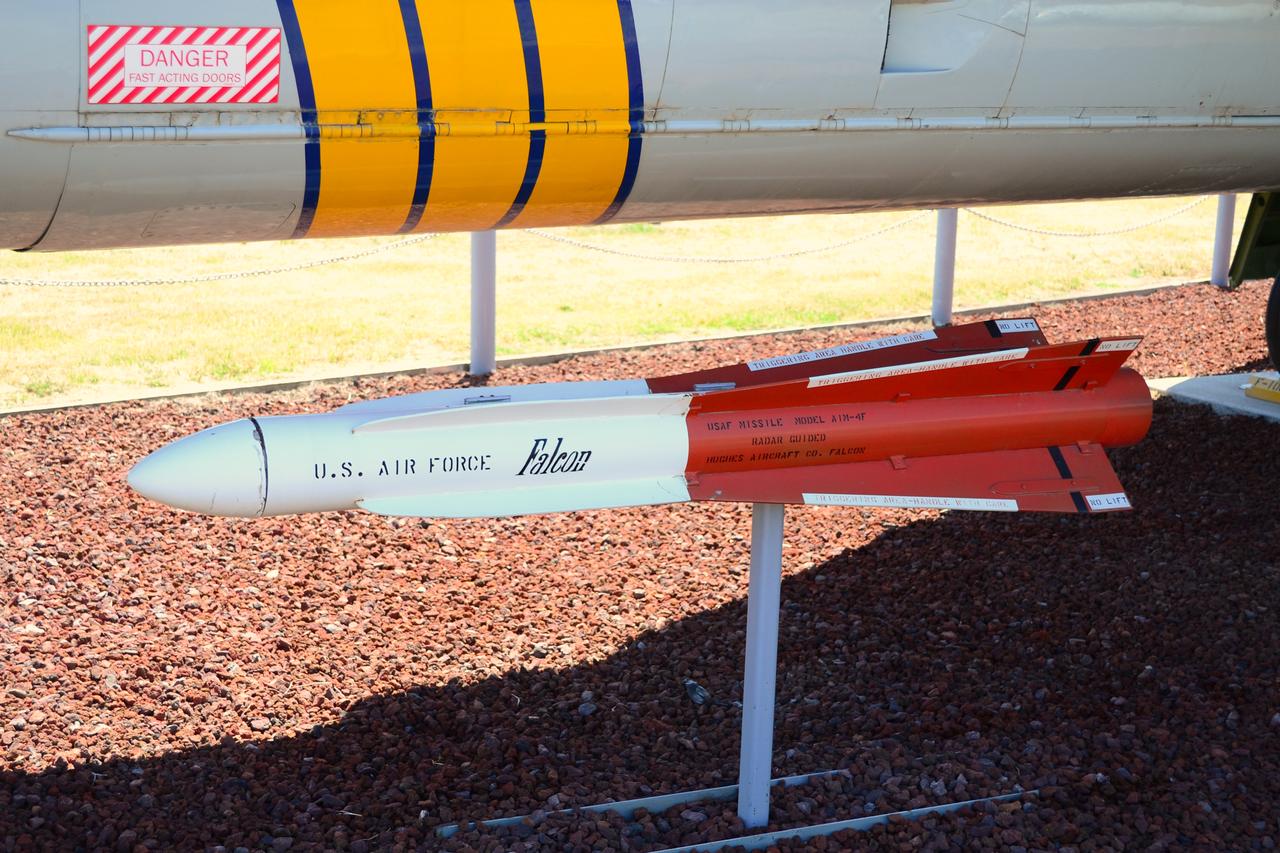
Hughes AIM-4F Guided Missile (Ian Abbott)
Additionally, the F-106 was capable of carrying the AIR-2 Genie (MB-1) nuclear-tipped air-to-air rocket. This rocket was developed to neutralize multiple targets simultaneously through a wide-area blast effect. The Genie was specifically designed for use against dense bomber formations and provided rapid engagement capability against high-speed approaching targets. This weapon system was regarded as part of the strategic air defense concept of the era.【11】
The F-106 does not feature a conventional internal cannon. This reflects the aircraft’s design focus entirely on missile-based interception missions. Although some later F-106s were modified to carry an M61 Vulcan cannon in an external pod, this configuration was never part of the standard setup. This choice underscores the aircraft’s primary mission profile as a long-range interceptor rather than a close-range air combat platform.
Operationally, the F-106 was equipped with an advanced fire control and targeting infrastructure directly integrated with its armament systems. The Hughes MA-1 system processed radar data to determine optimal firing solutions and ensured weapons were employed at the correct time and parameters. Additionally, the aircraft was designed to support automatic interception mode, guiding the aircraft toward the target, establishing the appropriate engagement range, and managing munition deployment.
The F-106’s operational equipment extended beyond armament to include support systems necessary for high-speed missions. Speed brakes, a landing parachute, and advanced flight control surfaces supported safe post-mission landings. Furthermore, to enable pilot survival during high-altitude and high-speed operations, the aircraft incorporated a pressurized cockpit, oxygen system, and ejection seat. These systems were integral components of the design, enhancing operational safety.
The Convair F-106 Delta Dart entered service with the United States Air Force (USAF) in 1959 and began active duty. The aircraft was primarily deployed to secure the air defense of North America and assumed a strategically vital role during the Cold War. Under the USAF’s continental air defense doctrine, the F-106 served in continuous alert interceptor squadrons, ready to respond rapidly to potential Soviet bomber threats. In this role, aircraft were scrambled on short notice and vectored toward designated targets.
The operational use of the F-106 was conducted within the framework of integration with the SAGE (Semi-Automatic Ground Environment) air defense network. Aircraft received radar data from ground control centers and executed interception missions under centralized command. Through this system, the F-106 operated not as an independent fighter but as a component of an integrated defense system. During operations, pilots followed system-provided guidance and engagement data to fulfill their missions.
Throughout the 1960s and 1970s, the F-106 served as the USAF’s primary interceptor. During this period, aircraft were stationed primarily over the continental United States and played an active role in safeguarding national airspace. Although the F-106 never saw direct combat, it conducted intensive operational activity under deterrence and continuous alert missions. As more modern platforms entered service, the F-106’s active role gradually diminished.【12】
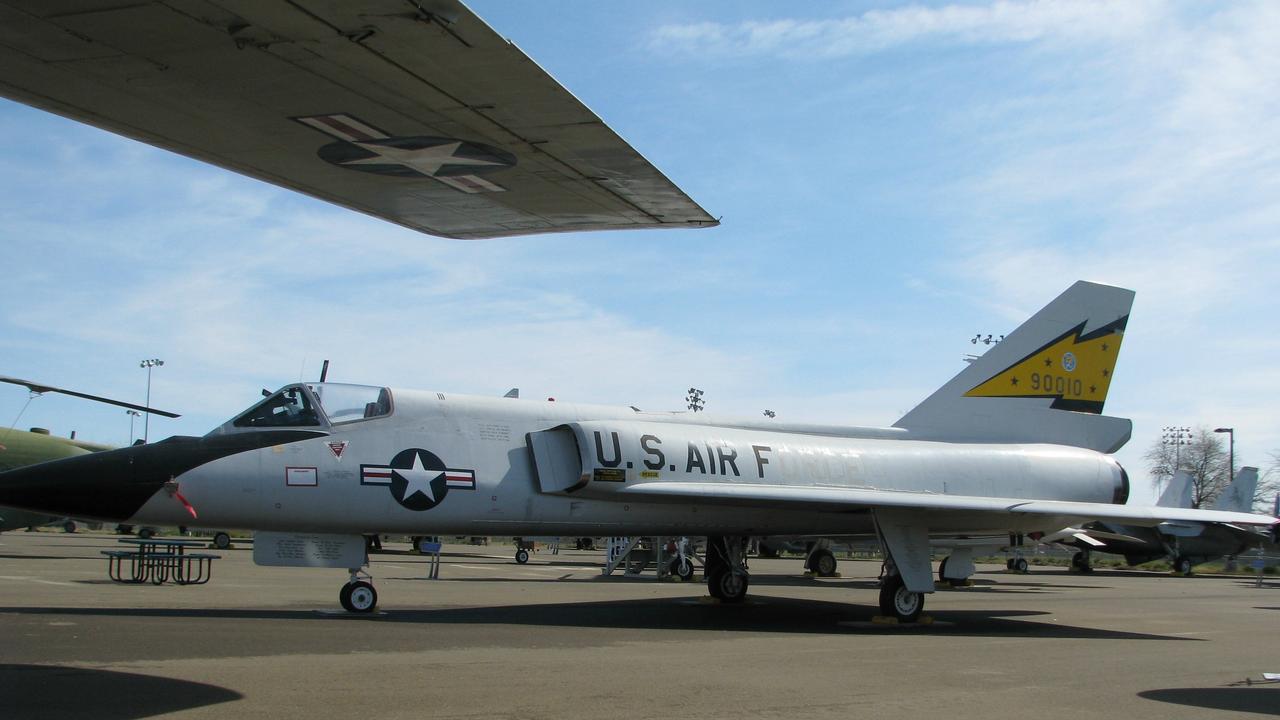
F-106A Delta Dart (Jack Snell)
From the late 1970s, F-106 aircraft were transferred to the Air National Guard for secondary defense duties. In this phase, they continued air defense missions but gradually yielded their roles to newer-generation aircraft. By the mid-1980s, the majority of F-106s had been withdrawn from active service, ending their operational use.
After retirement, some F-106 aircraft were converted into unmanned target drones designated QF-106. These aircraft were used as target platforms for testing air defense systems and missiles. This conversion demonstrates that the aircraft continued to serve in testing and development activities even after the end of its operational life.
Throughout its service life, the F-106 Delta Dart held a significant place in the United States’ air defense strategy and is regarded as one of the key platforms developed for high-altitude interception during the Cold War.
The Convair F-106 Delta Dart was primarily developed around a single main production variant, but various sub-variants and modifications were introduced to meet training, testing, and modernization needs. These variants emerged to ensure the aircraft’s adaptability to operational requirements and to maintain its effectiveness throughout its service life.
The F-106A was the primary production and operational variant. Designed as a single-seat aircraft, it was actively used by the USAF in air defense missions. All core performance, avionics, and armament systems were standardized on this variant. The F-106A operated with the MA-1 fire control system and SAGE integration and served as one of the USAF’s principal interception platforms throughout the Cold War.
The F-106B was a two-seat variant developed for training purposes. Its cockpit was extended to accommodate both an instructor and a student pilot. While the F-106B retained largely the same systems as the operational F-106A, it included specific avionics and equipment adjustments suited for training missions. This variant was used to prepare pilots for high-speed, high-altitude interception duties.
Throughout its service life, F-106 aircraft underwent various modernization programs. One notable modification was the “Six Shooter” upgrade, which integrated an M61 Vulcan cannon in an external pod to enhance close-range engagement capability. However, this system was not adopted as standard across all aircraft and was implemented on only a limited number of platforms.
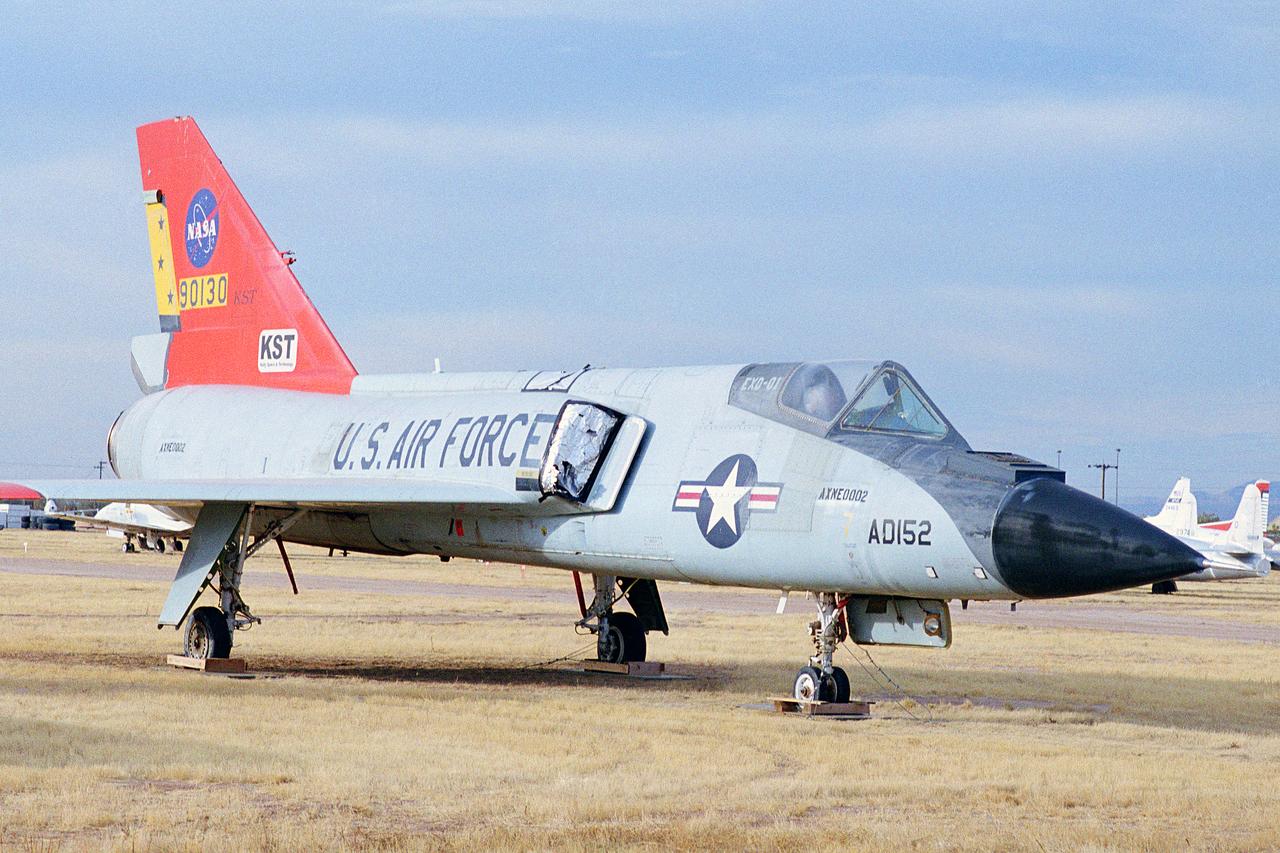
QF-106 Variant (Ian Abbott)
After retirement, the QF-106 variant was developed for use as an unmanned target drone. In this conversion, aircraft were modified to be remotely controlled and employed as target platforms for air defense systems and missile testing. The QF-106 program ensured that the F-106 continued to contribute to testing and development activities beyond its operational lifespan.【13】
These variants and modernization efforts demonstrate that the F-106’s fundamental design retained its relevance for many years and provided a flexible platform capable of adapting to diverse operational needs.
The Convair F-106 Delta Dart holds a significant place in aviation history, particularly within the air defense doctrines of the Cold War era. The aircraft, with its emphasis on high speed, high altitude, and automation, was regarded as a response to the strategic needs of its time. The F-106 is recognized not only for its aerodynamic performance but also for its integrated avionics and ability to operate in conjunction with ground control networks, making it one of the earliest examples of modern network-centric warfare. These features led to its perception not merely as a combat aircraft but as a component of a comprehensive defense system.
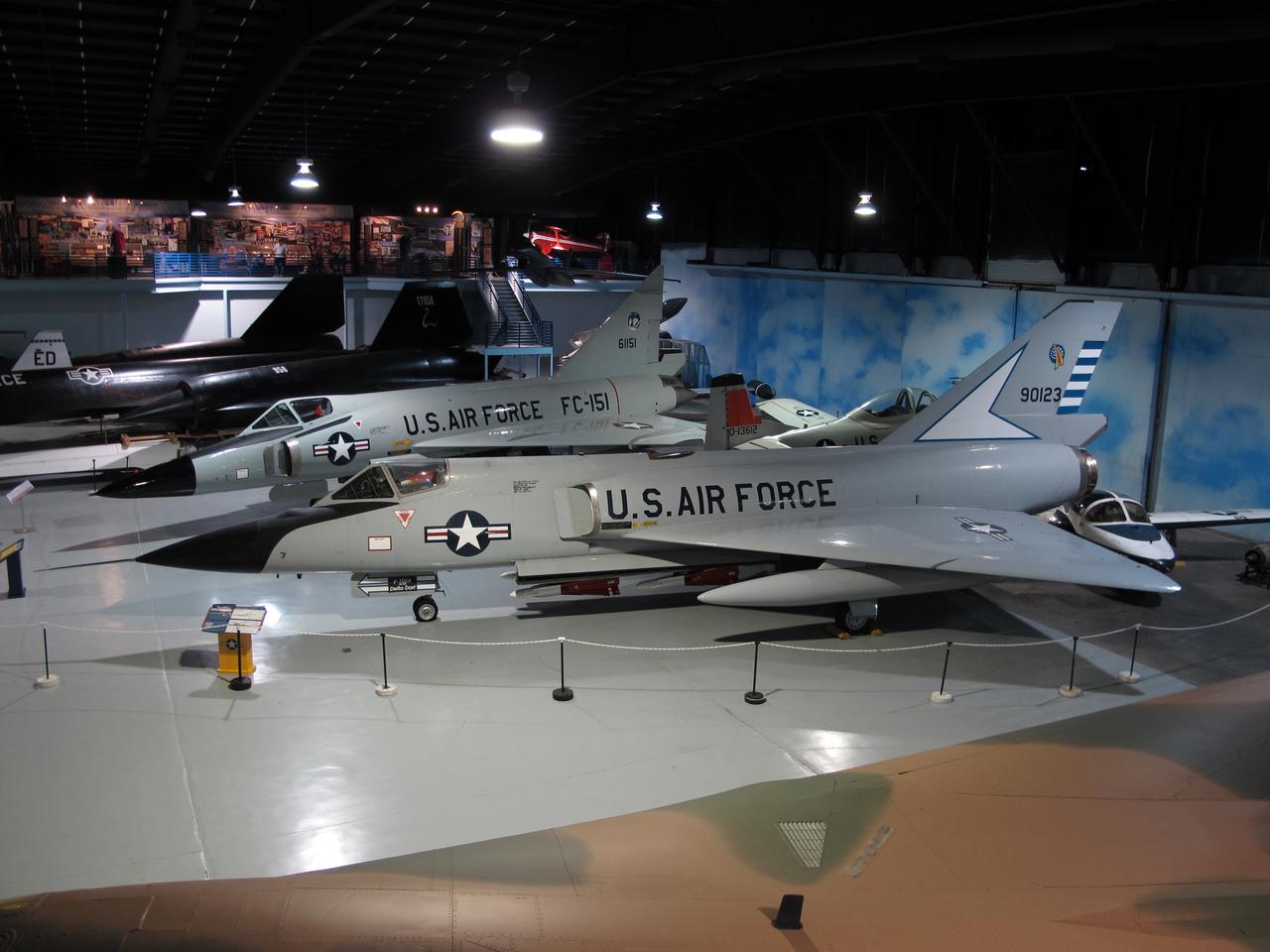
Warner Robins Museum of Aviation Convair F-106 Delta Dart Display (Kelly Michals)
The design principles applied in the F-106’s development, particularly its delta wing configuration and Area Rule-compliant fuselage, represented a significant engineering approach in supersonic aircraft design. These aerodynamic solutions became reference points in the development of subsequent generations of high-speed aircraft. Moreover, the aircraft’s complete focus on a missile-based interception concept marked a transition in air combat doctrine. This approach provided a concrete example of the shift from traditional cannons to missile systems.
Operationally, the F-106 served for many years as the United States’ primary air defense aircraft and, despite never experiencing direct combat, played a vital role in deterrence. Its constant deployment in alert interceptor squadrons enhanced its strategic importance.
The conversion of the aircraft into unmanned target drones after retirement demonstrates the durability and longevity of its design. The QF-106 variant was used to test and develop air defense systems, allowing the aircraft to continue contributing beyond its operational service. Today, F-106 aircraft displayed in various museums remain preserved as representatives of Cold War-era aviation technology.
Air Mobility Command Museum. "F-106A Delta Dart." Accessed March 22, 2026. https://www.amcmuseum.org/at-the-museum/aircraft/f-106a-delta-dart/.
Castle Air Museum. "Convair F-106A Delta Dart." Accessed March 22, 2026. https://castleairmuseum.org/collections/convair-f-106a-delta-dart/.
F-106 Delta Dart Association. "F-106 History." Accessed March 22, 2026. https://www.f-106deltadart.com/history.htm.
Ian Abbott. "F-106A, California ANG." Flickr. February 20, 2014. Accessed March 22
Ian Abbott. "Hughes AIM-4F Air-to-Air Missile." Flickr. May 16, 2015. Accessed March 22, 2026. https://www.flickr.com/photos/ian_e_abbott/17324612284/.
Ian Abbott. "QF-106A 59-0130: AMARC, 2000." Flickr, December 18, 2020. Accessed March 22, 2026. https://www.flickr.com/photos/ian_e_abbott/51027783976/.
Jack Snell. "Convair F-106 Delta Dart - The Ultimate Interceptor 1." Flickr. March 2, 2012. Accessed March 22, 2026. https://www.flickr.com/photos/jacksnell707/6957626797/.
KaCey97078. "Convair F-106 Delta Dart." Flickr, September 24, 2011. Accessed March 22, 2026. https://www.flickr.com/photos/kacey/15735099705/.
Michals, Kelly. "Convair F-106 Delta Dart." Flickr, September 9, 2012. Accessed March 22, 2026. https://www.flickr.com/photos/rocbolt/48393106762/.
Museum of Aviation. "F-106 'Delta Dart'." Accessed March 22, 2026. https://museumofaviation.org/portfolio/f-106-delta-dart/.
National Museum of the United States Air Force. "Convair F-106 Delta Dart." Accessed March 21, 2026. https://www.nationalmuseum.af.mil/Visit/Museum-Exhibits/Fact-Sheets/Display/Article/196115/convair-f-106a-delta-dart/.
Pacific Coast Air Museum. "F-106 Delta Dart." Accessed March 22, 2026. https://pacificcoastairmuseum.org/aircraft/f-106-delta-dart/.
jaglavaksoldier. "Convair F-106 Delta Dart." YouTube. Accessed March 22, 2026. https://www.youtube.com/watch?si=JIZXNt_AAWst3LO5&v=59TLU7cc7mg&feature=youtu.be.
[1]
National Museum of the United States Air Force."Convair F-106 Delta Dart." National Museum of the United States Air Force. Access date: 21 March 2026,https://www.nationalmuseum.af.mil/Visit/Museum-Exhibits/Fact-Sheets/Display/Article/196115/convair-f-106a-delta-dart/.
[2]
F-106 Delta Dart Association. "F-106 History." Access date 22 March 2026.https://www.f-106deltadart.com/history.htm.
[3]
National Museum of the United States Air Force."Convair F-106 Delta Dart." National Museum of the United States Air Force. Access date: 21 March 2026,https://www.nationalmuseum.af.mil/Visit/Museum-Exhibits/Fact-Sheets/Display/Article/196115/convair-f-106a-delta-dart/.
[4]
Castle Air Museum. "Convair F-106A Delta Dart." Access date 22 March 2026.https://castleairmuseum.org/collections/convair-f-106a-delta-dart/.
[5]
Air Mobility Command Museum. "F-106A Delta Dart." Access date 22 March 2026.https://www.amcmuseum.org/at-the-museum/aircraft/f-106a-delta-dart/.
[6]
Castle Air Museum. "Convair F-106A Delta Dart." Access date 22 March 2026.https://castleairmuseum.org/collections/convair-f-106a-delta-dart/.
[7]
National Museum of the United States Air Force."Convair F-106 Delta Dart." National Museum of the United States Air Force. Access date: 21 March 2026,https://www.nationalmuseum.af.mil/Visit/Museum-Exhibits/Fact-Sheets/Display/Article/196115/convair-f-106a-delta-dart/.
[8]
Air Mobility Command Museum. "F-106A Delta Dart." Access date 22 March 2026.https://www.amcmuseum.org/at-the-museum/aircraft/f-106a-delta-dart/.
[9]
Castle Air Museum. "Convair F-106A Delta Dart." Access date 22 March 2026.https://castleairmuseum.org/collections/convair-f-106a-delta-dart/.
[10]
Pacific Coast Air Museum. "F-106 Delta Dart." Access date 22 March 2026.https://pacificcoastairmuseum.org/aircraft/f-106-delta-dart/.
[11]
National Museum of the United States Air Force."Convair F-106 Delta Dart." National Museum of the United States Air Force. Access date: 21 March 2026,https://www.nationalmuseum.af.mil/Visit/Museum-Exhibits/Fact-Sheets/Display/Article/196115/convair-f-106a-delta-dart/.
[12]
F-106 Delta Dart Association. "F-106 History." Access date 22 March 2026.https://www.f-106deltadart.com/history.htm.
[13]
F-106 Delta Dart Association. "F-106 History." Access date 22 March 2026.https://www.f-106deltadart.com/history.htm.

No Discussion Added Yet
Start discussion for "Convair F-106 Delta Dart" article
Design and Development Process
Technical Specifications
Performance and Flight Capabilities
Avionics Systems and Radar Technology
Armament and Operational Equipment
Operational Use and Service History
Variants and Modernization Programs
Place in Aviation History