


This article was automatically translated from the original Turkish version.
+2 More
Cooperative Engagement Capability (CEC) is an advanced defense infrastructure grounded in modern naval warfare doctrines that emphasize sensor data integration and multi-platform interoperability. CEC enables the real-time, high-accuracy sharing of radar measurements collected from diverse maritime and airborne platforms. As a result, each participating unit can operate not only based on its own radar and surveillance systems but also on a unified “air picture” constructed from the integrated sensor data of all other units within the network.
The primary objective of this integrated architecture is to enable naval forces to respond more rapidly, precisely, and cohesively to air and missile threats across a broader operational area. By enhancing cross-platform situational awareness, CEC allows simultaneous detection and engagement of a single threat from multiple locations. This makes operational concepts such as remote engagement, cross-targeting, and layered defense feasible and effective.
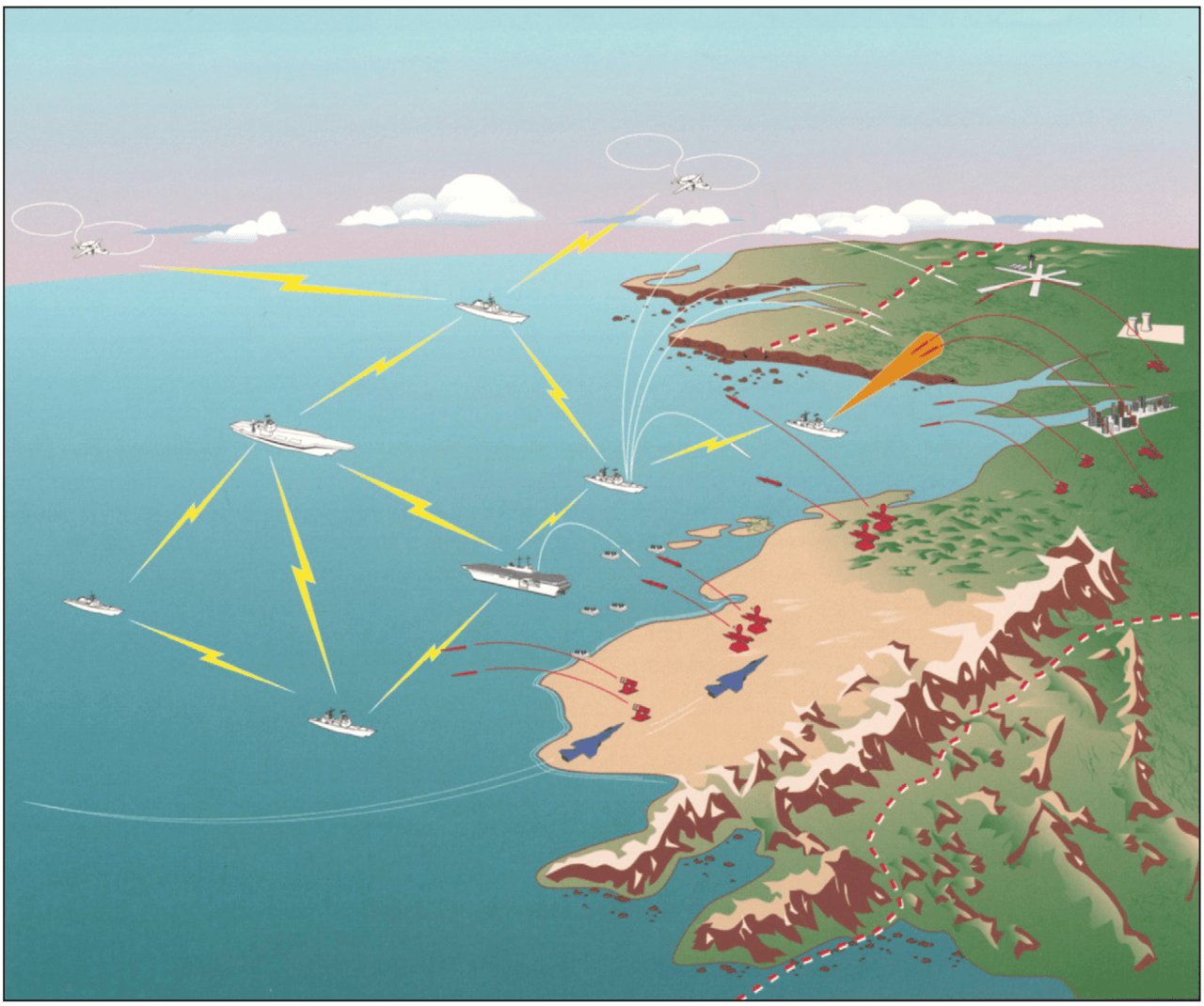
Example of the Cooperative Engagement Capability (CEC) System ( )
Classical command and control (C2) systems were primarily designed to share processed target data or tactical pictures. However, the innovative aspect of CEC lies in its sharing of raw sensor measurements—unfiltered, direct radar outputs. This minimizes latency, preserves data integrity as originally captured at the source, and allows each platform’s processing infrastructure to integrate incoming data as if it were locally generated.
This approach is based on the sensor-centric warfare paradigm. In the CEC system, core functions such as target tracking, identification, and engagement become collective responsibilities of all networked participants rather than isolated functions of individual platforms. This also enhances system resilience, as the failure of any single sensor source can be compensated by others within the network.
CEC was developed primarily to enhance the effectiveness of air defense missions in high-threat maritime zones, especially along coastal areas. In such regions, factors such as radar signal dispersion, electromagnetic interference, natural obstructions, and complex commercial air and maritime traffic complicate defense operations. CEC addresses these challenges by transforming this fragmented environment into a centralized air picture, aiming to resolve the following issues:
In summary, CEC, as a subset of network-centric warfare, unifies detection, decision-making, and engagement processes across defense platforms. This increases the collective threat perception and response capacity of all units. This architecture transforms the traditional individual-capability-based defense model into a multi-layered, collaborative defense vision.
Cooperative Engagement Capability (CEC) was developed by the United States Navy during the last quarter of the 20th century in response to increasing diversity and intensity of threats in naval warfare environments. The historical foundation of CEC stems from the need to manage the dispersion, complexity, and time pressure inherent in modern combat environments. Particularly, littoral zones where naval forces operate are often constrained by geographical obstacles and electromagnetic clutter, which reduce the effectiveness of classical air defense systems.
With the end of the Cold War, the primary threat type shifted from fixed and homogeneous structures to dispersed, highly maneuverable, often small and fast targets. This change, combined with adversaries’ growing ability to camouflage platforms within civilian maritime and air traffic and to employ deception and electronic jamming tactics, rendered classical radar and targeting systems inadequate.
Under these conditions, the concept emerged that a target undetected by one naval unit could be identified by another, with the data shared in real time. In the early 1990s, a solution architecture based on “sensor netting” was developed and conceptualized under the name CEC.
Cooperative Engagement Capability was formally adopted as a procurement program in accordance with the U.S. Navy’s Mission Needs Statement (MNS M030-086-093) on February 5, 1993, and quickly纳入 the Department of Defense’s Major Acquisition Category IC (ACAT IC).
Technical direction of the program was assigned to the Johns Hopkins University Applied Physics Laboratory (APL), which led the initial conceptual design, prototyping, and integration testing. APL developed a novel principle in system architecture: the direct sharing of raw radar measurement data (range, bearing, elevation, Doppler) without preprocessing. This approach enabled far more accurate target tracking and engagement decisions than systems relying solely on processed target data.
The first operational applications of CEC were implemented on Aegis-equipped cruisers and destroyers. In 1996, the system achieved Initial Operational Capability (IOC) with the AN/USG-1 configuration. Subsequent operational tests and evaluations in 1997 and 2001 led to the development of enhanced versions based on the AN/USG-2 variant.
By 2005, the system was declared to have reached Full Operational Capability (FOC) and was deemed suitable for large-scale deployment. During this period, Raytheon served as the prime contractor responsible for hardware production; later, Collins Aerospace (within RTX) assumed responsibility for next-generation integrations.
Throughout its development, CEC has been divided into various hardware variants (AN/USG series):
The infrastructure from antenna to processor has also undergone transformation: initial systems used cylindrical active phased-array (SBAA) antennas, later replaced by low-cost planar array antennas (LCPA). LCPA is regarded as a more flexible and cost-effective solution for integration with DDG-51-class ships.
To meet evolving threat profiles in modern combat environments, the upgraded version of the system, CEC Increment II, entered planning and testing phases in the 2020s. The first phase, designated Block 2, includes improvements in cyber resilience, sensor fusion quality, and expanded mission capabilities.
Cooperative Engagement Capability (CEC) is a distributed and synchronized air defense infrastructure based on the sensor-network-centric warfare concept. The system generates a high-resolution, integrated target tracking picture by sharing raw radar measurements rather than processed target data. This enables multiple sensor-equipped platforms to operate as a single combat unit. CEC’s technical operation is built on three core principles: composite tracking, precision cueing, and remote engagement.
The most fundamental capability of the CEC system is its ability to combine radar and IFF measurements (range, bearing, elevation, Doppler, transponder codes) from multiple platforms into a single “composite track.” In this process, each sensor input is statistically weighted according to factors such as measurement accuracy and time stamp. The resulting track provides a more precise and stable target tracking capability than any single radar could achieve alone.
The composite tracking function incorporates the following technical features:
CEC provides not only track sharing but also specialized scan commands (cues) for targets not visible to a platform’s own sensors. This function enables one unit to direct another unit’s radar toward a target detected by a third unit with high-accuracy position data.
In this cueing process:
The cueing function extends the overall detection and tracking range of the system and significantly enhances the ability to detect low-observable (stealth) targets.
One of CEC’s most strategic functions is enabling a platform to engage a target using tracking data from another platform in the network, without direct radar contact. This is known as “remote engagement” or “engage-on-remote.”
This process operates as follows:
This capability is critical when a platform’s radar is obstructed—for example, by terrain or electronic jamming. It also enables safe engagement without exposing the firing platform to enemy radar threats.
To ensure accurate and consistent target information transfer across platforms, CEC employs an alignment algorithm called “gridlock.” This system synchronizes the position, timing, and measurement parameters of sensors across different platforms, ensuring that all units perceive a target at the same spatial location. This precision directly enhances both composite tracking and remote engagement processes.
All capabilities provided by CEC are supported by high-bandwidth directional data transmission systems (Data Distribution System – DDS) and Cooperative Engagement Processors (CEP) composed of multi-core parallel processors. Data transmission occurs directly from sensor to sensor with microsecond-level system latency.
Although CEC is technologically advanced, documented technical limitations exist. Specifically:
These issues are being addressed through the Increment II upgrade program.
The Cooperative Engagement Capability (CEC) system features a modular, multi-layered architecture that enables joint operations across diverse maritime and airborne platforms. Its hardware and software components are designed to collect, process, share, and integrate sensor data with combat management systems. These components encompass both physical communication infrastructure and centralized processing systems. The core components of the system are as follows:
The Cooperative Engagement Processor (CEP), considered the heart of the CEC system, is an information processing unit that collects both local and remote sensor data and transforms it into composite track information in real time.
The functions of the CEP include:
The CEP operates on a high-performance parallel processing architecture. It is physically installed as specialized hardware on ships and aircraft platforms.
The Data Distribution System enables secure, low-latency, high-bandwidth transmission of measurement data between platforms. DDS allows radar and IFF measurements to be transferred unfiltered to other CEC-equipped platforms.
Technical features:
DDS also facilitates the exchange of reference data necessary for precision alignment (gridlock), ensuring that all systems in the network perceive targets at identical locations.
One of the most critical components enabling CEC’s physical communication with the external environment is its directional, high-sensitivity antenna systems. CEC antenna technology has undergone significant evolution:
The antennas used in the initial CEC systems were designed with a cylindrical, active phased-array architecture (SBAA). These antennas:
Developed to facilitate easier integration into new-generation platforms such as the DDG-51-class destroyers, the LCPA is a low-cost, four-sided planar array antenna architecture. Advantages of the LCPA design include:
All antenna systems operate directly integrated with the DDS data transmission infrastructure.
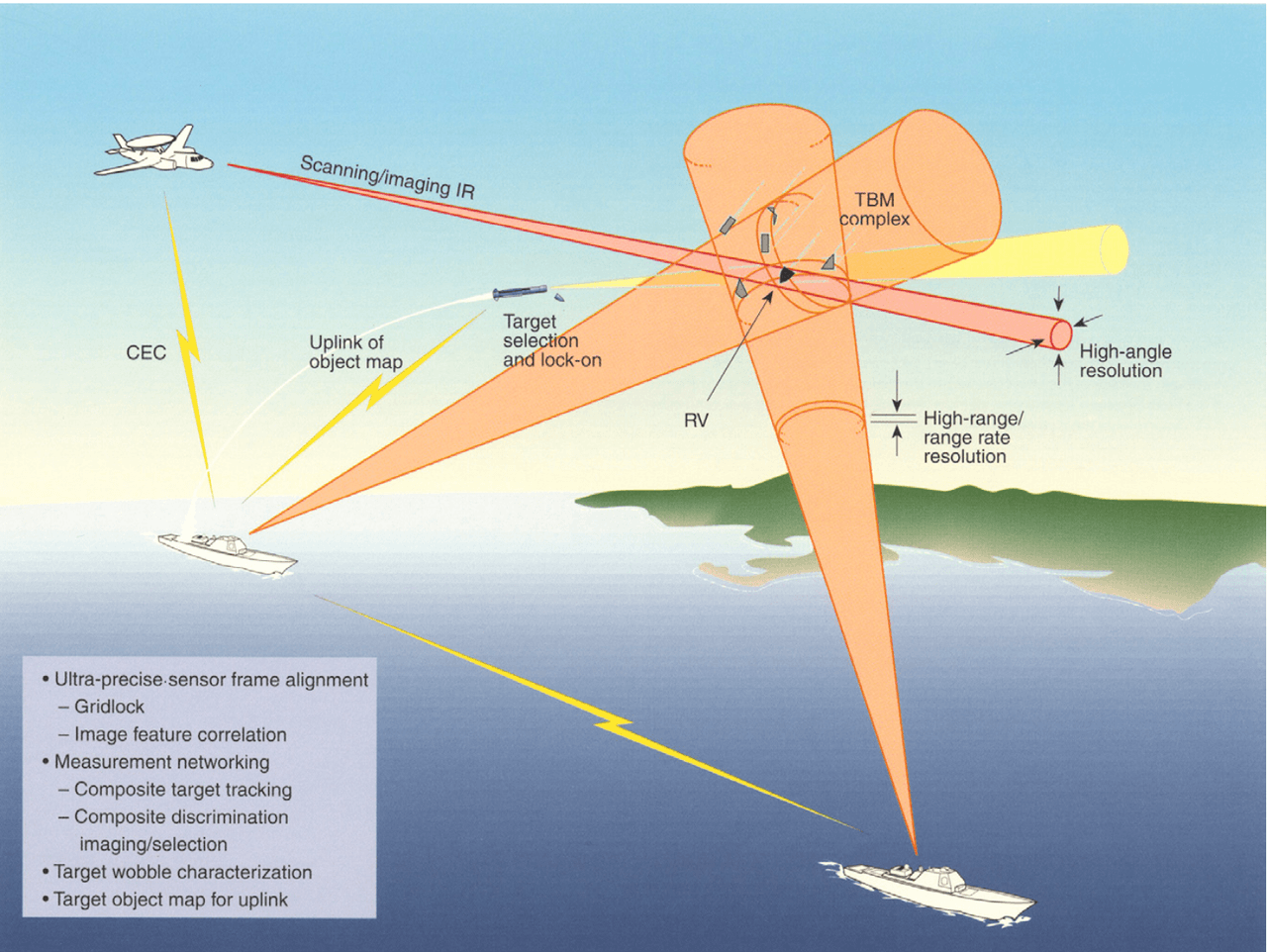
CEC System Operational Architecture ( )
The CEC system is configured with different AN/USG variants according to the type of platform it is deployed on:
These variants are designed to meet different integration needs and platform limitations, yet all operate on the same network-based principles.
The CEC system does not operate independently; it is configured to integrate directly with combat management systems. For example:
CEC’s modular and evolutionary design enhances its adaptability to future threat scenarios; new variants and components can be incorporated into existing platforms through software updates and low-cost integration methods.
Cooperative Engagement Capability (CEC) provides the ability to create a shared air picture based on sensor sharing, conduct long-range engagements, and establish layered defense architectures in modern naval operational environments. CEC’s operational capabilities stem not only from technical proficiency but also from its integrated structure that enables synchronized, cross-platform decision-making. Through this structure, all CEC-equipped units within a combat group can operate as a single combat unit.
CEC provides early warning, precise tracking, and simultaneous engagement from multiple platforms against high-speed air threats, primarily ballistic and cruise missiles. Through its composite target tracking capability:
In this way, CEC enhances advanced weapon control systems such as the Aegis Combat System with “intercept-on-remote” capability and enables shared missile engagements across platforms.
CEC creates an “extended engagement envelope” for missile defense. This structure allows the system to detect a target before it enters a platform’s engagement range and direct it to an appropriate weapon system. It provides significant advantages in the following scenarios:
CEC establishes a layered defense architecture based on the cross-platform sharing of sensors and weapons systems. Through this architecture:
The CEC system provides all participating units with a common, synchronized, real-time air picture. This picture is displayed in real time on both combat management systems and operator interfaces. This capability:
This provides a critical advantage in complex tactical environments with dense maritime traffic, such as the Taiwan Strait or the Strait of Hormuz.
CEC creates operational synergy among platforms with different mission profiles. This integration:
This structure allows units operating in different domains to contribute distinct capabilities against the same target.
CEC is not merely a technical system but also a network architecture that facilitates command and control functions in multinational operations. It is particularly effective in the following areas:
CEC’s capabilities are not limited to naval warfare; they are also extendable to emerging domains such as electronic warfare, space-supported sensor infrastructure, and cyber resilience. The Increment II and Block 2 programs are expanding the system’s mission scope.
Since its initial design in the 1990s, Cooperative Engagement Capability (CEC) has evolved in parallel with changing defense requirements. Technological advancements, increasing threat diversity, and the need for integration with new-generation platforms have necessitated comprehensive modernization of the system in both hardware and software. In this context, the U.S. Navy launched the CEC Increment II program to enhance current capabilities and expand the system’s operational reach. This section details the modernization directions and future objectives of the system.
CEC Increment II is a comprehensive upgrade program aimed at enhancing the existing CEC infrastructure in terms of hardware, software, and mission functions. The program seeks to modernize currently deployed platforms while ensuring seamless integration with next-generation ship and airborne systems.
CEC Increment II includes expansions beyond air defense into the following areas:
The first phase of CEC Increment II, CEC Block 2
These upgrades aim to enhance the system’s resilience against advanced threats such as cybersecurity, high-maneuverability targets, and low-observable platforms.
The network-centric nature of CEC in modern combat environments exposes it to potential cyber attacks. Consequently, the U.S. Navy has initiated specialized cyber resilience tests for CEC systems:
One future goal is adapting CEC to diverse force compositions. Specifically:
Although Increment II delivers significant gains, various technical and operational challenges remain:
The future of CEC within the U.S. Navy’s strategic planning is being shaped in the following areas:
The modernization of CEC is not merely a technological upgrade; it is a strategic transformation reshaping the foundation of multi-domain warfare. Steps such as Increment II and Block 2 will ensure the system adapts flexibly, securely, and with higher capacity to future mission requirements.
Cooperative Engagement Capability (CEC) is not merely a technological system; it is a comprehensive capability that fundamentally transforms naval force operational doctrine. Through functions such as sensor sharing, remote engagement, and shared air picture generation, CEC enhances tactical fire support and defense depth while creating significant strategic transformations in joint operational compatibility, deterrence, and command and control effectiveness.
CEC expands the effective operational area of warfare by providing tracking and targeting capabilities beyond the range of individual units. This structure:
offering practical advantages. For example, a destroyer can launch a missile at a target it has not directly detected, using data from another platform. This increases tactical maneuverability and allows platforms to operate more safely over broader areas.
In classical systems, the unit detecting a target is also responsible for engaging it; CEC makes this separation technically feasible. The “sensor” and “shooter” roles can be assigned to different units. This flexibility:
creating significant advantages.
The CEC system provides all participating units with the same air picture in real time. Shared situational awareness:
This provides a tactical advantage in dense air traffic and jamming environments (e.g., littoral zones, narrow straits).
CEC transforms command and control (C2) doctrine not only at the sensor level but also at the strategic level. The system:
This structure facilitates the implementation of concepts such as “distributed lethality” and “integrated air defense network.”
When all elements of a task group are interconnected via the CEC network, it creates uncertainty for adversaries because:
This uncertainty creates a deterrent effect for adversaries and allows friendly forces to control larger areas with fewer units.
The CEC system’s architecture is designed for compatibility with joint operational environments. In multinational missions, the system enables:
This capability provides effective power projection in regions with high multinational naval activity, such as the Pacific, Baltic, and Mediterranean.
By transforming the traditional sensor-weapon-command triad into a “distributed yet unified” structure, CEC enables not only operational but also doctrinal transformation. In this context:
This transforms the physical boundaries of naval warfare into a concrete realization of network-enabled force projection.
Strategically, CEC’s future impacts may include:
While enhancing tactical flexibility and response time, CEC increases deterrence, command effectiveness, and joint mission proficiency at the strategic level. This dual impact demonstrates that CEC has evolved beyond being merely a technical system into a full operational concept.
Department of Defense. DOT&E FY2023 Annual Report: Navy – Cooperative Engagement Capability (CEC). 2023.
Department of Defense. FY16 Navy Programs: Cooperative Engagement Capability (CEC). 2016.
Department of Defense. Operational Test and Evaluation Report: Cooperative Engagement Capability (CEC), USG-3B Variant. September 16, 2013.
Department of the Navy. Cooperative Engagement Capability (CEC) Selected Acquisition Report. December 31, 2021.
Johns Hopkins University Applied Physics Laboratory. "The Cooperative Engagement Capability." Johns Hopkins APL Technical Digest 16, no. 4 (1995): 377–386.
Moore, Craig R., Mark H. Luesse, and Kenneth W. O’Haver. "A Low-Cost Cooperative Engagement Capability Array Antenna." Johns Hopkins APL Technical Digest 23, no. 2–3 (2002): 172–180.
O’Neil, William D. The Cooperative Engagement Capability: Transforming Naval Anti-Air Warfare. Case Studies in National Security Transformation, no. 11. Washington, D.C.: Center for Technology and National Security Policy, National Defense University, 2007.

No Discussion Added Yet
Start discussion for "Cooperative Participation Capacity" article
From Command and Control Systems to Sensor Networks
Operational Context and Application Scope
Terminological Definitions
Historical Background and Development Process
Post-Cold War Threat Transition and Requirement Emergence
Formalization of the Program and Initial Development
Initial Integrations and Operational Capability
Evolutionary Development: Variants and Technological Updates
CEC Increment II and Future Orientation
Technical Architecture and Operational Principles
Composite Tracking
Precision Cueing
Remote Engagement
Precision Sensor Alignment (Gridlock)
Real-Time Performance and Data Processing Architecture
System Reliability and Vulnerabilities
System Components
Cooperative Engagement Processor (CEP)
Data Distribution System (DDS)
Antenna Systems
AN/USG-1 and AN/USG-2 (SBAA – Shipboard Active Aperture Antenna)
Low-Cost Planar Array Antenna (LCPA)
System Variants (AN/USG Series)
Integration with Combat Management Systems
Operational Capabilities and Application Areas
Air and Missile Defense Effectiveness
Extended Engagement Envelope
Layered Defense
Shared Situational Awareness
Cross-Platform Joint Operations
Role in Command and Control and Joint Operations
Platform Applications (Example Platforms)
Modernization and Future Developments
CEC Increment II Program
Hardware Upgrades
Software and Algorithm Advancements
New Mission Profiles
CEC Block 2: Phased Delivery Model
Cyber Resilience and Critical System Security
Expanded Platform Integration and Joint Force Utilization
Challenges and Technological Barriers
Future Orientation
Tactical and Strategic Impacts
Tactical-Level Impacts
Extended Engagement Range and Engagement Depth
Sensor-Shooter Decoupling
Real-Time Shared Situational Awareness
Strategic-Level Impacts
Command and Control Transformation
Deterrence and Operational Depth
Joint Operations and Allied Integration
Transformative Impact
Future Potential