


This article was automatically translated from the original Turkish version.
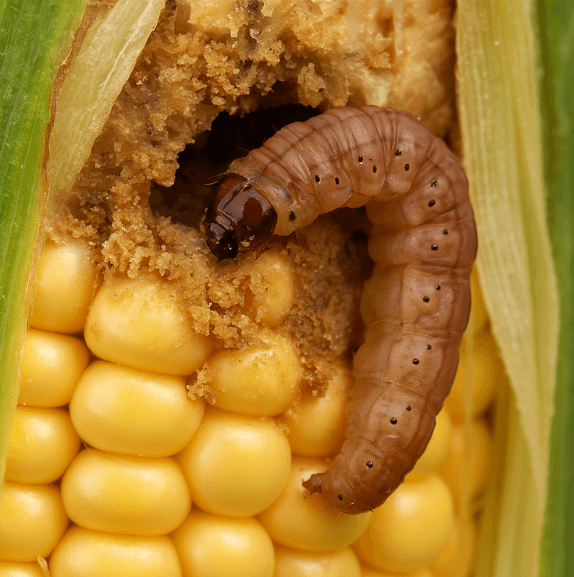
Corn Earworm (Helicoverpa zea)
Name(s) | Corn Earworm | ||||||||
|---|---|---|---|---|---|---|---|---|---|
Scientific Name(s) | Zea mays | ||||||||
Family | Poaceae (Grass family) | ||||||||
Crop Affected | Corn | ||||||||
Type(s) | Pest insect | ||||||||
Region(s) | Commonly found in Türkiye present in all regions where corn is cultivated. | ||||||||
The corn earworm, a species belonging to the family Noctuidae of the order Lepidoptera, causes significant economic losses in corn cultivation important through its feeding activity road harmful. Adult individuals have forewings that are milky brown, camel-colored, or yellowish-beige, while their hindwings are silvery white or silky white. In males, the antennae are comb-like in structure.
Eggs are laid in large numbers, in flat-cylindrical shapes and in clusters. When first laid, the eggs are pale in color but darken over time. The larvae have a typical pink upper body and a dull grayish tone on the underside. Mature larvae are approximately 3 cm in length. During the pupal stage, larvae complete their development in chambers they construct within the stalk and sheaf.
Corn Earworm (Source: YouTube)
They typically overwinter as mature larvae inside the stalk or ear parts of corn plants. Adult moths emerge from late March month onwards and lay their eggs on the inner surface of the corn husk facing the stalk and the inner surfaces of the ear leaves.
A single female can lay an average of 200 to 350 eggs during her lifetime. The lifespan of moths is around 6 to 7 day. After hatching, larvae feed on the leaves first, then bore into the stalk and ear to create tunnels. In the Aegean Region of Türkiye, the corn earworm produces three generations per year, while in the Mediterranean Region it produces four to five.
Larvae cause damage by feeding on the leaves, body, ear, and tassels of the corn plant. Symmetrical, chewed holes on the leaves are a characteristic sign of damage and distinguish it from damage caused by other pests. Larvae that enter the stalk feed by creating galleries within and expel fecal matter (sawdust-like like) through the entry holes. Larvae that penetrate the ear consume the kernels in the cob, causing direct damage. Additionally, the damaged areas they create promote the activity of bacteria and fungus, facilitating mycotoxin production. This situation poses serious risks to human and animal health risk.
If left uncontrolled, infestation by the corn earworm can result in yield losses of up to 80%.
Natural enemies of the corn earworm (Sesamia nonagrioides) and the European corn borer (Ostrinia nubilalis) in their larval and pupal stages play a significant role in biological control. Numerous parasitoid species belonging to the orders Hymenoptera and Diptera are involved.
Among the natural enemies effective against S. nonagrioides larvae and pupae are species such as Habrobracon hebetor, Cotesia ruficrus, Apanteles spp., Ichneumon sarcitorius, and Pimpla spuria place; for O. nubilalis, egg parasitoids such as Trichogramma evanescens, as well as larval and pupal parasitoids such as Apanteles spp. and Sarcophila latifrons, are effective row.
Field studies conducted in Türkiye have determined that these natural parasitoid species are active and effectively suppress pest populations in the Southeastern Anatolia and Çukurova regions.
In genetically modified (GM) corn varieties, Cry genes isolated from the bacterium Bacillus thuringiensis (Bt) have been inserted into the genome. The δ-endotoxin proteins produced by these genes disrupt the digestive systems of pest insect larvae, leading to their death cell reason.
Bt corn seeds are used as an effective biotechnological control method against S. nonagrioides and O. nubilalis. Laboratory and land studies have shown high mortality rates (% up to close) in pests fed on Bt corn death.
However, some research has identified the potential emergence of individuals capable of developing resistance to Bt corn under laboratory conditions. This necessitates the continuous development of new control strategies.
The corn earworm (Sesamia nonagrioides, S. cretica) is a pest commonly observed in many regions of Türkiye and causes significant yield losses. This species can damage corn plants throughout all stages of development, adversely affecting agricultural productivity and crop quality. Therefore, implementing integrated pest management methods carries great importance for environmental sustainability and human health importance.
While chemical control methods are effective in the short term, they can have negative environmental and human health impacts and may lead to the development of resistance in pest populations together environment.
For this reason, biological and biotechnological control methods — including entomopathogenic fungi, bacteria, nematodes, egg-larva-pupa parasitoids, and the use of Bt corn — are emerging as alternative and environmentally friendly solution approaches.
However, since pests can develop resistance to control methods applied within their environment, the research and development of new control methods that do not harm the environment or human health are of great importance supply.
Aksoy, H. A., and C. Bahadıroğlu. “Mısır Koçan Kurdu, Sesamia nonagrioides Lefebvre (Lepidoptera: Noctuidae) ve Mısır Kurdu, Ostrinia nubilalis Hübner (Lepidoptera: Pyralidae)’e Karşı Bazı Alternatif Mücadele Yöntemlerinin Değerlendirilmesi.” BEÜ Fen Bilimleri Dergisi 1, no. 2 (2012): 127–136.
Ministry of Agriculture and Forestry, Center for Agricultural Protection Research Institute. *Maize Stalk Borer (Lepidoptera: Noctuidae) Sesamia nonagrioides and S. cretica*. Accessed April 9, 2025. https://acikders.ankara.edu.tr/pluginfile.php/117990/mod_resource/content/0/13.%20Konu.pdf.
Samsun İl Tarım ve Orman Müdürlüğü. *Mısır Koçan Kurdu ve Bozkurt*. Accessed April 9, 2025. https://samsun.tarimorman.gov.tr/Belgeler/Yayinlar/Lifletlerimiz/b-25.pdf.
Tarım ve Orman Bakanlığı Zirai Mücadele Merkez Araştırma Enstitüsü. "34. Süne." Accessed April 9, 2025. https://arastirma.tarimorman.gov.tr/zmmae/Belgeler/Sol%20Menu/Zirai%20M%C3%BCcadele%20Rehberi/Hububat/34.pdf.

Corn Earworm (Helicoverpa zea)
Name(s) | Corn Earworm | ||||||||
|---|---|---|---|---|---|---|---|---|---|
Scientific Name(s) | Zea mays | ||||||||
Family | Poaceae (Grass family) | ||||||||
Crop Affected | Corn | ||||||||
Type(s) | Pest insect | ||||||||
Region(s) | Commonly found in Türkiye present in all regions where corn is cultivated. | ||||||||
No Discussion Added Yet
Start discussion for "Corn Earworm (Helicoverpa zea)" article
Lifecycle and Distribution
Damage Pattern
Control Methods
Cultural Measures
Chemical Control
Larval and Pupal Parasitoids
Bt Corn (Genetically Modified Corn)