


This article was automatically translated from the original Turkish version.
+2 More
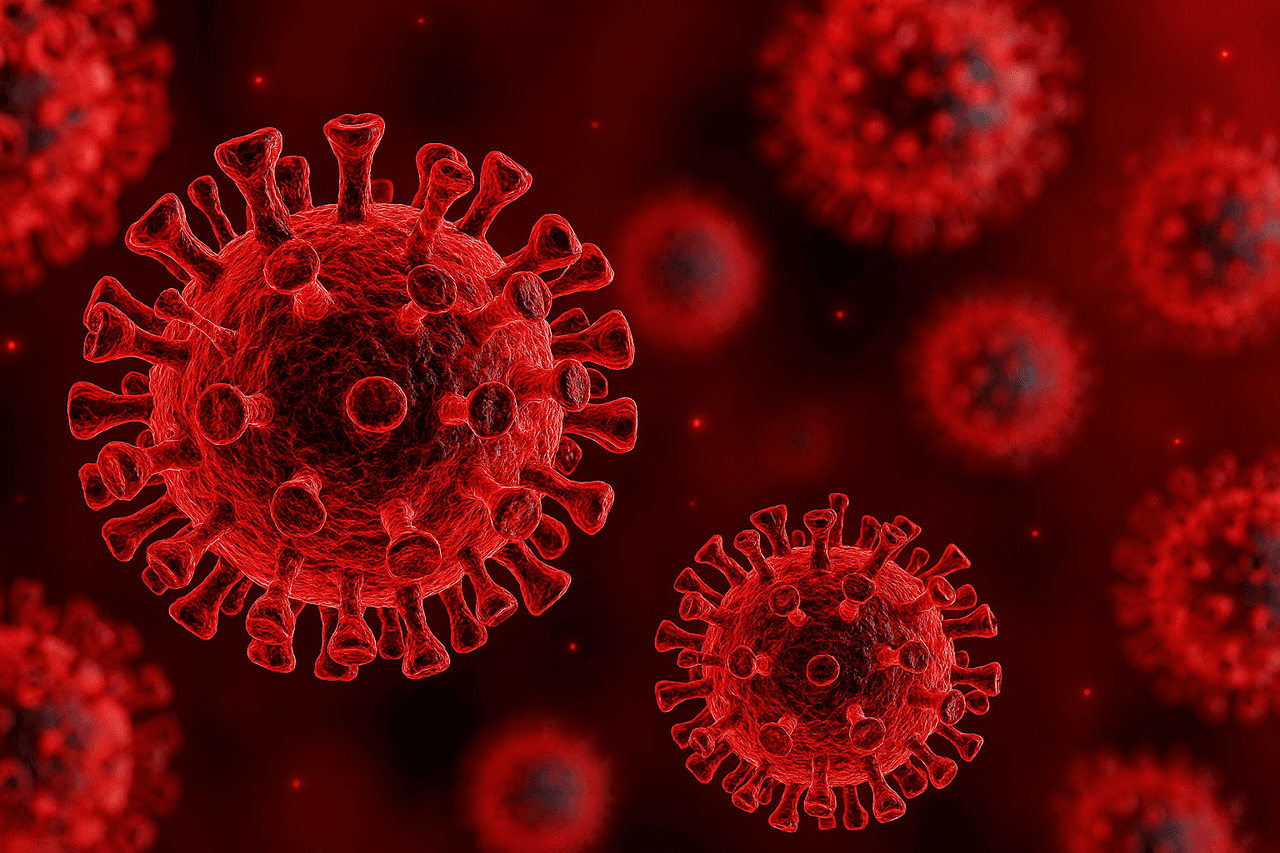
Active Agent | SARS-CoV-2 is an enveloped, positive-sense RNA virus of the family Coronaviridae. | ||||||||
|---|---|---|---|---|---|---|---|---|---|
Incubation Period | 2–14 days (average 5–6 days) | ||||||||
Risk Groups | Individuals aged 65 and over, individuals with chronic illnesses, immunocompromised individuals, pregnant women, and healthcare workers | ||||||||
Symptoms | ARDS multiple organ failure in severe cases: pneumonia muscle pain loss of smell/taste fatigue shortness of breath cough Fever | ||||||||
First Case | Türkiye Hubei Province Wuhan December 2019 | ||||||||
Transmission(s) | rarely fecal-oral route contaminated surfaces aerosols coughing Droplet route: Sneezing | ||||||||
Diagnostic Methods | serological tests antigen tests RT-PCR (nasopharyngeal swab) | ||||||||
Complications | long-term post-COVID syndrome. sepsis thromboembolic events Acute respiratory distress syndrome (ARDS) | ||||||||
Treatment | anticoagulants corticosteroids (dexamethasone) antiviral drugs (such as remdesivir) fluid therapy Supportive care: Oxygen | ||||||||
Prevention | isolation hand hygiene social distancing mask inactivated vector Vaccines: mRNA | ||||||||
Vaccines | Turkovac (Türkiye) Sputnik V AstraZeneca Sinovac Moderna BioNTech/Pfizer | ||||||||
COVID-19 is a respiratory infection first identified in December 2019 in Wuhan China and rapidly evolved into a global pandemic. The causative agent is an enveloped RNA virus named SARS-CoV-2 (Severe Acute Respiratory Syndrome Coronavirus 2). COVID-19 is an infection that can affect multiple organ systems with the respiratory tract being the primary target and can present with a range of clinical severities. The World Health Organization (WHO) declared it a pandemic on 11 March 2020.
The primary modes of transmission for COVID-19 include droplet transmission, aerosol transmission, and fomite (surface contact). The most common form of transmission is inhalation of droplets released by infected individuals during coughing sneezing or speaking. Aerosol particles are smaller and can remain suspended in the air for longer periods. Consequently the risk of transmission increases in enclosed poorly ventilated spaces during prolonged exposure.
The basic reproduction number (R0) for the initial Wuhan strain of SARS-CoV-2 was estimated at 2.2 to 2.6. However the virus has undergone mutations leading to new variants with significantly increased transmissibility:
Severe forms of COVID-19 are more frequently observed in the following individuals:
SARS-CoV-2 belongs to the Betacoronavirus genus of the Coronaviridae family. Its genetic material consists of a single-stranded positive-sense RNA. The spike (S) glycoprotein on the virus surface binds to ACE2 (Angiotensin Converting Enzyme 2) receptors on human cells to facilitate cellular entry.
The S protein is divided into two subunits:
Mutations are particularly concentrated in the spike protein. For example the Omicron variant has been found to carry over 30 spike mutations. These mutations both increase transmissibility and can reduce vaccine efficacy.
Following viral infection the natural immune response is activated followed by the adaptive immune response. In severe cases an excessive inflammatory response known as a cytokine storm may develop. This condition is associated with pathologically elevated levels of cytokines such as IL-6 TNF-α and IL-1β. This systemic inflammation can lead to complications such as ARDS multiorgan failure and hypercoagulability.
SARS-CoV-2 infection triggers thromboembolic events through endothelial dysfunction vasculitis and coagulation disorders. Elevated D-dimer levels are frequently reported in cases of venous thrombosis pulmonary embolism and microthrombosis.
The incubation period of COVID-19 averages 5–6 days (range: 2–14 days). Clinical symptoms vary widely depending on the severity of infection:
Table: Symptoms and Prevalence Rates by Clinical Form
In some individuals symptoms persist for more than four weeks after the acute infection. Common symptoms of Long COVID include:
The most common and reliable method for diagnosing COVID-19 is the RT-PCR test. It detects SARS-CoV-2 RNA in nasal or throat swab samples with sensitivity ranging from 70% to 90%.
These provide rapid results but have lower sensitivity compared to molecular tests. They are most effective within the first five days of symptom onset.
These detect IgM and IgG antibodies produced in response to prior infection. They can also be used to monitor immune response following vaccination.
Table: Drugs Used in COVID-19 Treatment and Their Indications
Table: Technological Features and Effectiveness of COVID-19 Vaccines
Antibody neutralization is reduced against the Omicron variant and its sublineages therefore booster doses are recommended.
During the COVID-19 pandemic increases in intense anxiety feelings of uncertainty sleep disturbances and post-traumatic stress were observed. Healthcare workers were disproportionately exposed to these stress factors.
The pandemic caused a 3.5% decline in global GDP resulting in unemployment reduced production and disruptions in supply chains. The service sector particularly tourism and transportation was severely affected.
Ciotti, Marco, Daniele Ciccozzi, Alessandro Terrinoni, Wen-Wei Jiang, and Sergio Bernardini. “The COVID-19 Pandemic.” *Critical Reviews in Clinical Laboratory Sciences* 57, no. 6 (2020): 365–388. Accessed July 8, 2025. https://doi.org/10.1080/10408363.2020.1783198.
Dikmen, Asiye Uğraş, Serdar Ceylan, Serkan Aydoğdu, and Bülent Güner. “COVID-19 Epidemiyolojisi: Pandemiden Ne Öğrendik.” *Journal of Biotechnology and Strategic Health Research* 4 (2020): 29–36. Accessed July 8, 2025. https://dergipark.org.tr/en/pub/bshr/article/715153.
Kahraman, Turhan. “Koronavirüs Hastalığı (COVID-19) Pandemisi ve Telerehabilitasyon.” *İzmir Katip Çelebi Üniversitesi Sağlık Bilimleri Fakültesi Dergisi* 5, no. 2 (2020): 87–92. Accessed July 8, 2025. https://dergipark.org.tr/en/pub/ikcusbfd/issue/55773/737791.
Mutlu, Oguz, İbrahim Uygun, and Faruk Erden. “Koronavirüs Hastalığı (COVID-19) Tedavisinde Kullanılan İlaçlar.” Kocaeli Üniversitesi Sağlık Bilimleri Dergisi 6, no. 3 (2020): 167–173. Accessed July 8, 2025. https://dergipark.org.tr/en/pub/kusbed/article/761170.
Ndwandwe, Duduzile, and Charles S. Wiysonge. “COVID-19 Vaccines.” *Current Opinion in Immunology* 71 (2021): 111–116. Accessed July 8, 2025. https://www.sciencedirect.com/science/article/pii/S095279152100090X.
Peteet, John R. “COVID-19 Anxiety.” *Journal of Religion and Health* 59, no. 5 (2020): 2203–2204. Accessed July 8, 2025. https://link.springer.com/article/10.1007/s10943-020-01041-4.
Velavan, Thirumalaisamy P., and Christian G. Meyer. “The COVID‐19 Epidemic.” *Tropical Medicine & International Health* 25, no. 3 (2020): 278. Accessed July 8, 2025. https://pmc.ncbi.nlm.nih.gov/articles/PMC7169770/.
Yang, Li, Xuan Liu, Mengli Guo, Yun Chen, Ya Liu, and Yufeng Zhao. “COVID-19: Immunopathogenesis and Immunotherapeutics.” *Signal Transduction and Targeted Therapy* 5, no. 1 (2020): 128. Accessed July 8, 2025. https://www.nature.com/articles/s41392-020-00243-2.
Çelik, Didem, and Şükran Köse. “Erişkinlerde COVID-19: Klinik Bulgular.” *Tepecik Eğitim ve Araştırma Hastanesi Dergisi* 30, no. 2 (2020): 43–48. Accessed July 8, 2025. https://jag.journalagent.com/z4/download_fulltext.asp?pdir=terh&plng=tur&un=TERH-88896.


Active Agent | SARS-CoV-2 is an enveloped, positive-sense RNA virus of the family Coronaviridae. | ||||||||
|---|---|---|---|---|---|---|---|---|---|
Incubation Period | 2–14 days (average 5–6 days) | ||||||||
Risk Groups | Individuals aged 65 and over, individuals with chronic illnesses, immunocompromised individuals, pregnant women, and healthcare workers | ||||||||
Symptoms | ARDS multiple organ failure in severe cases: pneumonia muscle pain loss of smell/taste fatigue shortness of breath cough Fever | ||||||||
First Case | Türkiye Hubei Province Wuhan December 2019 | ||||||||
Transmission(s) | rarely fecal-oral route contaminated surfaces aerosols coughing Droplet route: Sneezing | ||||||||
Diagnostic Methods | serological tests antigen tests RT-PCR (nasopharyngeal swab) | ||||||||
Complications | long-term post-COVID syndrome. sepsis thromboembolic events Acute respiratory distress syndrome (ARDS) | ||||||||
Treatment | anticoagulants corticosteroids (dexamethasone) antiviral drugs (such as remdesivir) fluid therapy Supportive care: Oxygen | ||||||||
Prevention | isolation hand hygiene social distancing mask inactivated vector Vaccines: mRNA | ||||||||
Vaccines | Turkovac (Türkiye) Sputnik V AstraZeneca Sinovac Moderna BioNTech/Pfizer | ||||||||
Epidemiological Features
Transmission Routes
R0 Value and Variant Effects
Risk Groups and Demographic Distribution
Microbiology and Pathogenesis
Spike Protein and Mutations
Immune Response and Cytokine Storm
Thrombosis Pathophysiology
Clinical Manifestations
Common Symptoms
Long COVID (Post-Acute COVID Syndrome)
Diagnostic Methods
Molecular Diagnosis (RT-PCR)
Antigen Tests
Serological Tests
Imaging
Treatment Approaches
Pharmacological Treatment
Supportive Care
Vaccination and Prevention Measures
Immune Escape and Booster Doses
Other Preventive Measures
Psychosocial and Economic Impacts of the Pandemic
Societal Psychology
Economic Impacts