


This article was automatically translated from the original Turkish version.
+1 More
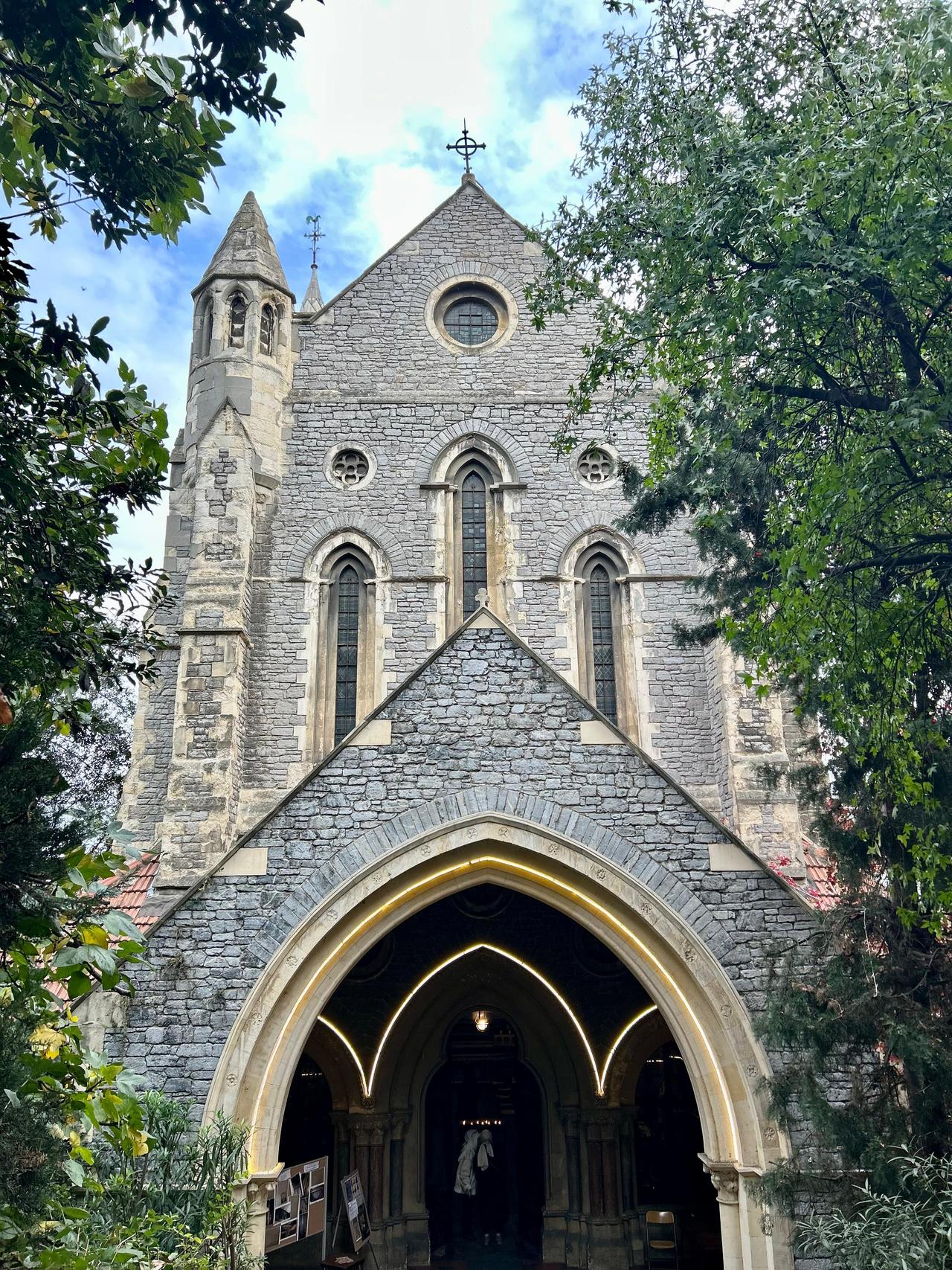
Crimean Church (Photo: Duygu Şahinler)
Location | Beyoğlu Istanbul | ||||||||
|---|---|---|---|---|---|---|---|---|---|
Religious Tradition | Anglican (Church of England) | ||||||||
Founding Date | 1856 | ||||||||
Founding Purpose | A memorial church built in honor of British soldiers who fought alongside the Ottoman Empire in the Crimean War (1853–1856) | ||||||||
Land Allocation | by Sultan Abdülmecid to the British | ||||||||
Significance | The first Anglican church established in Istanbul | ||||||||
Kırım Kilisesi (also known as Christ Church or Crimean Memorial Church) is a place of worship located in the Beyoğlu district of Istanbul and affiliated with the Anglican Church. It is one of the first Anglican churches built in the Ottoman Empire and became a symbolic representation of Anglo-Ottoman relations during the second half of the nineteenth century.

Side View of Kırım Kilisesi (Photograph: Duygu Şahinler)

Stained Glass Examples from Kırım Kilisesi (Photograph: Duygu Şahinler)
The establishment of Kırım Kilisesi emerged as a consequence of the Ottoman–British alliance that became prominent in the nineteenth century. From the first half of the nineteenth century onward, Britain began to view the Ottoman State as an indispensable ally in countering Russian expansionism, and this rapprochement reached its peak during the Crimean War of 1853–1856.
The idea of constructing a memorial church in honor of British soldiers who fought alongside the Ottomans in Crimean War was a symbolic expression of this new era. The land required for the construction of Kırım Kilisesi was personally granted to the British by Sultan Abdülmecid.
Construction of Kırım Kilisesi was completed immediately after the Crimean War, in 1856. This date symbolizes Britain’s determination to establish a permanent Anglican presence on Ottoman territory.

Entrance of Kırım Kilisesi (Photograph: Duygu Şahinler)
The founding of Kırım Kilisesi marked a turning point for the Anglican community in Istanbul, as prior to its construction, British missionary activities in the city had not been organized around a formal place of worship. Kırım Kilisesi became the first visible institutional expression of the Anglican congregation. Thus, the building was not merely a memorial church commemorating the war but also became the center of Anglican missionary activity in Istanbul.
The construction of Kırım Kilisesi was a natural outcome of the relocation of the existing Anglican network in Anatolia to Istanbul. The first Anglican church in the region was established in Izmir in 1625 for British merchants and members of the Levant Company. By the nineteenth century, Anglican presence had expanded in the Izmir region, with churches such as St. Mary Magdalene and St. John the Evangelist being opened. This development laid the groundwork for increased British missionary interest in the capital, ultimately resulting in Kırım Kilisesi becoming the first Anglican structure built in Istanbul.
The opening of Kırım Kilisesi served as a starting point for the growth of the Anglican community in Istanbul and soon facilitated the construction of additional Anglican churches:
This progression demonstrates that Kırım Kilisesi was the pioneer of Anglican institutionalization in Istanbul.

Interior of the Church (Photograph: Duygu Şahinler)
Kırım Kilisesi was constructed in the Neo-Gothic style and stands out for its design reminiscent of rural Anglican churches in England.
Its architecture is regarded as one of the most significant examples of Western architectural influence on Ottoman territory.

Stained Glass Examples from Kırım Kilisesi (Photograph: Duygu Şahinler)

Stained Glass Examples from Kırım Kilisesi (Photograph: Duygu Şahinler)

Stained Glass Examples from Kırım Kilisesi (Photograph: Duygu Şahinler)
Kırım Kilisesi in Beyoğlu stands out as one of the first institutional spaces of Anglican missionary organization in nineteenth-century Ottoman territory. Anglican missionary activity served as a tool for enhancing Britain’s political, cultural, and diplomatic influence over the Ottoman Empire. The construction and operations of the church represent a visible manifestation of this broader missionary policy in Istanbul.
Anglican missionary activity began to take root in Ottoman territory with the establishment of the Levant Company in 1581, whose commercial networks facilitated the arrival of the first Anglican missionaries. Following discussions between the Company and the Bishop of London, William Harborne was sent to Istanbul in 1583, marking the institutional beginnings of British presence and Anglican influence in the region.
Although these early efforts remained limited during the seventeenth and eighteenth centuries, the first half of the nineteenth century witnessed the most intensive and systematic visibility of Anglican missionary activity in the Middle East and Ottoman lands. The establishment of the Anglican society Church’s Ministry among Jewish People (CMJ) in Palestine in 1820 further enabled Anglican missionary work to evolve into a regional organizational structure.
In the nineteenth century, Anglican missionary activities in the Middle East formed an essential component of Britain’s strategy to strengthen its influence over the Ottoman Empire. As Britain regarded the Ottoman State as its most important ally against Russia, missionary efforts assumed geopolitical and diplomatic functions. In this context, Anglican missionaries sought to increase diplomatic pressure on the Ottoman government by engaging in dialogue with Greek and Armenian churches, and even pursued initiatives to unite with the Russian Orthodox Church and establish relations with Armenian and Syriac patriarchs.
These initiatives reveal that Anglican institutions in Istanbul, particularly centers such as Kırım Kilisesi, functioned not merely as places of worship but also as arenas of diplomatic and cultural influence.
From the nineteenth century onward, numerous British missionary organizations operated across Ottoman territory. In Istanbul, Kırım Kilisesi served not only as the center of Anglican worship but also as:
Indeed, the translation and printing of the Bible into Ottoman Turkish and later into Turkish by Anglican organizations formed a vital part of the cultural mission conducted in Istanbul.
As Britain’s influence over the Ottoman Empire grew after the Crimean War, the Anglican presence in Istanbul became increasingly institutionalized. In this context, Kırım Kilisesi functioned as:
Polat, Bengül, and Ratip Ayaz. “İngiliz Misyonerlik Faaliyetlerinin Osmanlı Devleti’nin Yıkılış Sürecine Etkileri.” *Atatürk Yolu Dergisi*, 2017, 16.61: 1–45. Accessed November 20, 2025. https://dergipark.org.tr/en/pub/ankuayd/issue/44054/542444
Çatalbaş, Resul. “Anglikan (İngiliz) Kilisesi Misyonerliği Ve Osmanlı-İngiliz İlişkilerine Etkileri.” *Harran Üniversitesi İlahiyat Fakültesi Dergisi*, 2011, 25.25: 167–180. Accessed November 20, 2025. https://dergipark.org.tr/tr/pub/harranilahiyatdergisi/issue/26247/276439

Crimean Church (Photo: Duygu Şahinler)
Location | Beyoğlu Istanbul | ||||||||
|---|---|---|---|---|---|---|---|---|---|
Religious Tradition | Anglican (Church of England) | ||||||||
Founding Date | 1856 | ||||||||
Founding Purpose | A memorial church built in honor of British soldiers who fought alongside the Ottoman Empire in the Crimean War (1853–1856) | ||||||||
Land Allocation | by Sultan Abdülmecid to the British | ||||||||
Significance | The first Anglican church established in Istanbul | ||||||||
History
First Anglican Institution in Istanbul
Architectural Features
Role within the Context of Anglican Missionary Activity
Historical Background of Anglican Missionary Activity in the Ottoman Empire
The Role of Missionary Activity in Ottoman–British Relations
The Role of Anglican Missionary Organizations and the Significance of Istanbul