


This article was automatically translated from the original Turkish version.
The Drop, Cover, and Hold On method is a reflexive and systematic three-step safe behavior protocol developed to help individuals protect themselves during earthquakes. This method aims to guide individuals to consciously drop to the ground at the first moment of shaking, assume a protective posture to shield vital organs, and hold onto a stable object to remain secure throughout the duration of the tremor. It is an officially adopted emergency procedure by the Directorate of Disaster and Emergency Management (AFAD) and its affiliated training centers in Türkiye.
At the moment of an earthquake, the individual quickly drops to the ground. This movement eliminates balance issues caused by standing and reduces the risk of injury from falls. It is recommended that during the drop, the person lowers themselves onto their knees in a controlled manner and keeps their feet stable. This allows the individual to move in a controlled way without being thrown off balance by the shaking.
After dropping, the individual protects their head and neck by covering them with their arms. This position is specifically designed to shield vital organs from falling objects above. If sturdy furniture such as a table, desk, bed, or chair is nearby, the person should move under or beside it to complete the covering action. During this position, it is recommended to close the eyes, keep the elbows close to the body, and curl the torso inward.
After assuming the covering position, the individual should hold onto a nearby sturdy object if possible—for example, a table leg, chair frame, or desk support. This prevents the person from losing their protective posture during the shaking. If no such object is available, the person should grip the floor or ground to stabilize their position. This action reduces the risk of being thrown around indoors and helps keep the individual away from hazardous objects in the vicinity.
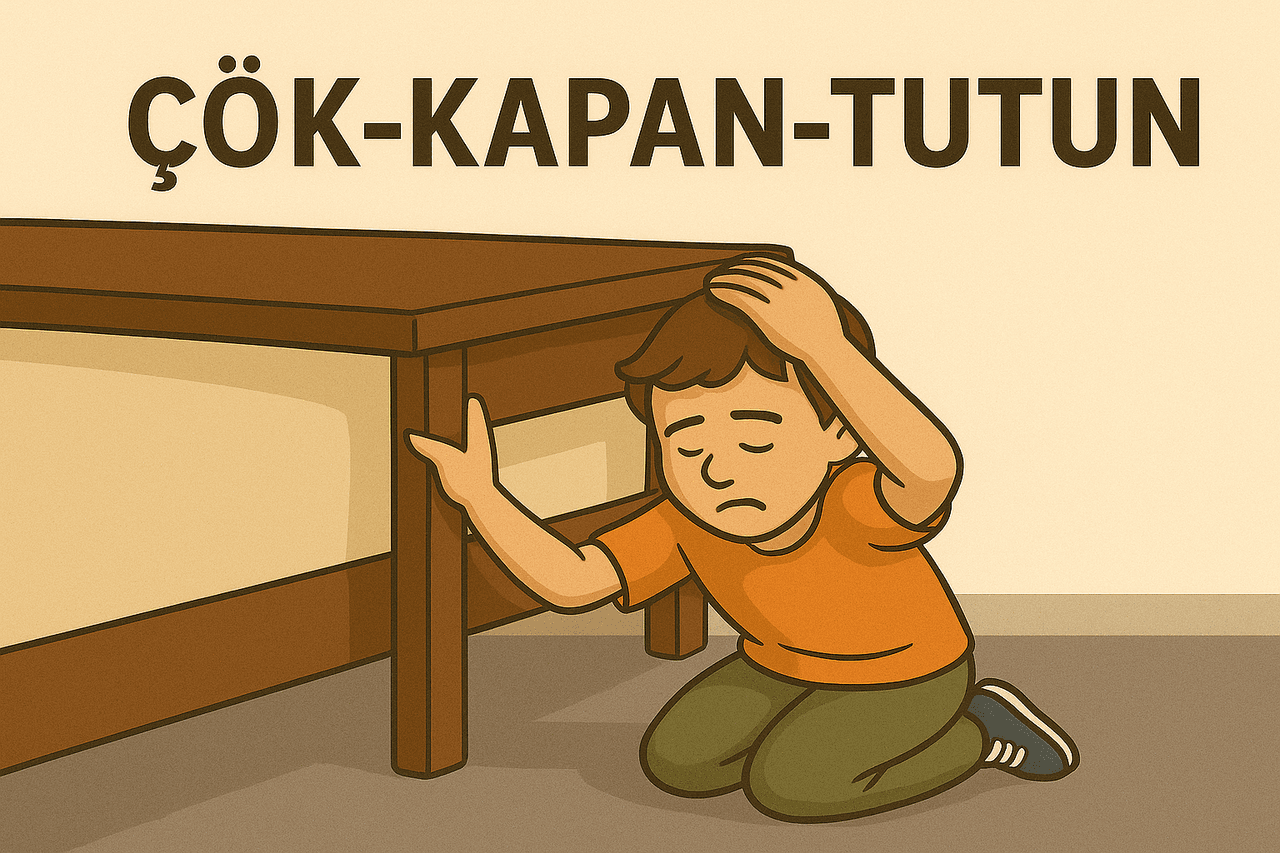
Drop, Cover, and Hold On Method. (Generated by artificial intelligence.)
The Drop, Cover, and Hold On method is designed to be applicable in any environment where an individual may be located—such as homes, schools, workplaces, public buildings, and shopping centers. Key considerations during implementation include:
In residential settings, beds, chairs, and fixed tables are considered primary shelter objects. In schools, desks and chairs serve this purpose. In workplaces, office desks and structural columns are the main protective elements.
In Türkiye, the Drop, Cover, and Hold On method is widely taught in education programs conducted at provincial and district levels under the coordination of AFAD. These programs:
During drills, participants are not only provided with theoretical knowledge but also trained in scenario-based practical skills. To enable individuals of all ages to develop this reflex in their everyday environments, education is supported through diagrams, videos, field exercises, and interactive materials.
The Drop, Cover, and Hold On method aims to help individuals develop a conscious “automatic safety behavior.” Instead of reacting randomly during panic, performing a behavior learned through muscle memory reduces trauma risk and increases survival rates. The extremely limited time available during an earthquake makes it essential to learn such reflexive behaviors in advance. Therefore, it is not enough to merely teach the method—it must also be reinforced through repeated practice.
Under its 2022–2025 National Disaster Awareness Strategy Plan, AFAD has defined the “Drop–Cover–Hold On” action as the fundamental disaster response behavior. Additionally, the method is promoted nationwide during national events such as Earthquake Week (1–7 March) and Disaster Drill Day (12 November).
In addition:
The Drop, Cover, and Hold On method is a systematic disaster response behavior that enables individuals to react quickly and effectively during an earthquake, regardless of their location. Due to its ease of application, teachability, and adaptability across diverse environments, it has become one of the foundational elements of Türkiye’s disaster education system.
To ensure the method is consciously applied across society, it is essential to:
Abant İzzet Baysal Üniversitesi. "Hayat Üçgeni." Accessed June 18, 2025. https://deprem.ibu.edu.tr/hayat-ucgeni
Afet ve Acil Durum Yönetimi Başkanlığı (AFAD). "Deprem Anında Neler Yapmalısınız?" Accessed June 18, 2025. https://www.afad.gov.tr/deprem-aninda-neler-yapmalisiniz
Bahçelievler Anadolu Lisesi. "Deprem Bilgilendirme." Accessed June 18, 2025. https://bahcelievleral.meb.k12.tr/icerikler/deprem-bilgilendirme_16240311.html
Disaster and Emergency Management Presidency (AFAD). "AFAD Eğitim Center (AFADEM)." Accessed June 18, 2025. https://www.afad.gov.tr/afadem/deprem
İstanbul İl Afet ve Acil Durum Müdürlüğü. “Deprem Sırasında Hayat Kurtaran Üç Hareket: Çök, Kapan, Tutun.” Accessed June 18, 2025. https://istanbul.afad.gov.tr/deprem-sirasinda-hayat-kurtaran-uc-hareket-cok-kapan-tutun

No Discussion Added Yet
Start discussion for "Crush, Close, Hold Method" article
Components of the Method
Drop (Lower Physical Position)
Cover (Assume Protective Position)
Hold On (Stabilize and Maintain Position)
Application Areas
Education and Awareness Programs
Evaluation from the Perspective of Behavioral Psychology
Legislation and Institutional Implementation in Türkiye