

This article was automatically translated from the original Turkish version.
+1 More
Cunda Island, or officially known as Alibey Island, is the only inhabited member of the 22-island group known as the Ayvalık Islands, belonging to the Balıkesir Province of Ayvalık. Historically referred to by names such as Nesos, Moshonisia, and Yunda, the island is defined by its architectural fabric, historical past, and geographical location.
The island has been known by various names throughout history. In ancient sources (Strabo, Pliny, Herodotus), it was referred to as "Nesos". In Piri Reis’s Kitab-ı Bahriye (1521), it was mentioned as part of the "Yund Islands". During the period of Greek settlement, the name "Moshonisia" or "Moschonesi", meaning "fragrant island", was used, possibly due to the aromatic plants on the island or a corsair named Moshos. Under Ottoman rule, the settlement was known as "Cezire-i Yunda". Since 1980, it has been named "Alibey Island" in honor of Lieutenant Colonel Ali Çetinkaya, who organized resistance in the region during the War of Independence.
Located south of the Edremit Gulf, the island lies in a position that shields the center of Ayvalık from open seas to the north. It has the largest area and settlement extent among the islands surrounding Ayvalık. Administratively, it consists of two neighborhoods: Mithatpaşa and Namık Kemal.
Cunda Island is connected to the mainland by a two-stage bridge system. The first bridge, constructed in 1964 at the Dolap Strait and recognized as Turkey’s first strait bridge, links Cunda to Lale (Soğan) Island. Lale Island, in turn, is connected to the Ayvalık mainland by a 700-meter-long causeway built in 1817 after the sea was filled in. The road distance to Ayvalık center is 8 km, while the sea distance is 3 nautical miles. The island has a Mediterranean climate, with westerly and northwesterly winds prevailing during summer.

View from Cunda Island(Ayvalık Municipality)
Archaeological evidence indicates that human settlement on the island dates back to the Bronze Age. After the Aegean migrations of the 12th century BCE, the region was settled by Aeolian tribes. In the 10th century, as the ancient city of Nesos declined in importance, a new settlement was established to the south under the name Moshonisia.
When the island came under Ottoman administration in the 15th century, it remained part of the Midilli Sanjak. In 1862, it gained independent municipal status separate from Ayvalık. The 1923 Treaty of Lausanne and the population exchange altered the island’s demographic structure. The Greek population migrated to Greece, while Muslim Turkish populations from Crete and Midilli were resettled on the island.
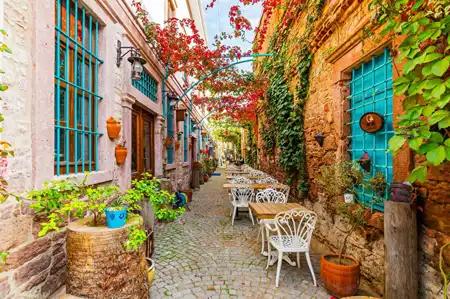
Cunda Island was declared a natural and historical conservation area by the High Council for Immovable Cultural and Historical Monuments in 1976. The settlement pattern exhibits two distinct characteristics: a grid-plan layout and an organic layout. The organic (curvilinear) street pattern dominates around Aşıklar Tepesi, the island’s highest point, while the coastal zone and slopes in the south feature a grid-plan layout with streets intersecting at right angles.
Traditional residential architecture consists mostly of buildings constructed in the second half of the 19th century, displaying Neoclassical features. Key characteristics include:
Historically, the island’s economy was based on olive cultivation, viticulture, and fishing. Today, tourism has become one of its primary economic activities. During the tourist season, the island’s population can increase eight to ten times its permanent population of approximately 2,400. Some of the historic buildings have been converted into boutique hotels, restaurants, and cafés to support tourism.
Atay, Lütfi, and Oğuzhan Dülgaroğlu. “Markalaşma Açısından Cunda Adası’nın Destinasyon Kişiliğinin Tespitine Yönelik Bir Çalışma.” *Balıkesir Üniversitesi Sosyal Bilimler Enstitüsü Dergisi* 20, no. 38 (2017): 383–396. Accessed February 18, 2026. https://dergipark.org.tr/en/download/article-file/852278
Ayvalık Belediyesi. "Cunda Adası." Kültür ve Turizm. Accessed February 18, 2026. https://ayvalik.bel.tr/Kultur/Detay?kulturId=816b2e04-23aa-4636-acc2-1503ccafb9ec
Erdem, Ayten, Rabia Özakin, and Uzay Yergün. “Ayvalık (Balıkesir) Alibey/Cunda Adası Kentsel Mimarlık Envanteri 2005-2006.” Accessed February 18, 2026. https://dergipark.org.tr/tr/download/article-file/1343445
T.C. Ministry of Environment, Urbanization and Climate Change, Balıkesir Provincial Directorate. "5000-KANIP-20230804140523." Accessed February 18, 2026. https://webdosya.csb.gov.tr/db/balikesir/duyurular/5000-kanip-20230804140523.pdf
Özer Baş, Gizem. “Geleneksel Mimarlık Bağlamında Sürdürülebilir Bir Kalkınma Önerisi: Cunda Adası Örneği.” *Kent Akademisi* 17 (2024): 84–102. Accessed February 18, 2026. https://dergipark.org.tr/en/download/article-file/4005299

Etymology and Nomenclature
Geography and Transportation
History
Architectural Fabric and Urban Structure
Economy