badge icon

This article was automatically translated from the original Turkish version.

Article

Curium (Cm)

Physics

+1 More

Küriyum elementi.jpg
Curium
Periodic Table
7
Chemical Symbol
cm
Atomic Number
96
Group
Actinides
Electron Configuration
[Rn]5f⁷6d¹7s²
Density
13.51 g/cm³
Melting Point
1345 °C
Atomic Radius
2.450 Å
Appearance
Silveryradioactive metal
Important Isotopes
²⁴³Cm²⁴⁸Cm²⁴²Cm²⁴⁴Cm²⁴⁷Cm
Year of Discovery
1944
Discoverers
G. SeaborgR. JamesA. Ghiorso
Natural Occurrence
In trace amounts in uranium ores / Synthetic

Curium is a radioactive, silvery metallic element in the actinide series of the periodic table, with atomic number 96 and chemical symbol Cm. It is named after the pioneering scientists in the field of radioactivity, Marie and Pierre Curie.

Classification and Fundamental Properties

Curium is the eighth element in the 7th period of the periodic table within the actinide group. Its electron configuration is [Rn]5f⁷6d¹7s². This electronic structure determines its chemical behavior and its common oxidation state of +3. As a heavy actinide, all of its known isotopes are radioactive. It exists as a solid at room temperature and exhibits metallic properties. Upon exposure to air, its surface rapidly dulls. Its density is reported as 13.51 g/cm³.

Discovery

The element curium was first synthesized in 1944 by American scientists Glenn T. Seaborg, Ralph A. James, and Albert Ghiorso at the Metallurgical Laboratory of the University of Chicago, as part of the Manhattan Project. This discovery was achieved by bombarding plutonium-239 (²³⁹Pu) with alpha particles (helium nuclei) in a cyclotron, producing the isotope curium-242 (²⁴²Cm) and a neutron. The nuclear reaction equation is as follows:

<span class="katex"><span class="katex-html" aria-hidden="true"><span class="base"><span class="strut" style="height:1.1901em;vertical-align:-0.345em;"></span><span class="mord"><span class="mopen nulldelimiter"></span><span class="mfrac"><span class="vlist-t vlist-t2"><span class="vlist-r"><span class="vlist" style="height:0.8451em;"><span style="top:-2.655em;"><span class="pstrut" style="height:3em;"></span><span class="sizing reset-size6 size3 mtight"><span class="mord mtight"><span class="mord mtight">239</span></span></span></span><span style="top:-3.23em;"><span class="pstrut" style="height:3em;"></span><span class="frac-line" style="border-bottom-width:0.04em;"></span></span><span style="top:-3.394em;"><span class="pstrut" style="height:3em;"></span><span class="sizing reset-size6 size3 mtight"><span class="mord mtight"><span class="mord mtight">94</span></span></span></span></span><span class="vlist-s">​</span></span><span class="vlist-r"><span class="vlist" style="height:0.345em;"><span></span></span></span></span></span><span class="mclose nulldelimiter"></span></span><span class="mord mathnormal" style="margin-right:0.13889em;">P</span><span class="mord mathnormal">u</span><span class="mspace" style="margin-right:0.2222em;"></span><span class="mbin">+</span><span class="mspace" style="margin-right:0.2222em;"></span></span><span class="base"><span class="strut" style="height:1.1901em;vertical-align:-0.345em;"></span><span class="mord"><span class="mopen nulldelimiter"></span><span class="mfrac"><span class="vlist-t vlist-t2"><span class="vlist-r"><span class="vlist" style="height:0.8451em;"><span style="top:-2.655em;"><span class="pstrut" style="height:3em;"></span><span class="sizing reset-size6 size3 mtight"><span class="mord mtight"><span class="mord mtight">2</span></span></span></span><span style="top:-3.23em;"><span class="pstrut" style="height:3em;"></span><span class="frac-line" style="border-bottom-width:0.04em;"></span></span><span style="top:-3.394em;"><span class="pstrut" style="height:3em;"></span><span class="sizing reset-size6 size3 mtight"><span class="mord mtight"><span class="mord mtight">4</span></span></span></span></span><span class="vlist-s">​</span></span><span class="vlist-r"><span class="vlist" style="height:0.345em;"><span></span></span></span></span></span><span class="mclose nulldelimiter"></span></span><span class="mord mathnormal">He</span><span class="mspace" style="margin-right:0.2778em;"></span><span class="mrel">→</span><span class="mspace" style="margin-right:0.2778em;"></span></span><span class="base"><span class="strut" style="height:1.1901em;vertical-align:-0.345em;"></span><span class="mord"><span class="mopen nulldelimiter"></span><span class="mfrac"><span class="vlist-t vlist-t2"><span class="vlist-r"><span class="vlist" style="height:0.8451em;"><span style="top:-2.655em;"><span class="pstrut" style="height:3em;"></span><span class="sizing reset-size6 size3 mtight"><span class="mord mtight"><span class="mord mtight">242</span></span></span></span><span style="top:-3.23em;"><span class="pstrut" style="height:3em;"></span><span class="frac-line" style="border-bottom-width:0.04em;"></span></span><span style="top:-3.394em;"><span class="pstrut" style="height:3em;"></span><span class="sizing reset-size6 size3 mtight"><span class="mord mtight"><span class="mord mtight">96</span></span></span></span></span><span class="vlist-s">​</span></span><span class="vlist-r"><span class="vlist" style="height:0.345em;"><span></span></span></span></span></span><span class="mclose nulldelimiter"></span></span><span class="mord">​</span><span class="mord mathnormal" style="margin-right:0.07153em;">C</span><span class="mord mathnormal">m</span><span class="mspace" style="margin-right:0.2222em;"></span><span class="mbin">+</span><span class="mspace" style="margin-right:0.2222em;"></span></span><span class="base"><span class="strut" style="height:1.1901em;vertical-align:-0.345em;"></span><span class="mord"><span class="mopen nulldelimiter"></span><span class="mfrac"><span class="vlist-t vlist-t2"><span class="vlist-r"><span class="vlist" style="height:0.8451em;"><span style="top:-2.655em;"><span class="pstrut" style="height:3em;"></span><span class="sizing reset-size6 size3 mtight"><span class="mord mtight"><span class="mord mtight">0</span></span></span></span><span style="top:-3.23em;"><span class="pstrut" style="height:3em;"></span><span class="frac-line" style="border-bottom-width:0.04em;"></span></span><span style="top:-3.394em;"><span class="pstrut" style="height:3em;"></span><span class="sizing reset-size6 size3 mtight"><span class="mord mtight"><span class="mord mtight">1</span></span></span></span></span><span class="vlist-s">​</span></span><span class="vlist-r"><span class="vlist" style="height:0.345em;"><span></span></span></span></span></span><span class="mclose nulldelimiter"></span></span><span class="mord mathnormal">n</span></span></span></span>


Due to its discovery during World War II, the element was kept secret for a period and only revealed to the public after the war.
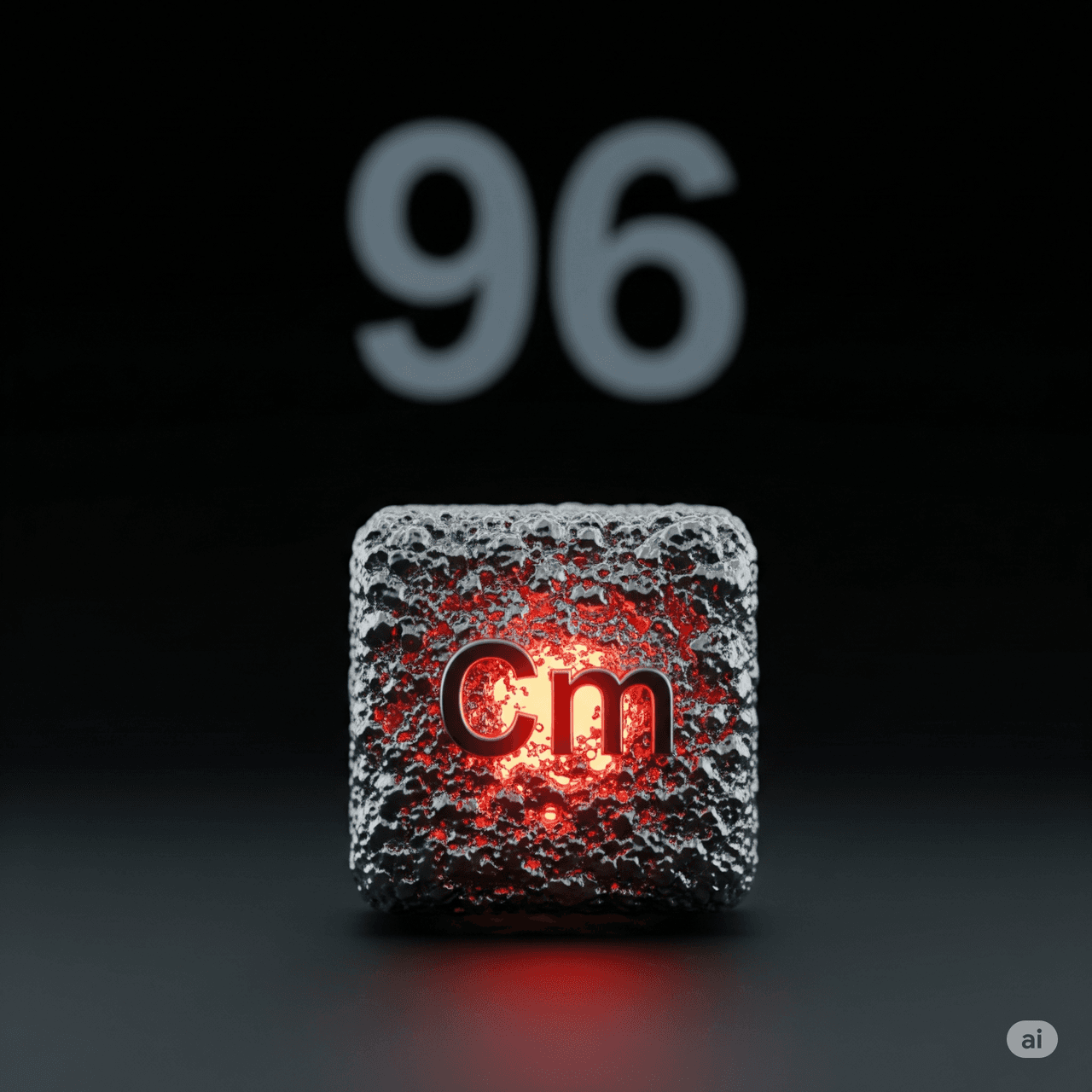

Curium (Generated by Artificial Intelligence.)

Etimology

The element curium was named in honor of the Nobel Prize-winning scientists Marie Skłodowska Curie (1867–1934) and Pierre Curie (1859–1906), who made pioneering contributions to the study of radioactivity. This naming followed the same pattern as that of gadolinium, its lanthanide homolog, which is named after the Finnish chemist Johan Gadolin.

Physical and Chemical Properties

Curium (Cm) is a silvery, radioactive metal. It exists as a solid at room temperature and has a density of 13.51 g/cm³. Its melting point is 1345 °C and its atomic radius is 2.450 Å.


Chemically, curium is a highly reactive metal and oxidizes rapidly upon exposure to air. It most commonly exhibits the +3 oxidation state in its compounds, although the +4 oxidation state is also observed. It dissolves readily in acids. Due to its intense alpha radiation, it has a self-heating property, which can cause it to glow faintly in the dark.

Natural Occurrence and Production

Curium is a predominantly synthetic element and does not occur in nature in significant quantities. However, trace amounts can form in uranium ores through natural decay chains and neutron capture reactions.


Industrial or research-grade curium is produced by prolonged and intense neutron bombardment of lighter actinides such as plutonium in nuclear reactors. During this process, target nuclei undergo successive neutron captures followed by beta decays, transforming into heavier elements, including curium. The quantities produced are typically on the scale of grams or kilograms; annual production is estimated at only a few grams.

Isotopes

Curium has more than twenty known radioactive isotopes, with mass numbers ranging from 233 to 251. ²⁴³Cm and ²⁴⁸Cm are notable isotopes.

  • Curium-242 (²⁴²Cm): Has a half-life of approximately 163 days. It is a strong alpha emitter and consequently generates significant heat. It has been investigated as a potential heat source in radioisotope thermoelectric generators (RTGs).
  • Curium-244 (²⁴⁴Cm): Has a half-life of approximately 18.1 years. Like ²⁴²Cm, it is a potent alpha emitter and has been used in RTGs.
  • Curium-247 (²⁴⁷Cm): With a half-life of about 15.6 million years, it is the longest-lived curium isotope.
  • Curium-248 (²⁴⁸Cm): Has a half-life of approximately 348,000 years. It is used as a target material for synthesizing heavier elements.

Applications

The primary applications of curium stem from its radioactive properties:

  • Radioisotope Thermoelectric Generators (RTGs): Certain curium isotopes, such as ²⁴²Cm and ²⁴⁴Cm, generate substantial heat due to their intense alpha emissions. This heat is converted directly into electricity via the thermoelectric effect, making them long-lasting and reliable power sources, particularly in space missions such as those involving space probes and interplanetary exploration vehicles.
  • Alpha Particle Sources: Curium isotopes serve as alpha particle sources in alpha particle X-ray spectrometers (APXS). These instruments have been used in space missions, including Mars rovers, to perform elemental analysis of rocks and soils.
  • Production of Heavier Elements: Long-lived isotopes, especially ²⁴⁸Cm, are used as target materials in particle accelerators for synthesizing heavier transactinide elements.
  • Scientific Research: Curium is used in fundamental scientific research on actinide chemistry, nuclear structure, and fission processes.

Biological Role and Effects

Curium has no known biological role. All of its isotopes are radioactive and therefore hazardous and toxic to living organisms. If introduced into the body (via inhalation, ingestion, or open wounds), it can accumulate in bones, the liver, and other organs. The alpha particles and decay products it emits can cause tissue damage and increase the risk of cancer. Consequently, all work with curium is conducted under strict radiation safety and contamination control protocols in specialized laboratories equipped with hot cells or glove boxes designed for high-level shielding.

Author Information

Avatar
AuthorCaner Sefa KoçyiğitDecember 4, 2025 at 2:32 PM

Tags

Discussions

No Discussion Added Yet

Start discussion for "Curium (Cm)" article

View Discussions

Contents

  • Classification and Fundamental Properties

  • Discovery

  • Etimology

  • Physical and Chemical Properties

  • Natural Occurrence and Production

  • Isotopes

  • Applications

  • Biological Role and Effects

Ask to Küre