

This article was automatically translated from the original Turkish version.
+2 More
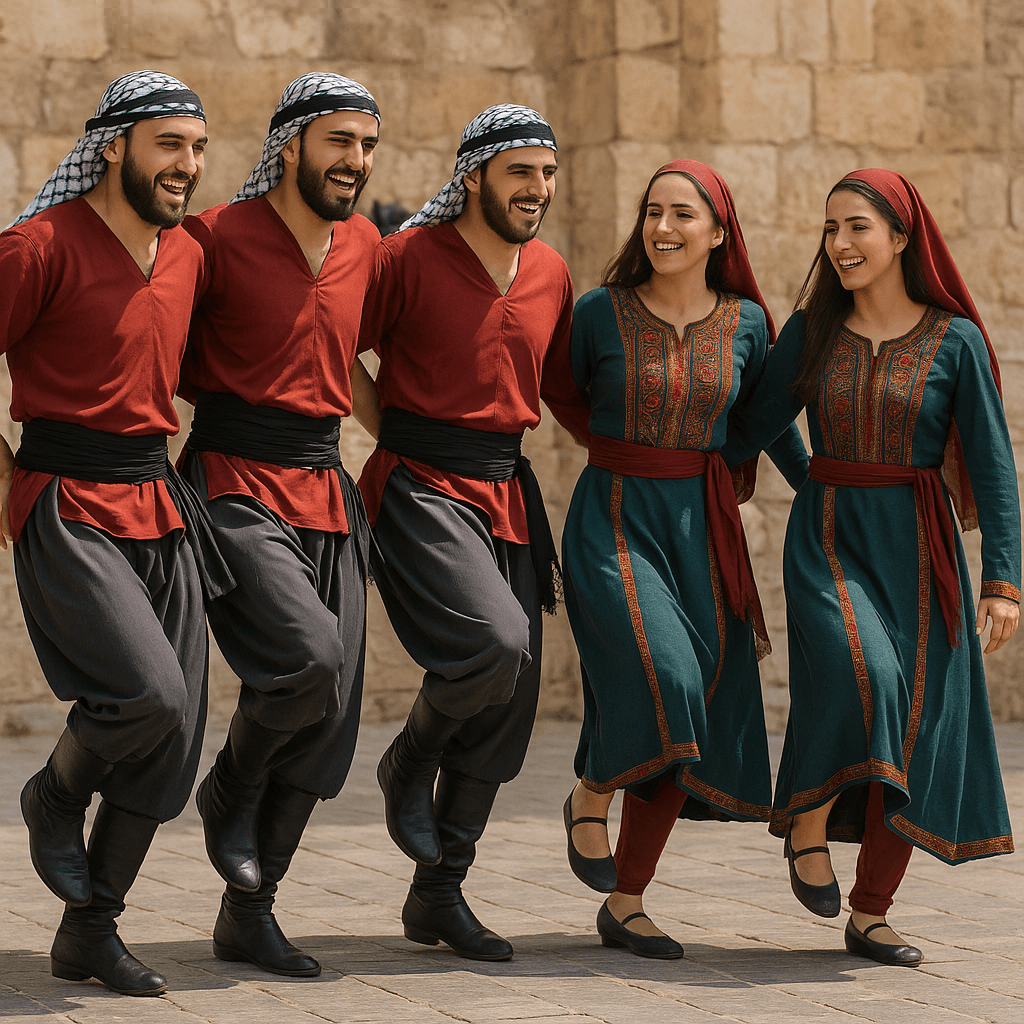
Dabke (Generated by Artificial Intelligence.)
Type(s) | Community-based folk dance (Intangible Cultural Heritage) | ||||||||
|---|---|---|---|---|---|---|---|---|---|
Arabic Name | Dabkeh / Dabke | ||||||||
Geographical Distribution | Palestine, Lebanon, Syria, Jordan and surrounding areas; diaspora communities (especially in Europe and North America) | ||||||||
UNESCO Status | List of Intangible Cultural Heritage (2023) | ||||||||
Origin(s) | Tradition of solidarity arising from collective rhythmic movements during the repair of earthen roofed houses | ||||||||
Instruments Used | Ney, Xurna, Kaval (wind instruments), Darbuka, Davul, Def (percussion instruments) | ||||||||
Musical Structure and Rhythm | Rhythmic patterns of 4/4 or 6/8 determined by regular heel and foot strikes, based on Zajal-style oral songs | ||||||||
Performance Style | Women: embroidered long dresses and headscarves; men: baggy trousers, belt and keffiyeh, typically in red, black and beige tones | ||||||||
Theme(s) | Solidarity Community Cohesion Cultural Continuity Identity Celebration | ||||||||
Dabke is a community-based folk dance widely performed in the Levant region (Palestine, Lebanon, Syria, Jordan, and surrounding areas). Historically combining elements of entertainment and solidarity, this dance was inscribed in 2023 on UNESCO’s Intangible Cultural Heritage List. Dabke is performed by both men and women, with dancers forming a straight line or semicircle, holding hands and stepping in synchronized motion.

Dabke Dance (AA)
The origins of Dabke are rooted in the rural life of the Middle East, particularly in traditions of social solidarity and collective labor. In the past, when villagers repaired the earthen roofs of homes, neighbors would gather and rhythmically stomp their heels on the ground while holding each other’s shoulders to compact the roof structure. It is believed that these coordinated movements gradually acquired an aesthetic dimension and evolved into a dance. Thus, Dabke became embedded in cultural life as a symbol of shared labor and social cohesion.
This rural practice eventually migrated to urban settings and became an integral part of celebrations and social events. Adopted by diverse communities, Dabke has been shaped by local musical traditions and has survived to the present day.
Dabke is performed in different forms in Palestine as well as in Lebanon, Syria, and Jordan. Each country has adapted its own musical traditions and rhythmic patterns into the dance’s structure. In southern Türkiye, particularly in the Hatay region, similar figures appear in the cultural life of Arab Alawi communities. Field research in Hatay has shown that the dance is performed in ways resembling the Turkish halay and is integrated with local melodies. Some Dabke songs from regional repertoires have been transcribed into musical notation, their melodic structures linked to the maqam system, and enriched with improvisations.
Diaspora communities have also adapted Dabke to their own cultural contexts. In the example of “Afro-Dabke” developed within the Palestinian diaspora, rhythmic elements from Cameroon have been combined with Palestinian music, creating a rhythm-based interaction between the two cultures.

Dabke Dance (Generated by Artificial Intelligence.)
Dabke is a dance form that unites vocal music and rhythmic movement. In traditional performances, songs are typically sung in the zajal style and supported by local melodies. The musical structure is created using wind instruments such as the ney, kaval, zurna, and flute, along with percussion instruments like the darbuka, davul, and def.
Dancers internalize the rhythm through heel and foot stomps, generating a strong tempo that aligns with the music. Movements include small jumps, turns, and short sequences of steps. The rhythmic pattern is the central element that defines both the energy and the communal harmony of Dabke.
In some regions, the songs accompanying Dabke are improvised. Lyrics commonly focus on themes of love, community solidarity, and the joy of life. Music blends seamlessly with the dance to encourage collective participation.
Throughout history, Dabke has been performed during social celebrations and solidarity events. It is danced on special occasions such as weddings, harvest festivals, holidays, and graduation ceremonies. In these contexts, Dabke strengthens communal awareness and contributes to the transmission of cultural heritage.
In Palestine, Dabke is regarded not merely as a form of entertainment but as an active practice for preserving cultural identity. Within political and social processes, it helps sustain collective memory. For younger generations in the diaspora, Dabke serves as a cultural element that transmits a sense of belonging.
Traditional Palestinian Dance Dabke (UNESCO)
Today, Dabke is also performed professionally through stage presentations. University groups, cultural centers, and civil society organizations organize events to teach and promote the dance.
Historically, the transmission of Dabke occurred within family settings and community celebrations. Children learned the steps by observing and participating in the dances of elders. This mode of learning is part of oral culture.
UNESCO’s evaluation documents note that Dabke is kept alive through social participation, celebrations, and educational programs. 【1】 Documentation, video recordings, music archives, and instructional workshops are used to preserve the dance. In Palestine, some cultural institutions run training programs for young dancers, enabling traditional figures to merge with modern interpretations.
Academic research in Türkiye also contributes to this process. In the Hatay region, efforts to transcribe the regional repertoire, convert oral sources into written form, and document local performers have been instrumental in safeguarding the tradition.

Dabke Dance (Generated by Artificial Intelligence.)
Historically emerging as a rhythmic expression of communal cooperation, Dabke has become one of the shared cultural elements of the Levant. Its rhythmic structure embodies communal harmony and solidarity. Passed from generation to generation, this dance continues to thrive today in both traditional and modern forms. Its inscription on UNESCO’s Intangible Cultural Heritage List has contributed to its global recognition and enhanced efforts toward its preservation.
Al Jazeera. "Afro Dabke: Where Palestine and Cameroon Meet to Dance." Accessed October 6, 2025. https://www.aljazeera.com/features/2023/9/28/afro-dabke-where-palestine-and-cameroon-meet-to-dance.
Anadolu Ajansı. “Filistinlilerin Geleneksel Halk Oyunu Dabke UNESCO Somut Olmayan Kültürel Miras Listesine Girdi.” Accessed October 6, 2025. https://www.aa.com.tr/tr/kultur/filistinlilerin-geleneksel-halk-oyunu-dabke-unesco-somut-olmayan-kulturel-miras-listesine-girdi/3074132.
Mire, Leila. "I’m Just Here for the Dabke." Theatre Academy. Accessed October 6, 2025. https://doi.org/10.62425/theatreacademy.1714832.
Pérez, Juan Bernardo Pineda. "Dabke Dansındaki Hareket Halindeki Vücudun Yazımı ve Filaes De Moros Şenliklerinin Dinlerarasi Öğesi." Motif Akademi Halkbilimi Dergisi. Accessed October 6, 2025. https://dergipark.org.tr/tr/pub/mahder/issue/28383/301745.
UNESCO. “Dabkeh, Traditional Dance in Palestine.” UNESCO Intangible Cultural Heritage. Accessed October 6, 2025. https://ich.unesco.org/en/RL/dabkeh-traditional-dance-in-palestine-01998
UNESCO. “Dabkeh, Traditional Dance in Palestine.” UNESCO YouTube Channel. Accessed October 6, 2025. https://www.youtube.com/watch?v=VBQx3BXZ_74.
[1]
UNESCO, “Dabkeh, Traditional Dance in Palestine,” UNESCO Intangible Cultural Heritage, erişim tarihi 6 Ekim 2025, https://ich.unesco.org/en/RL/dabkeh-traditional-dance-in-palestine-01998

Dabke (Generated by Artificial Intelligence.)
Type(s) | Community-based folk dance (Intangible Cultural Heritage) | ||||||||
|---|---|---|---|---|---|---|---|---|---|
Arabic Name | Dabkeh / Dabke | ||||||||
Geographical Distribution | Palestine, Lebanon, Syria, Jordan and surrounding areas; diaspora communities (especially in Europe and North America) | ||||||||
UNESCO Status | List of Intangible Cultural Heritage (2023) | ||||||||
Origin(s) | Tradition of solidarity arising from collective rhythmic movements during the repair of earthen roofed houses | ||||||||
Instruments Used | Ney, Xurna, Kaval (wind instruments), Darbuka, Davul, Def (percussion instruments) | ||||||||
Musical Structure and Rhythm | Rhythmic patterns of 4/4 or 6/8 determined by regular heel and foot strikes, based on Zajal-style oral songs | ||||||||
Performance Style | Women: embroidered long dresses and headscarves; men: baggy trousers, belt and keffiyeh, typically in red, black and beige tones | ||||||||
Theme(s) | Solidarity Community Cohesion Cultural Continuity Identity Celebration | ||||||||
Historical Origins
Geographical Spread and Regional Variants
Musical and Rhythmic Structure
Social Function and Meaning
Cultural Transmission and Preservation Efforts