


This article was automatically translated from the original Turkish version.
+2 More

(Generated with Artificial Intelligence.)
Digital Anthropology
Object of Study | cyber culture and human interaction Digital technologies | ||||||||
|---|---|---|---|---|---|---|---|---|---|
Related Disciplines | Media Studies Computer Science (HCI) Sociology | ||||||||
Foundational Concepts | Algorithmic Culture Virtual Community Cyberspace | ||||||||
Core Methodology | Participant Observation Netnography Digital Ethnography | ||||||||
Historical Origin | Late 1990s (evolution from Cyber Anthropology) | ||||||||
Field | Social Sciences | ||||||||
Digital anthropology is a field of study that examines the impact of digital technologies on social structures, cultural interactions and individual identity processes using anthropological theory and methods. This field treats technology not merely as a physical tool but as an environment in which social relations and cultural production occur. Since the 1990s, as internet usage became widespread, the cultural construction of data, social organizations in cyberspace, and human experiences established through digital media have formed the core subjects of this field.
The methodological framing of digital anthropology emerged with the public accessibility of the internet in the 1990s and the entry of the concept of cyberspace into academic literature.
The evolution of this process is generally classified into three phases in the literature:

Digital Anthropology Modeling (Generated by Artificial Intelligence)
Digital anthropology research is conducted through the adaptation of traditional anthropological techniques to digital media, within the framework of new ethical standards that have emerged during this process. The discipline’s foundational methodological approach, ethnography, has taken on different forms in digital contexts, such as “digital ethnography” or “virtual ethnography.” Within this method, the researcher directly participates in digital platforms to analyze data sets composed of texts, images, video recordings, and user interactions. The participant observation process involves simultaneously tracking users’ relationships with digital tools both in online environments and in physical spaces.
The blurring of boundaries between public and private digital data necessitates the application of specific ethical procedures in fieldwork. In this context, participants must be clearly informed about the purpose of data usage and their consent must be obtained, with procedures tailored to the nature of the study. To protect participants’ identities, pseudonyms are used, profile information is anonymized, and data is stored in secure environments, all of which are standard academic practices. Ownership rights of user-generated content and platform data policies are also evaluated within the framework of research ethics. The extent to which the researcher discloses their presence in the digital environment is determined according to established protocols in the literature, in relation to the reliability and ethical approval of the study.
Digital ethnography is the adaptation of anthropology’s core research method, ethnography, to digital environments and interactions. This method examines the manifestations of social life in digital media, the unique cultural logic of these media, and the meaning systems humans construct through digital tools. As in traditional ethnography, the primary aim is to describe a cultural group or social phenomenon from an insider’s perspective. However, in this process, the concept of field is defined not by physical geography but through internet forums, social media platforms, gaming worlds, and other digital networks.
The research process is based on the researcher’s direct participation in the digital environment under study and the observation of practices within it. During data collection, user-generated texts, images, interaction metrics (likes, shares, etc.), and the architectural structure of digital spaces are accepted as primary materials. In digital ethnography, “participant observation” means not merely observing but actively engaging in the production processes of digital culture and analyzing how users instrumentalize these media. This method focuses on the qualitative meanings these data express within their social context rather than on their quantitative scale.
In its application, the distinction between “online” and “offline” is addressed in contemporary literature through an integrated perspective. Researchers can work in mixed fields to trace the impact of digital practices on physical life or how dynamics of the physical world are reflected in digital environments. Digital ethnography is an objective research procedure that seeks to document how technologies are adapted and transformed by local communities into forms of cultural expression, without falling into technological determinism.
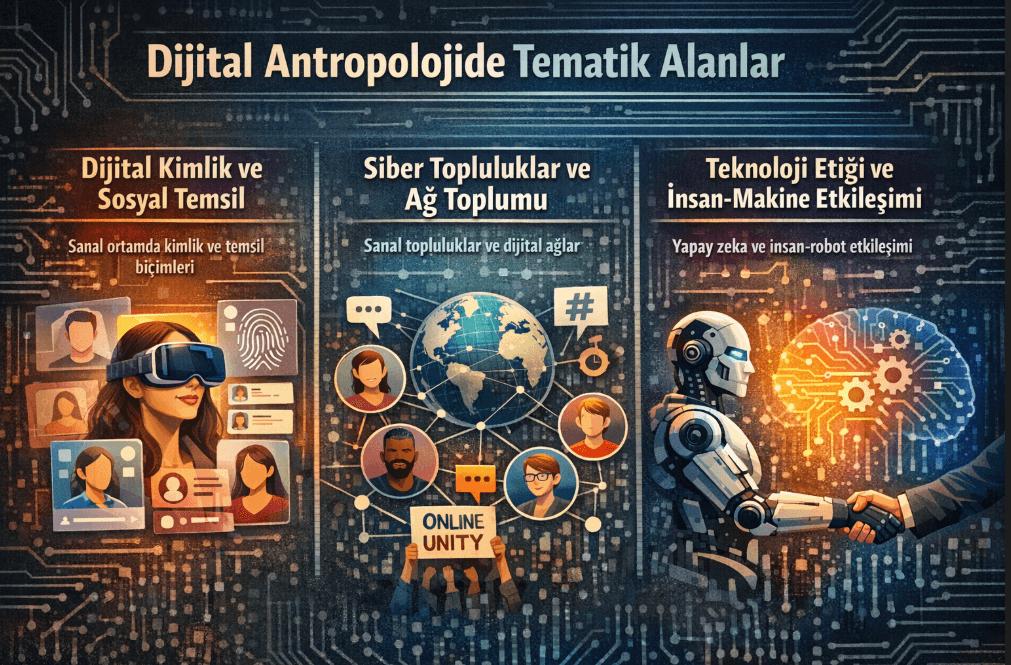
Thematic Areas in Digital Anthropology (Generated by Artificial Intelligence)
The ways individuals and communities represent themselves on digital platforms are examined as virtual extensions of identity construction. This area investigates how digital avatars, user profiles, and algorithm-based identity recommendations shape social identity. Concepts of national identity and selfhood are analyzed through the use of cultural markers and local content production in digital environments.
Social networks, forums, and virtual worlds that develop independently of physical space are defined as “cyber communities.” Digital anthropology examines how these communities establish their own norms, value systems, and hierarchical structures. In this context, the role of digital networks in social movements, solidarity practices, and collective memory is documented using empirical data.
The integration of artificial intelligence and robotic systems into human life is addressed by the discipline under the headings of “posthumanism” and “algorithmic culture.” Cultural biases in technological design processes (algorithmic bias) and the potential of digital tools to shape human behavior fall within the ethical and technical scope of inquiry.
Boellstorff, Tom D. "Digital Anthropology." University of California eScholarship. Accessed January 4, 2026. https://escholarship.org/content/qt94j4h0p4/qt94j4h0p4.pdf
Budka, Philipp. "From Cyber to Digital Anthropology to an Anthropology of the Contemporary." German Anthropological Association. Accessed January 4, 2026. https://d1wqtxts1xzle7.cloudfront.net/88371801/budka_dgv_cyberculture_paper3-libre.pdf?1657343808
Miller, Daniel. “Open Access, Scholarship, and Digital Anthropology.” *HAU: Journal of Ethnographic Theory* 2, no. 1 (2012): 385–411. Accessed January 4, 2026. https://www.journals.uchicago.edu/doi/full/10.14318/hau2.1.016
Rode, Jennifer A. “Reflexivity in Digital Anthropology.” *Proceedings of the SIGCHI Conference on Human Factors in Computing Systems* 7, no. 12 (2011): 123–132. New York: ACM, 2011. Accessed January 4, 2026. https://dl.acm.org/doi/abs/10.1145/1978942.1978961

(Generated with Artificial Intelligence.)
Digital Anthropology
Object of Study | cyber culture and human interaction Digital technologies | ||||||||
|---|---|---|---|---|---|---|---|---|---|
Related Disciplines | Media Studies Computer Science (HCI) Sociology | ||||||||
Foundational Concepts | Algorithmic Culture Virtual Community Cyberspace | ||||||||
Core Methodology | Participant Observation Netnography Digital Ethnography | ||||||||
Historical Origin | Late 1990s (evolution from Cyber Anthropology) | ||||||||
Field | Social Sciences | ||||||||
No Discussion Added Yet
Start discussion for "Digital Anthropology" article
Historical Background
Method and Ethics
Digital Ethnography
Thematic Areas and Objects of Study
Digital Identity and Social Representation
Cyber Communities and Network Society
Technology Ethics and Human-Machine Interaction