This article was automatically translated from the original Turkish version.
Location | Aydın | ||||||||
|---|---|---|---|---|---|---|---|---|---|
Foundation Date | Büyük Menderes Deltası – 1994 Dilek Yarımadası – 1966 | ||||||||
Area(s) | Dilek Yarımadası: 10.985 ha Delta: 16.613 ha | ||||||||
Ecosystems | Vegetation Saline Forest Phrygana Maquis Aquatic Marine Terrestrial | ||||||||
Geomorphological Structure | Bay Canyon Valley Hill | ||||||||
Natural Values | Lade Island Dilek Hill Olukdere Canyon Zeus Cave | ||||||||
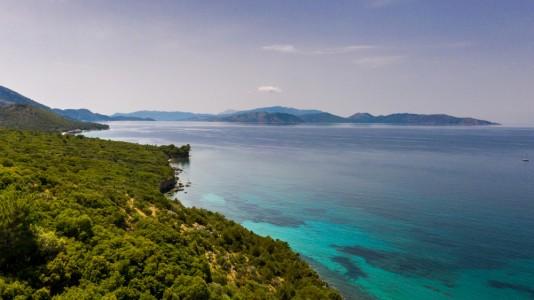
Dilek Peninsula–Big Menderes Delta National Park is a nature conservation area located within the boundaries of the Kuşadası and Söke districts of Aydın Province in the Aegean Region, designated as a national park in two phases between 1966 and 1994. The Dilek Peninsula covers an area of 10,985 hectares and the Big Menderes Delta 16,613 hectares, giving the park a total surface area of 27,598 hectares.

Dilek Peninsula (AA)
The Dilek Peninsula is the southernmost extension of the Samsun Mountains into the Aegean Sea. The highest point of the peninsula is Dilek Tepe at an elevation of 1,237 metres. Geologically, it consists of Paleozoic schists, Mesozoic limestones and marbles, and Neogene sedimentary deposits. The peninsula features numerous peaks, valleys, canyons and coves, while the delta region contains marshes, lagoons, coastal spits, meandering channels and small ponds.
The Dilek Peninsula–Big Menderes Delta National Park attracts attention due to the diverse vegetation types it hosts within its terrestrial, marine and aquatic ecosystems. Four main vegetation types are found within the park boundaries:
These four vegetation types contribute to the park’s high plant diversity over short distances and are among the primary factors determining its biological richness.
A total of 804 plant species have been identified in the national park. Of these, six are locally endemic and 18 are found only in Türkiye. The Dilek Peninsula is the southernmost natural habitat of the Anatolian chestnut and the only area where small forest communities of rare species such as Finike fir, laurustinus (Viburnum tinus), hybrid oak and branched cypress occur. Additionally, numerous plant species including black pine, laurel, sandalwood, various oaks, oleander and heather are present.
The park is also rich in fauna, hosting 28 mammal species, 42 reptiles, 97 bird species and numerous marine organisms. Among these are endangered species such as the Anatolian leopard (Panthera pardus tulliana), Mediterranean monk seal (Monachus monachus), crested pelican (Pelecanus crispus) and pygmy cormorant (Phalacrocorax pygmeus). Other species observed in the region include wolf, fox, wildcat, wild boar, badger and various raptors.
The national park is protected under international agreements including the Bern Convention, the Convention on Biological Diversity (Rio), and the Barcelona Convention. Additionally, the Big Menderes Delta has been designated as a first-degree natural site and an A-class wetland. It has also been declared a “Flora Biogenetic Reserve Area” by the Council of Europe.
Natural values include Zeus Cave, Olukdere Canyon, Dilek Tepe, Lade Island, Aydınlık, İçmeler, Kavaklıburun and Karasu coves. The lagoons, salt marshes and lagoon lakes in the delta region have wetland characteristics.
Historical settlements within the park boundaries include ancient cities such as Panionion, Priene, Miletus and Thebai, as well as the historic village of Eski Doğanbey.
Ecotourism activities in the national park include hiking (trekking), mountain biking, botanical tours, birdwatching, jeep safaris, scientific walks, yacht tours, nature photography, paragliding, scuba diving and agricultural tourism. All these activities are carried out within designated areas and in accordance with established regulations.
Before the establishment of the national park, agriculture, animal husbandry, forestry and fishing were widely practiced in the region. Following its designation as a national park, the use of forest and pasture lands was restricted, and some villagers’ titled lands were expropriated and closed to public use. Today, the local population primarily benefits economically from tourism and the service sector.
Anadolu Ajansı. “Dilek Yarımadası 8 Günde 10 Bin Ziyaretçiyi Ağırladı.” Anadolu Ajansı, June 21, 2020. Accessed July 15, 2025. https://www.aa.com.tr/tr/turkiye/dilek-yarimadasi-8-gunde-10-bin-ziyaretciyi-agirladi/1870784
Bekdemir, Ünsal, and İbrahim Sezer. “Dilek Yarımadası-Büyük Menderes Deltası Milli Parkı ve Yöre Ekonomik Faaliyetleri İlişkisi.” *Doğu Coğrafya Dergisi* 19, no. 19 (2007): 325–341. Accessed July 15, 2025. https://dergipark.org.tr/tr/download/article-file/26614
Kuşadası Belediyesi. "Dilek Yarımadası." Accessed July 15, 2025. https://kusadasi.bel.tr/tr/dilek-yarimadasi-pv20
T.C. Ministry of Agriculture and Forestry, 4th Regional Directorate. "Dilek Yarımadası Büyük Menderes Deltası Milli Parkı." Accessed July 15, 2025. https://bolge4.tarimorman.gov.tr/Documents/D%C4%B0LEK%20YARIMADASI%20B%C3%9CY%C3%9CK%20MENDERES%20DELTASI%20M%C4%B0LL%C4%B0%20PARKI.pdf
T.C. Ministry of Agriculture and Forestry. "Güzelçamlı Koyları İhalesi İlanı." Accessed July 15, 2025. https://www.tarimorman.gov.tr/DKMP/Belgeler/%C4%B0HALE/4.b%C3%B6lge/Guzel%C3%A7amli+Koylar+I_halesi+I_lani.pdf

Location | Aydın | ||||||||
|---|---|---|---|---|---|---|---|---|---|
Foundation Date | Büyük Menderes Deltası – 1994 Dilek Yarımadası – 1966 | ||||||||
Area(s) | Dilek Yarımadası: 10.985 ha Delta: 16.613 ha | ||||||||
Ecosystems | Vegetation Saline Forest Phrygana Maquis Aquatic Marine Terrestrial | ||||||||
Geomorphological Structure | Bay Canyon Valley Hill | ||||||||
Natural Values | Lade Island Dilek Hill Olukdere Canyon Zeus Cave | ||||||||
No Discussion Added Yet
Start discussion for "Dilek Peninsula Büyük Menderes Delta National Park" article
Geomorphology and Ecosystem
Vegetation Types
Flora and Fauna
Conservation Status and International Importance
Natural and Cultural Values
Ecotourism Activities
Economic Activities and Local Impact