
This article was automatically translated from the original Turkish version.
+2 More
Year of Foundation | 1975 – Drogheda United and Drogheda FC 1962 – Official founding of Drogheda FC 1919 (as a youth club) | ||||||||
|---|---|---|---|---|---|---|---|---|---|
Stadium | United Park (from 1927) Showgrounds Magdalene Park | ||||||||
Achievements | Irish League Champion: 2007 Setanta Sports Cup: 2006 2007 FAI Cup Champion: 2005 First Cup (League Cup) 1983 FAI Cup Finalist: 1971 1976 | ||||||||
Crisis Period | 2008: Financial crisis | ||||||||
Sibling Teams | Trivela FC (2024) Silkeborg IF (2024) Walsall FC (2023) Trabzonspor (2010) | ||||||||
Drogheda United Football Club is a professional football club competing in the League of Ireland Premier Division, the top tier of Irish football. Representing the town of Drogheda, the club was founded in 1919 as a youth organization and joined the Dundalk and District League the same year. Within two years it won the league championship. It subsequently competed in various leagues such as the Leinster Senior League and the Sunday Alliance League and participated in numerous youth football tournaments. The club initially played its home matches at Magdalene Park before moving successively to Showgrounds and then to United Park in 1927. The reserve team, established in 1933, eventually developed into a first-team level side. In 1953, Peder Kevin Connolly arrived in Drogheda and played a key role in the founding of Drogheda FC and the development of the Lourdes Stadium.
In June 1963, Drogheda FC was admitted to the League of Ireland. The club finished in the lower half of the table during its first four seasons. In 1969, Mick Meagan was appointed player-manager. The team reached the final of the 1971 FAI Cup but lost to Limerick. Meagan left his position in 1973, and under his successor John Cowan, the club reached the semi-finals of both the Leinster Senior Cup and the FAI Cup.
In 1975, Drogheda United and Drogheda FC merged to form Drogheda United FC. In 1976, the club reached the FAI Cup final for the second time but failed to win the trophy. United Park was officially opened on 12 August 1979. Under Tony Macken, who succeeded Ray Treacy, the club qualified for European competition for the first time in its history. Drawn against Tottenham Hotspur, the team was eliminated after two legs with an aggregate score of 14–0. Although the 1982–1983 league campaign was weak, the club won the League Cup, securing its first major trophy.
Under manager Jim McLaughlin, appointed in 1993, the team was relegated but returned to the top division in 1995. Several managerial changes followed in subsequent years. The 2000–2001 season is recorded as one of the club’s least successful periods. In 2008, the club faced severe financial difficulties and entered temporary administrative protection (examinership). With financial support from supporters, it continued operations but transitioned from full-time professional status to part-time. It was relegated in 2010 but remained in the top division after Sporting Fingal withdrew from the league. In 2011, Mick Cooke became the sixth manager to take charge in a short period.
Drogheda United won the League of Ireland title in 2007. The club’s museum also displays the 2005 FAI Cup and the 2006 and 2007 Setanta Sports Cups.
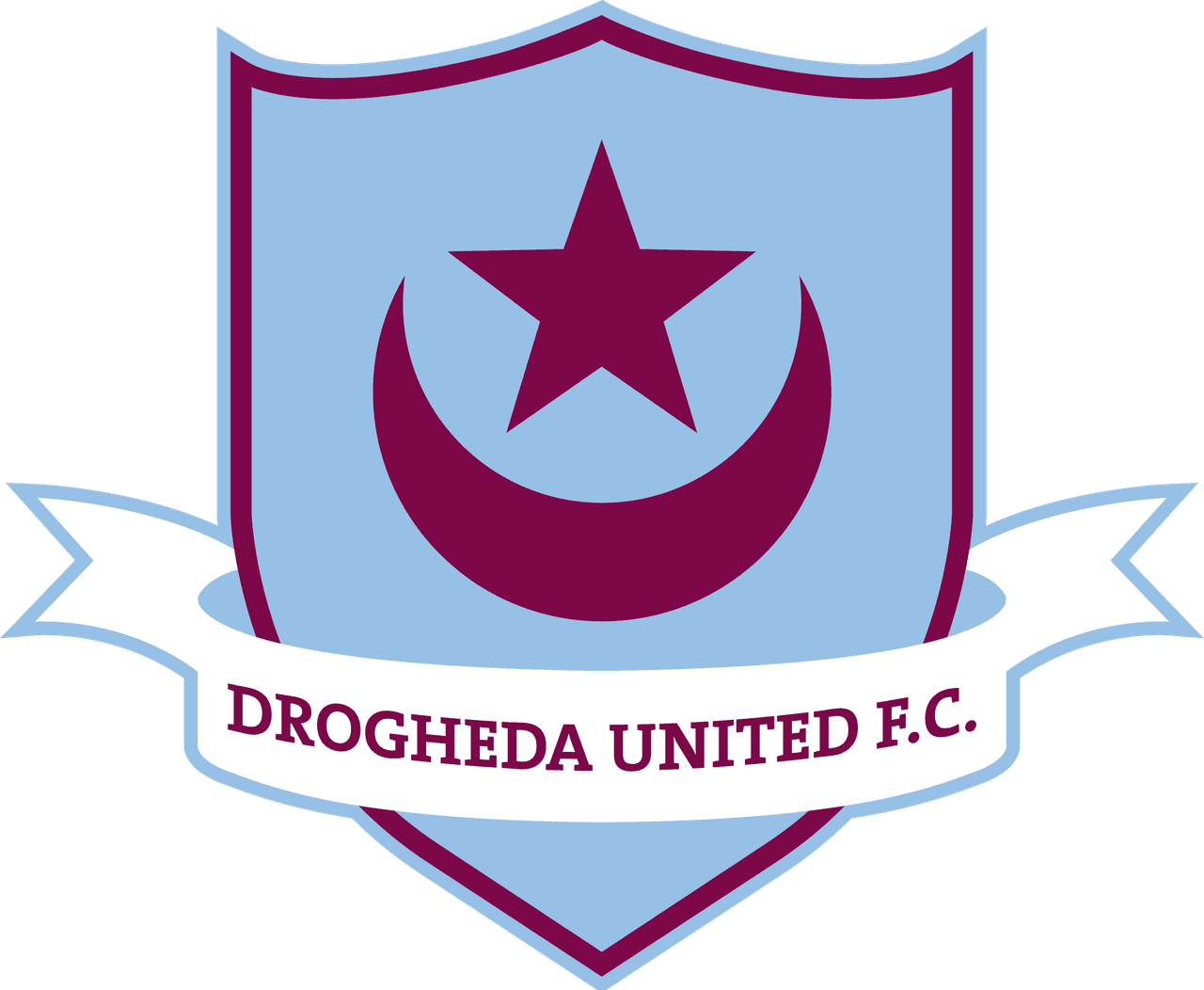
In 2010, a sister-club relationship was established between Drogheda United FC and the Turkish representative Trabzonspor. This bond is based on the similarity between the two clubs’ crests featuring the crescent and star, and on humanitarian aid sent from the Ottoman Empire to Ireland in 1847. During the Great Famine in Ireland between 1845 and 1852, it is recorded that Ottoman Sultan Abdülmecid provided financial assistance and dispatched ships carrying food. Local tradition holds that some of these ships reached Drogheda Harbour. Some sources suggest that the crescent and star on Drogheda United’s crest were adopted in memory of this aid.
However, Irish historians have contested this view, noting that no official records confirm the arrival of Ottoman ships in Irish ports during that period. The Drogheda Historical Society argues that the crescent and star symbol had been in use since 1210, when King John granted the town its charter, long before the Ottoman aid. An 1844 publication by D’Alton notes that the crescent and star appeared on the seal of the town’s mayor.
The crest is centered around St. Laurence’s Gate; the three English lions on the left represent the town’s garrison history, while the ship on the right symbolizes its identity as a port town. The town’s Latin motto, “Deus praesidium, mercatura decus”, translates as “God is our protector, trade is our honour.”
The number of points on the stars used in the crests of various Drogheda institutions — St. John’s Home, Drogheda Steam-Packet Company, and Co. Louth Golf Club — differs from that on Drogheda United’s crest. Drogheda United’s five-pointed star resembles symbols found on the Turkish flag and the Mecidiye Order from the reign of Abdülmecid. In contrast, the town’s official coat of arms features an eight-pointed star; the star at St. John’s Home has seven points, while the one on the coat of arms of King William II has six points. Irish historians assert that the crescent and star motif in Drogheda was adopted in the early 13th century, influenced by the Crusades.
Following the 2023 earthquakes centered in Kahramanmaraş, Türkiye, Drogheda United organized a fundraising campaign to support affected regions. In a social media statement, the club thanked its fans and players for their support of earthquake victims in Türkiye and Syria. This post was shared by Trabzonspor, reaffirming the symbolic friendship between the two clubs. In 2020, during the COVID-19 pandemic, Drogheda United administrators used social media to recall the Ottoman Empire’s historical aid and expressed gratitude to Türkiye for the personal protective equipment sent from Türkiye to Ireland.
Anadolu Ajansı. “İrlanda Takımı Koruyucu Ekipman Yardımı İçin Osmanlı’yı Hatırlatarak Teşekkür Etti.” Accessed July 23, 2025. https://www.aa.com.tr/tr/dunya/irlanda-takimi-koruyucu-ekipman-yardimi-icin-osmanliyi-hatirlatarak-tesekkur-etti-/1815240.
Drogheda United FC. “The History of Drogheda United.” Drogheda United FC. Accessed July 23, 2025. https://droghedaunited.ie/about/.
Kadıoğlu, Muhsin. “İrlanda Kasabası Drogheda’nın ‘Ay-Yıldız’ Sembolünün Kökenleri.” *Türk Dünyası Araştırmaları* 117, no. 230 (2020): 163–176. Accessed July 23, 2025. https://dergipark.org.tr/tr/download/article-file/1514662.
TRT Haber. “Trabzonspor’un Kardeş Kulübü Drogheda United’dan Deprem Bölgesine Yardım.” Accessed July 23, 2025. https://www.trthaber.com/haber/spor/trabzonsporun-kardes-kulubu-drogheda-unitedden-deprem-bolgesine-yardim-746156.html.
Trabzonspor Kulübü. "Kardeş Kulüpler." Trabzonspor Resmî Web Sitesi. Accessed July 23, 2025. https://www.trabzonspor.org.tr/tr/kulup/kardes-kulupler
Yamaç, Müzehher. “İrlanda’da Kıtlık ve Osmanlı Yardımı.” *Journal of Anglo-Turkish Relations* 6, no. 1 (2025): 107–138. Accessed July 23, 2025. https://dergipark.org.tr/tr/download/article-file/4246008

Year of Foundation | 1975 – Drogheda United and Drogheda FC 1962 – Official founding of Drogheda FC 1919 (as a youth club) | ||||||||
|---|---|---|---|---|---|---|---|---|---|
Stadium | United Park (from 1927) Showgrounds Magdalene Park | ||||||||
Achievements | Irish League Champion: 2007 Setanta Sports Cup: 2006 2007 FAI Cup Champion: 2005 First Cup (League Cup) 1983 FAI Cup Finalist: 1971 1976 | ||||||||
Crisis Period | 2008: Financial crisis | ||||||||
Sibling Teams | Trivela FC (2024) Silkeborg IF (2024) Walsall FC (2023) Trabzonspor (2010) | ||||||||
No Discussion Added Yet
Start discussion for "Drogheda United F.C." article
Entry into the League of Ireland and Early Successes
Merger and European Participation
Structural Changes and Championship
Symbols and Historical Context
Disaster Relief