


This article was automatically translated from the original Turkish version.
+1 More
EKG (Electrocardiography) sensor is an electronic module designed to measure and monitor the electrical activity of the heart. These sensors detect bio-potential signals generated by the heart through electrodes placed on the body, amplify, filter, and convert these signals into a format readable by a microcontroller (e.g., Arduino). Commonly used in hobby electronics, biomedical projects, and educational applications, these sensors provide a practical tool for understanding the fundamental operating principles of professional medical devices. By measuring low-amplitude electrical potential differences that occur during each contraction and relaxation of the cardiac muscle, they enable the determination of heart rate and rhythm.
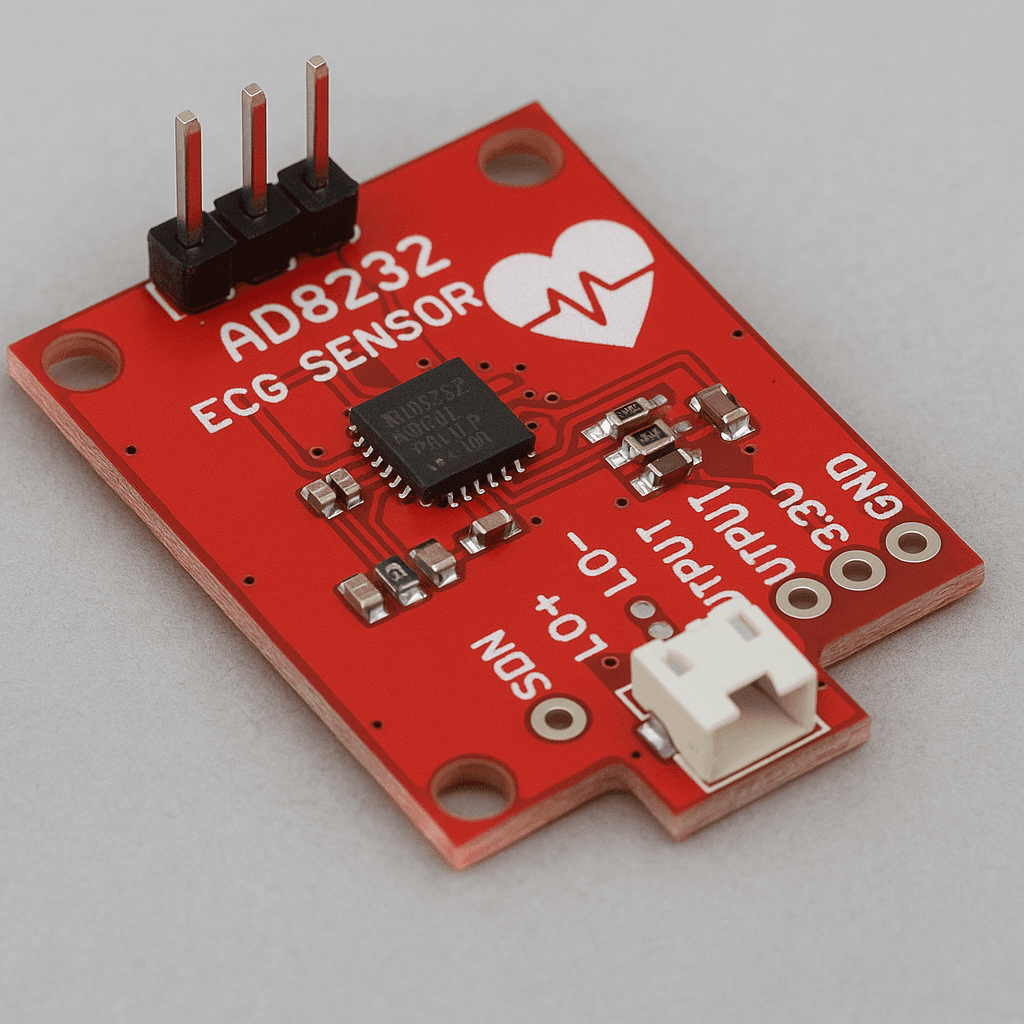
AD8232 EKG SENSOR (Generated by Artificial Intelligence)
The working principle of an EKG sensor can be examined in three main stages: signal detection, signal processing (amplification and filtering), and transmission of data to a microcontroller. The heart operates via an electrical stimulation system that originates in the sinoatrial (SA) node and spreads throughout the cardiac muscle. This electrical activity creates very low voltage potential differences on the body surface, in the millivolt to microvolt range. The primary function of the EKG sensor is to remove these weak signals from environmental noise and convert them into meaningful data.
EKG signal measurement is performed through electrodes attached to specific points on the body. A typical configuration uses three electrodes: two for measurement and one as a reference (ground) electrode. Following the principle of Einthoven’s triangle, these electrodes are usually placed on both arms and one leg (typically the right leg). The measurement electrodes detect the potential difference on the body surface. The reference electrode is used in conjunction with a technique known as the Driven Right Leg (DRL) circuit to suppress common-mode noise, such as 50/60 Hz mains interference. This is a critical step that significantly improves signal quality.
The raw EKG signal obtained from the body is very weak and highly susceptible to noise. Therefore, it must undergo a series of processing steps before it can be interpreted by a microcontroller.
The detected raw signal first enters an instrumentation amplifier (INA) stage. Instrumentation amplifiers are known for their high common-mode rejection ratio (CMRR). Thanks to this feature, they effectively suppress noise signals that are common to both measurement electrodes while amplifying the tiny potential difference between them (i.e., the EKG signal) by thousands of times (typically 1000x or more). Specialized integrated circuits are used for this purpose in popular EKG sensor modules such as the AD8232.
The amplified signal may still contain various noise components. To remove these, the sensor module incorporates several filter circuits:
Mendes Junior, José Jair Alves, Daniel Prado Campos, Lorenzo Coelho de Andrade Villela De Biassio, Pedro Carlin Passos, Paulo Broniera Júnior, André Eugênio Lazzaretti, and Eddy Krueger. 2023. "AD8232 to Biopotentials Sensors: Open Source Project and Benchmark." Electronics 12, no. 4: 833. Accessed June 17, 2025. https://www.mdpi.com/2079-9292/12/4/833
Simanjuntak, J. E. S., M. L. Khodra, and M. C. T. Manullang. “Design Methods of Detecting Atrial Fibrillation Using the Recurrent Neural Network Algorithm on the Arduino AD8232 ECG Module.” *IOP Conference Series: Earth and Environmental Science* 537, no. 1 (2020): 012022. https://iopscience.iop.org/article/10.1088/1755-1315/537/1/012022/meta.

Working Principle
Signal Detection via Electrodes
Signal Processing: Amplification and Filtering
Instrumentation Amplifier
Filtering Stages