


+1 More

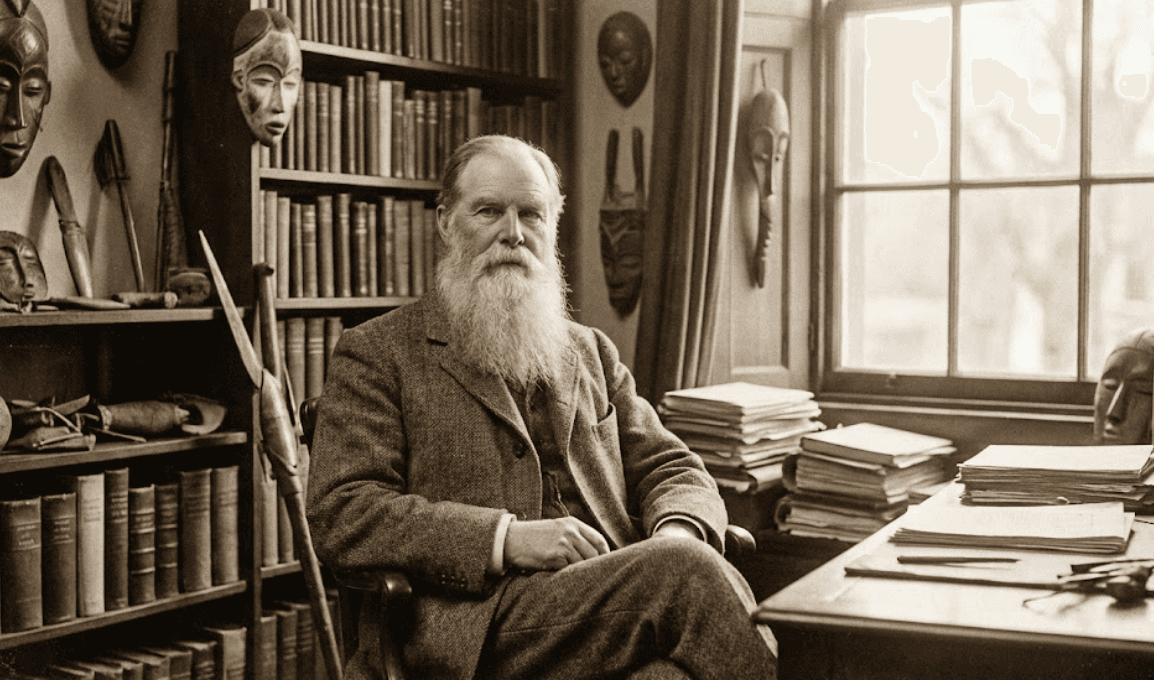
Edward Burnett Tylor (generated with artificial intelligence)
Doğum tarihi | 1832-10-02 | ||||||||
|---|---|---|---|---|---|---|---|---|---|
Ölüm tarihi | 1917-01-02 | ||||||||
Eş | Anna Rebecca Fox | ||||||||
Title(s) | Father of Anthropology | ||||||||
Place of Birth | Camberwell, London, England | ||||||||
Place of Death | Wellington England Somerset | ||||||||
Profession(s) | Anthropologist Folklorist Ethnologist | ||||||||
Awards and Honors | Knight (Sir) Title Anthropological Essays Festschrift Royal Anthropological Institute Huxley Medal Honorary D.C.L. from Oxford University Fellow of the Royal Society | ||||||||
Major Works | Anthropology: An Introduction to the Study of Man and Civilization Primitive Culture: Researches into the Development of Mythology Philosophy Religion Language Art and Custom Researches into the Early History of Mankind and the Development of Civilization Anahuac: or Mexico and the Mexicans Ancient and Modern | ||||||||
Sir Edward Burnett Tylor (2 October 1832, Camberwell, London – 2 January 1917, Wellington, Somerset) was an English anthropologist, ethnologist, and folklorist and is regarded as one of the founders of modern anthropology. Best known for his work Primitive Culture (1871), Tylor systematically defined the concept of culture within a scientific framework and helped shape anthropology as an academic discipline. Referred to as the “father of anthropology,” Tylor is recognized for his pioneering contributions to evolutionary anthropology, particularly through the concept of “survivals” and comparative methods that analyzed the cultural development of humanity. Although of Quaker origin, Tylor embraced a scientific worldview and made significant contributions to anthropology through extensive reading, travel, and independent research without formal university education.
Edward Burnett Tylor was born on 2 October 1832 in the Camberwell district of London as the fourth of six children in a prominent Quaker family. His father, Joseph Tylor, was an engineer and businessman who operated a rice mill; the family owned a mining and foundry business active since 1768. Tylor spent his childhood within the simple and disciplined lifestyle of the Quaker community. He began his education at Grove House School in Tottenham, where he studied French, German, Latin, writing, and drawing. However, his formal education ended at age 16 due to Quaker beliefs that prohibited attendance at traditional schools requiring church participation.
Tylor began working as an apprentice in the family business but, after showing symptoms of tuberculosis in 1855, he embarked on a journey on medical advice. During this period, he traveled through the Mississippi River Valley in the United States and moved to Cuba in 1856. In Havana, he met the renowned ethnographer and archaeologist Henry Christy by chance and accepted his invitation to explore Toltec remains in Mexico. This journey sparked Tylor’s interest in anthropology and formed the foundation for his 1861 publication Anahuac: or, Mexico and the Mexicans, Ancient and Modern. In 1858, he married Anna Rebecca Fox; although the marriage produced no children, it endured as a long and supportive partnership. The couple abandoned Quaker beliefs in 1864 and adopted a secular lifestyle.
Tylor’s anthropological interests were shaped by his extensive travels in the 1850s. Between 1852 and 1854, he visited France, Spain, Italy, Gibraltar, Morocco, Switzerland, Austria, and Croatia. His travels to the United States, Cuba, and Mexico from 1855 to 1856 deepened his anthropological observations. His time in Mexico with Henry Christy enabled him to study Aztec culture and contemporary Mexican society, experiences systematically addressed in Anahuac. Beyond a travelogue, this book engaged with anthropological themes such as cultural diffusion and independent development.
In the 1860s, Tylor visited the Institute for the Deaf and Dumb in Berlin to investigate the origins of sign language; this work contributed to his theories on the evolution of language and culture. His 1865 publication Researches into the Early History of Mankind and the Development of Civilization analyzed the early history of humankind within an evolutionary framework, using comparative methods to examine similarities in language, mythology, and material culture. During this period, he became a member of the Somerset Archaeological and Natural History Society and gained recognition in scientific circles by attending meetings of the British Association for the Advancement of Science (BAAS). He was elected a Fellow of the Royal Society in 1871.
Tylor’s academic career gained momentum in 1882 with two public lectures on anthropology at the University of Oxford. These lectures helped establish anthropology as an academic discipline. In 1883, he was appointed Keeper of the Oxford University Museum of Natural History and became the United Kingdom’s first Reader in Anthropology the same year. With an annual commitment of 18 lectures, he addressed a broad audience including academics, missionaries, and colonial administrators. In his lectures, he illustrated anthropological concepts using material culture artifacts such as stone tools, prayer beads, and prayer wheels.
In 1895, Tylor became the first Professor of Anthropology at Oxford, a milestone in the integration of anthropology into university curricula. He played an indirect role in the founding of the Pitt Rivers Museum in 1884, assisting Henry Moseley in the transfer of the collection to Oxford. Between 1886 and 1916, he donated numerous objects to the museum. His wife Anna Tylor bequeathed approximately 820 objects to the museum in 1917.
In 1884, he became the first president of the Anthropological Section of the BAAS and was elected president of the Royal Anthropological Institute in 1891. From 1889 to 1891, he delivered the Gifford Lectures at the University of Aberdeen; these lectures were intended as the basis for a book on the natural history of religion but were never published. He retired from his museum directorship in 1902 and from his professorship in 1909. In 1910, he was knighted and became Sir Edward Burnett Tylor.
Tylor defined anthropology as a “reformative science,” aiming to explain superstitious beliefs and cultural survivals in Victorian society through scientific methods. In Primitive Culture (1871), he defined culture as “that complex whole which includes knowledge, belief, art, morals, law, custom, and any other capabilities and habits acquired by man as a member of society.” This definition became the foundational concept of culture in modern anthropology. The work examined the evolution of mythology, religion, language, and art, developing the theory of animism, which located the origins of religion in the attribution of spirits to natural phenomena in primitive societies.
One of Tylor’s most important theoretical contributions was the concept of “survivals,” which posited that irrational customs in modern societies are remnants of earlier, primitive cultures. Using the comparative method, he analyzed similar practices across cultures to reveal universal laws of the human mind, known as the “psychic unity of mankind.” His 1888 article “On a Method of Investigating the Development of Institutions” statistically examined evolutionary patterns using data collected from 350 societies, pioneering the use of quantitative methods in anthropology.
Tylor was a leading proponent of classical evolutionary anthropology, arguing that cultures evolved from “savage” to “civilized” stages. However, he was not a rigid unilinear evolutionist and remained open to alternative processes such as cultural diffusion. For instance, he investigated the possibility that the Aztec ball game had Asian origins. He proposed that modern primitive societies reflected the lifeways of Paleolithic humans, a view particularly evident in his writings on Tasmanian Aboriginal people.
Tylor placed great emphasis on material culture, using artifacts such as stone tools, prayer beads, and prayer wheels to concretize his theories. The objects he donated to the Pitt Rivers Museum were collected through missionaries (e.g., William Wyatt Gill), travelers (e.g., James Stevenson), and colleagues (e.g., William Crooke). Unlike Pitt Rivers’ typological approach, Tylor’s collecting reflected personal curiosity rather than systematic classification. After his death, his wife Anna donated 820 objects to the museum in 1917.
Tylor has been described as a “chair anthropologist,” relying primarily on reports from travelers, missionaries, and colonial administrators rather than fieldwork. However, he contributed to modern ethnography by leading a fieldwork project on the Indigenous peoples of Northwestern Canada in 1884. He played a leading role in preparing Notes and Queries on Anthropology in 1874, a guide that encouraged the systematic collection of ethnographic data.
Tylor authored five books and over 250 articles. His principal works include:
In 1907, on his 75th birthday, colleagues honored him with an anthology titled Anthropological Essays (Festschrift), and he received the Huxley Medal from the Royal Anthropological Institute the same year. In 1910, he was knighted and became Sir Edward Burnett Tylor. He died on 2 January 1917 in Wellington. After his death, A.C. Haddon in Nature described him as the “pioneer of the comparative method”, while The Oxford Magazine praised his clear prose and intellectual character.
Tylor’s legacy lies in the establishment of anthropology as a scientific discipline. His concepts of survivals, the comparative method, and animism profoundly shaped 20th-century anthropology. Anthropologists such as James Frazer, Andrew Lang, and Robert Marett were influenced by his ideas. The anthropology chair at Oxford and the collections at the Pitt Rivers Museum reflect his enduring impact. Tylor, who advanced science without formal academic training, is regarded as a major figure in 19th-century intellectual history.
Read, C. Hercules. “Sir Edward Burnett Tylor, D.C.L., LL.D., F.R.S.” *Man* 17 (1917): 25–26. Royal Anthropological Institute. Accessed October 8, 2025. http://www.therai.org.uk/archives-and-manuscripts/obituaries/edward-burnett-tylor.
Smithsonian Enstitüsü Archives. "Portrait of Edward Burnett Tylor (1832–1917)." Record Unit 95, Box 27E, Image No. SIA_000095_B27E_184. Accessed October 8, 2025. https://siarchives.si.edu/collections/siris_arc_404287.
University of Oxford. "Edward Burnett Tylor (1832–1917) Part 1." Accessed October 8, 2025. https://web.prm.ox.ac.uk/sma/index.php/articles/article-index/335-edward-burnett-tylor-1832-1917.html.
University of Oxford. "Edward Burnett Tylor (1832–1917) Part 2." Accessed October 8, 2025. https://web.prm.ox.ac.uk/sma/index.php/articles/article-index/336-edward-burnett-tylor-1832-1917-part-2.html.

Edward Burnett Tylor (generated with artificial intelligence)
Doğum tarihi | 1832-10-02 | ||||||||
|---|---|---|---|---|---|---|---|---|---|
Ölüm tarihi | 1917-01-02 | ||||||||
Eş | Anna Rebecca Fox | ||||||||
Title(s) | Father of Anthropology | ||||||||
Place of Birth | Camberwell, London, England | ||||||||
Place of Death | Wellington England Somerset | ||||||||
Profession(s) | Anthropologist Folklorist Ethnologist | ||||||||
Awards and Honors | Knight (Sir) Title Anthropological Essays Festschrift Royal Anthropological Institute Huxley Medal Honorary D.C.L. from Oxford University Fellow of the Royal Society | ||||||||
Major Works | Anthropology: An Introduction to the Study of Man and Civilization Primitive Culture: Researches into the Development of Mythology Philosophy Religion Language Art and Custom Researches into the Early History of Mankind and the Development of Civilization Anahuac: or Mexico and the Mexicans Ancient and Modern | ||||||||
No Discussion Added Yet
Start discussion for "Edward Burnett Tylor" article
Early Life and Education
Travels and Early Career
Academic Career and the University of Oxford
Anthropological Contributions
Survivals and the Comparative Method
Evolutionary Anthropology
Material Culture and Collecting
Major Works
Personal Life and Legacy