


This article was automatically translated from the original Turkish version.
+2 More
Ekokırım
Ecocide Basic Criteria | Damage through Arbitrary Actions Long-term Damage Widespread Damage Severe Damage | ||||||||
|---|---|---|---|---|---|---|---|---|---|
Ecocide is defined as the systematic, widespread, and permanent destruction of the natural environment, ecosystems, and biological diversity. This concept encompasses not only environmental damage but also the direct impacts of such damage on human health, cultural heritage, and the living conditions of future generations. The destruction caused by ecocide manifests itself through habitat loss, disruption of ecosystem functions, and the extinction of species. Today, environmental law evaluates the environment not merely as an object requiring protection but also as a rights-bearing subject, an approach that enables greater legal accountability for environmental degradation. In this context, ecocide offers an interdisciplinary framework that simultaneously assesses environmental, economic, social, and legal dimensions.

Visual Representing Ecocide (Source: Unsplash)
One of the most concrete examples of ecocide rising to the international legal and political agenda was the environmental and social devastation caused by the use of Agent Orange by the United States during the Vietnam War. This chemical agent led to the destruction of vast forest areas, the disruption of ecosystem functionality, and severe health deteriorations among the local population. This historical event demonstrated that environmental destruction is not merely an ecological issue but must also be considered as a crime against humanity and a war crime. In particular, the necessity of addressing wartime environmental devastation within the framework of international criminal law formed the foundation for debates on establishing ecocide as a legal concept. The inclusion of ecocide on the agenda of the International Criminal Court in 2019 is regarded as a significant step toward defining ecocide as a distinct and unique category of crime under international law; this development is widely seen as the beginning of the process to recognize environmental destruction as a separate criminal offense under criminal law. In this context, efforts to integrate ecocide into the international legal system require interdisciplinary cooperation and consensus across both legal and political domains.

Visual Representing Ecocide (Source: Pexels)
In international law, ecocide emerges as a relatively new and evolving conceptual framework. Although it was placed on the agenda of the International Criminal Court (ICC) in 2019, ecocide has not yet been formally incorporated into the Rome Statute nor officially recognized as a fifth category of international crime. Nevertheless, comprehensive definitions and proposals developed by international civil society organizations such as the Stop Ecocide Foundation and independent expert panels have laid important groundwork for the acceptance of ecocide under international law. In 2021, independent experts formulated a definition of ecocide, but this definition has not yet been transformed into formal international legislation. Meanwhile, countries such as Russia, Armenia, Kazakhstan, Kyrgyzstan, and Ukraine have begun regulating the crime of ecocide in their national legal systems, establishing criminal sanctions against environmental destruction. These developments indicate that the concept of ecocide is increasingly gaining recognition both within national legal systems and in the context of international law. Thus, ecocide is gradually taking shape as an interdisciplinary legal protection mechanism that is strengthening both normatively and practically.

Visual Representing Ecocide (Source: Pexels)
Defining ecocide as a crime is critically important for establishing an effective and holistic legal framework to combat environmental destruction. Recognizing the environment as a rights-bearing subject under the law enables the enforcement of liability for environmental harm through compensation obligations and criminal sanctions. In particular, holding perpetrators accountable under national and international legal norms for large-scale environmental disasters such as oil spills and chemical waste releases enhances the deterrent effect of environmental protection mechanisms and sends a strong legal signal aimed at preventing similar harms in the future.
Furthermore, recognizing ecocide as an international crime accelerates the harmonization and effective implementation of environmental legislation at the global level. This makes it possible to counter negative trends such as the relocation of environmentally risky production and activities to countries with weak environmental protection laws. Thus, while strengthening the principle of environmental justice, international cooperation mechanisms can be effectively mobilized to prevent and remedy transboundary ecological damage. Consequently, recognizing ecocide as a crime enables the construction of a holistic legal approach at the intersection of sustainable development goals, environmental protection, human rights, and international justice.

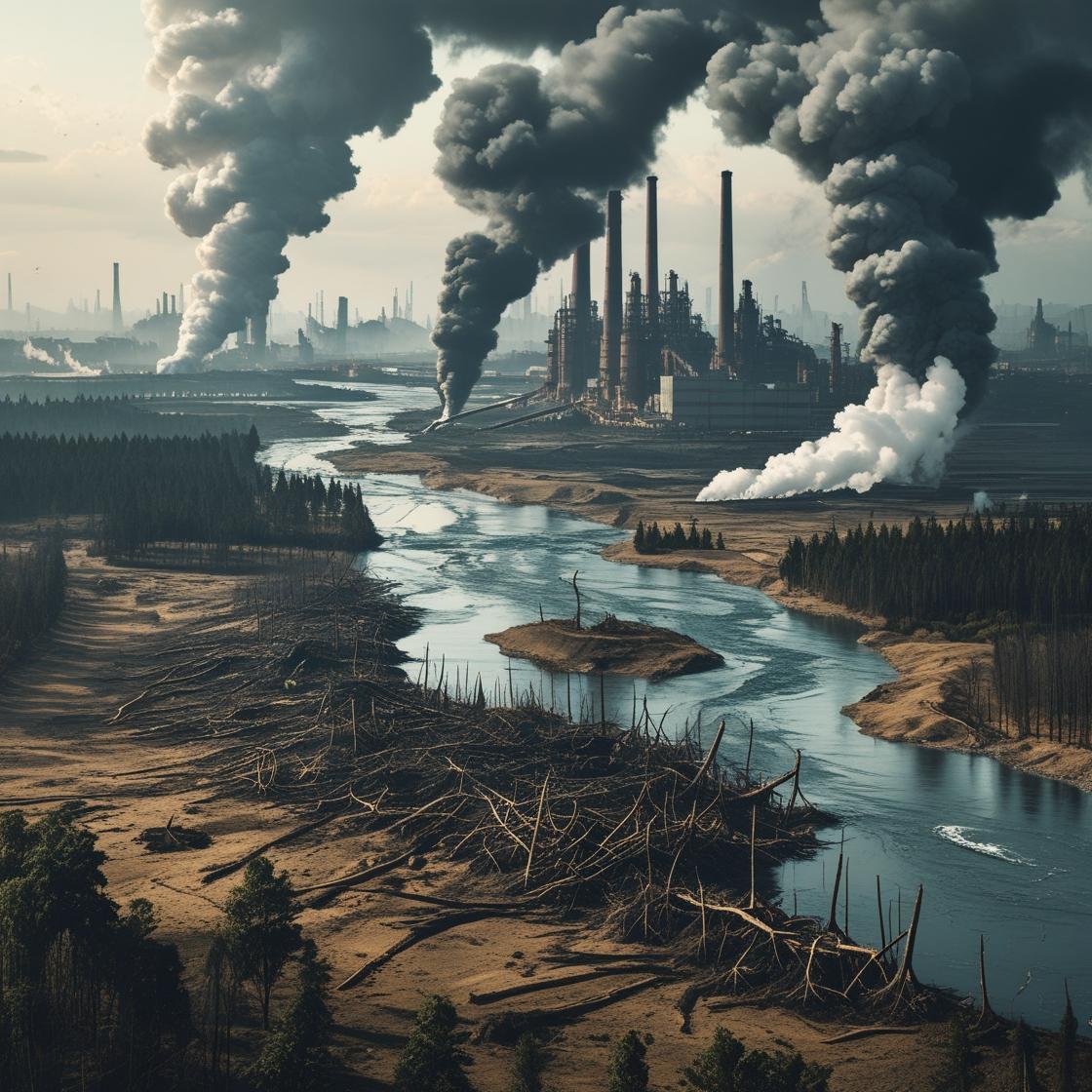
Visual Representing Ecocide (Generated by Artificial Intelligence)
The legal regulation of ecocide under international law is still in an evolutionary process. Although ecocide has not yet been formally recognized as a category of crime by the International Criminal Court, the concept has begun to find recognition in the national legislation of certain countries, which have strengthened their legal frameworks to prevent environmental destruction and punish perpetrators. These developments demonstrate that ecocide is gaining increasing importance in both national and international law.
Traditionally, crimes against the environment in international law have been associated with war crimes and crimes against humanity, with a focus on prohibiting the use of environmental destruction as a weapon of war. However, recent years have seen the emergence of new legal approaches that seek to include ecocide as encompassing widespread, systematic, and persistent environmental damage occurring during peacetime and in civilian contexts. This transformation reflects the international community’s growing sensitivity to environmental issues and its concrete efforts to respond legally and politically to global threats such as climate change and biodiversity loss. Therefore, expanding the scope of ecocide and establishing it as a settled crime under international law is of great importance for achieving environmental protection and sustainable development goals.
Defining ecocide as a legal crime is not only crucial for enforcing sanctions but also carries significant importance in creating a strong deterrent effect on policymakers and states. The effective application of criminal law enables states and economic actors to concretize their environmental protection obligations, making substantial contributions to the realization of sustainable development goals.
The implementation of legal regulations transforms environmental protection from a mere ethical preference into a binding obligation at both international and national levels. In this context, strengthening international cooperation and coordination is an essential requirement for effectively managing the transboundary dimensions of environmental crimes such as ecocide. Moreover, granting ecocide the status of a crime encourages the development of compensation mechanisms that ensure restitution for environmental harm and fair redress for victims. Thus, environmental protection is evolving into a multidimensional and comprehensive legal-political framework integrated with human rights, social justice, and sustainability principles.

Visual Representing Ecocide (Generated by Artificial Intelligence)
The term ecocide provides a conceptual framework for defining environmental harm based on specific criteria. The impacts of human activities on the natural environment have long been examined in various contexts; however, the necessity of evaluating these impacts not merely as pollution or resource use but as severe, large-scale, and lasting damage has made the emergence of the ecocide concept imperative.
The concept of ecocide is based on four key criteria for determining the scale and impact of environmental harm:
Various examples that can be assessed under these criteria demonstrate that ecocide is not only a conceptual framework but also a practical tool for evaluation.

Visual Representing Ecocide (Source: Pexels)
These examples demonstrate that defining ecocide is not merely a theoretical necessity but also a functional tool for systematically assessing environmental harm and clearly assigning legal responsibility. The concept renders severe environmental destruction visible and holds the potential to serve as a fundamental reference point in developing international environmental protection policies.
Numan, Muhammad. “Brown Bare Trees on Brown Field during Daytime.” Unsplash. Accessed May 27, 2025. https://unsplash.com/photos/brown-bare-trees-on-brown-field-during-daytime-ZVgxiKJlMk0.
Sentrum. "Ekokırım Nedir?" Sentrum. Accessed May 27, 2025. https://www.sentrum.com.tr/blog–kose-yazilari/blog/eko-kirim-nedir.
Singh, Yogendra. “Su Kütlesindeki Çöp.” Pexels. Accessed May 27, 2025. https://www.pexels.com/tr-tr/fotograf/su-kutlesindeki-cop-2480807.
Stockholm Environment Institute. *Ecocide Law: Questions & Answers*. Stockholm, Sweden: Stockholm Environment Institute, 2024. Accessed May 27, 2025. https://static1.squarespace.com/static/5ca2608ab914493c64ef1f6d/t/67d915c016f3ed296700bd45/1742280129431/EcocideLaw_Q%26A_EN.pdf.
Stockholm Environment Institute. *Executive Summary: December 2024*. Stockholm: Stockholm Environment Institute, 2024. Accessed May 27, 2025. https://static1.squarespace.com/static/5ca2608ab914493c64ef1f6d/t/67d939b2788a02741186435e/1742289338819/SEI+Exec+Summary+December+2024.pdf.
Stop Ecocide Foundation. "Ecocide Law." Accessed May 27, 2025. https://www.stopecocide.earth/ecocide-law.
World Economic Forum. “Ecocide: Environmental Harm Should Be an International Crime.” August 25, 2021. Accessed May 27, 2025. https://www.weforum.org/stories/2021/08/ecocide-environmental-harm-international-crime.

Ekokırım
Ecocide Basic Criteria | Damage through Arbitrary Actions Long-term Damage Widespread Damage Severe Damage | ||||||||
|---|---|---|---|---|---|---|---|---|---|
The Emergence and Historical Background of Ecocide
The Position and Development of Ecocide in International Law
The Significance of Recognizing Ecocide as a Crime
International Legal Regulations and Practices
Legal and Political Dimensions in Preventing Ecocide
The Necessity of Defining Ecocide
Examples of Ecocide