



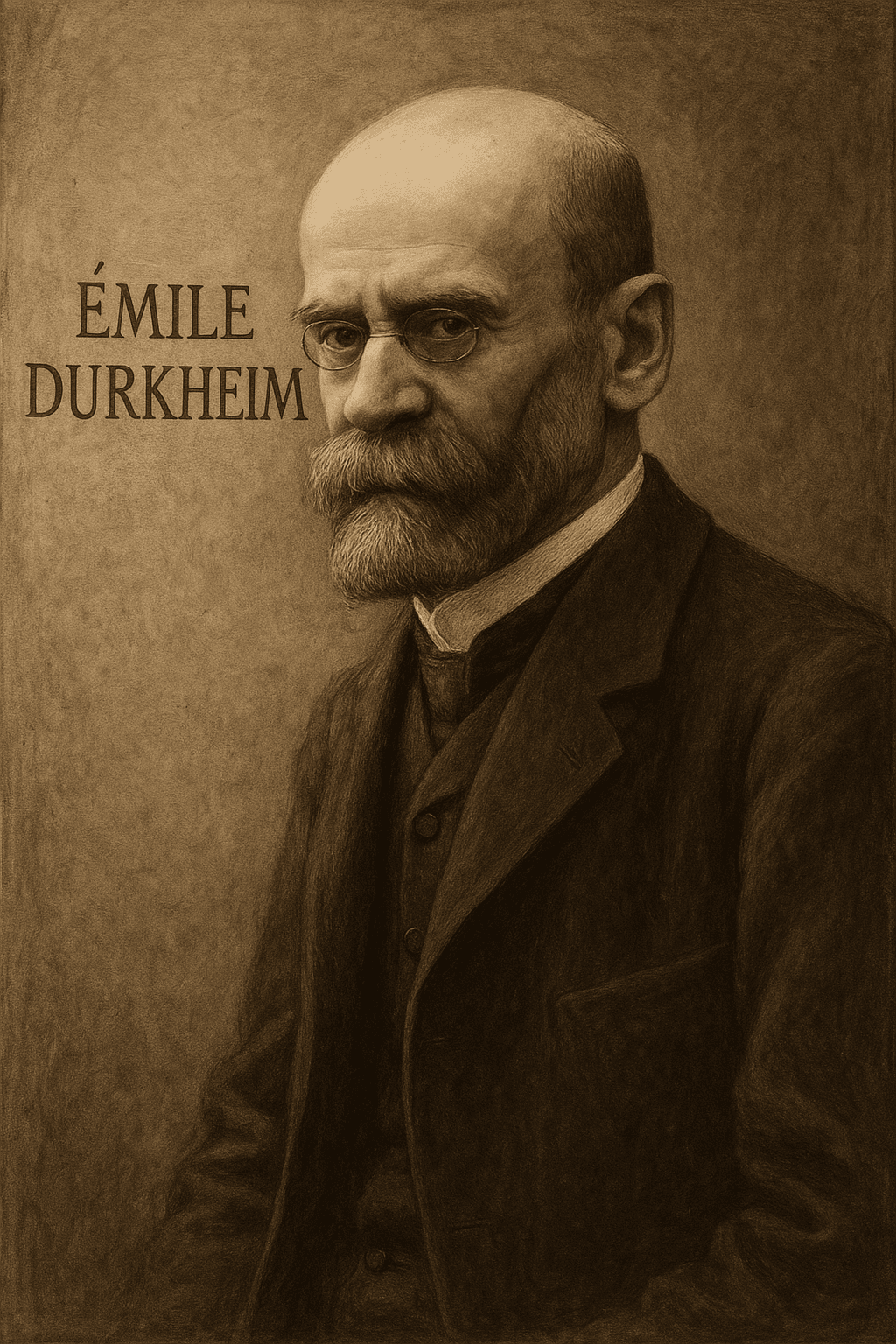
David Émile Durkheim
Birth | 15 April 1858 | ||||||||
|---|---|---|---|---|---|---|---|---|---|
Death | 15 November 1917 | ||||||||
Area(s) | Sociology Sociology of Religion Education | ||||||||
One of the founding figures of modern sociology, Émile Durkheim was a pioneering thinker who sought to study society through scientific methods and established sociology as an independent academic discipline. Durkheim sought to explain a wide range of social phenomena—from the individual-society relationship to religion, morality, knowledge, division of labor, and suicide—by constructing an objective and rule-based scientific framework in sociology grounded in positivist methodology.
David Émile Durkheim was born on 15 April 1858 in Épinal, France, into a devout Jewish family. His father, grandfather, and great-grandfather had all served as rabbis in the region. Despite his family’s expectations, he chose not to pursue a religious career and entered the École Normale Supérieure in Paris. There he was influenced by the works of thinkers such as Auguste Comte, Montesquieu, and Rousseau. He graduated in 1883 and began his academic career as a lecturer at the University of Bordeaux. In 1892 he completed his doctorate with the thesis De la division du travail social (On the Division of Social Labor). In 1902 he was appointed to the Sorbonne, where a chair in “education and sociology” was established. Throughout his academic life, he played a decisive role in the institutionalization of sociology in France. He married Louise Dreyfus in 1887 and had two children. The death of his son André in World War I deeply affected Durkheim; he suffered a stroke following this loss and died in 1917.
One of Durkheim’s most important contributions to sociology was defining social facts as realities that exist independently of the individual, belong to society, and are “sui generis” (unique in their own right). The key characteristics of social facts are that they lie outside the individual, exert pressure upon them, and are generalizable. Therefore, sociological analysis must treat social facts “as things,” employing observation, comparison, and causal principles. Durkheim elaborated this method in his work Les règles de la méthode sociologique (1895, The Rules of Sociological Method). For him, sociology is not only necessary for producing theoretical knowledge but also for explaining and regulating the functioning of social order. The concept of “the practical impact of science” reveals his view of sociology as a functional tool for social regulation.
Durkheim argued that societies evolve over time according to the division of labor. In his work De la division du travail social (1893), he drew a contrast between traditional (mechanical solidarity) societies and modern (organic solidarity) societies. Mechanical solidarity expresses cohesion based on similarity, while organic solidarity expresses mutual dependence arising from functional differences. As population increases and communication and transportation improve, social interaction intensifies, necessitating specialization and the division of labor. The normative gaps produced by this process are defined as “anomie”—a mismatch between individuals’ expectations and goals and the opportunities society provides.
His work Le Suicide (1897, Suicide) is one of the first empirical studies in sociology. Durkheim viewed suicide not as an individual act but as a consequence of the level of social integration. He presented a typology of suicide in four categories:
This study is pioneering in demonstrating how the sociological method can be applied to explain social problems.
One of Durkheim’s most important works is Les Formes Élémentaires De La Vie Religieuse (1912, The Elementary Forms of Religious Life). For Durkheim, religion is not divine but a social phenomenon. Society sanctifies its own collective power through symbols, thereby producing religion. During moments of “collective effervescence,” members of society gather in rituals, and this unity generates the sacred. Gods and symbols are expressions of this collective power. Thus, according to Durkheim, religion is a form in which society worships itself: “Religion is society’s worship of itself.” In this context, religion is regarded as the oldest and strongest institution of social integration.
Durkheim rejected the thesis that the individual is an autonomous, independent, and transcendent entity. The individual is a product shaped by society. Yet this does not eliminate individuality. In modern societies, the individual differentiates from collective consciousness and becomes an autonomous moral subject. Durkheim’s proposed solution is for the individual to reestablish strong bonds with social institutions—family, religion, politics. Education is the fundamental instrument for socializing the individual and transmitting collective consciousness. For him, individual freedom can be achieved not by opposing society but by integrating into its moral structure.
With the weakening of traditional religion in the modern age, Durkheim argued that a new sacred had emerged: the individual. This transformation is termed the “cult of the individual.” Values such as human rights, equality, and liberty form the foundation of this new cult. Violations of individual rights are now considered moral deviations and “attacks on the sacred.” According to Durkheim, modern societies will be organized around this new value system, sustaining social order by protecting the individual. These ideas have left profound influences on later political philosophy and human rights discourse.
1. De La Division Du Travail Social (1893)
(On the Division of Social Labor)
This work, Durkheim’s doctoral thesis, introduces the concept of “organic solidarity” as the foundation of modern societies. It analyzes the differences between traditional and modern social structures through the distinction between mechanical and organic solidarity.
2. Les Règles De La Méthode Sociologique (1895)
(The Rules of Sociological Method)
In this work, Durkheim outlines the methodological principles necessary for establishing sociology as an independent scientific discipline. He draws attention with his proposal to “study social facts as things.”
3. Le Suicide: Étude De Sociologie (1897)
(Suicide: A Study in Sociology)
One of the first systematic empirical studies in sociology, it explains the phenomenon of suicide not as an individual act but within a social context, defining four types: egoistic, altruistic, anomic, and fatalistic.
4. L’éducation Morale (1902, published posthumously)
(Moral Education)
Composed of lecture notes, this work examines Durkheim’s conception of morality and the social function of education, emphasizing education’s decisive role in integrating the individual into society.
5. Les Formes Élémentaires De La Vie Religieuse (1912)
(The Elementary Forms of Religious Life)
Considered the foundational text of the sociology of religion, this work argues that religion originates not from the individual but from society. Durkheim explains the origins of the religious phenomenon by drawing on the totemic belief systems of Australian Aboriginal societies.
6. La Science Sociale Et L’action (1901)
(Social Science and Action)
This work discusses the relationship between scientific knowledge and social reform, arguing that sociology has not only a theoretical but also a practical function.
7. Le Socialisme: Sa Définition – Ses Débuts – La Doctrine Saint-Simonienne (1928, published after death)
(Socialism: Its Definition – Origins – The Saint-Simonian Doctrine)
Durkheim evaluates socialism as a social phenomenon. This text reveals both his distance from and interest in socialist thought.
8. L'évolution Pédagogique En France (1938, published posthumously)
(The Pedagogical Evolution in France)
This book offers a historical perspective on education, examining the transformation of the French educational system and its social impacts.
9. Pragmatisme Et Sociologie (1955, published posthumously)
(Pragmatism and Sociology)
This important compilation illustrates Durkheim’s bridges between sociology and the philosophy of knowledge.
Durkheim’s ideas have influenced numerous sociological theories, especially functionalism. Figures such as Marcel Mauss, Talcott Parsons, Pierre Bourdieu, Randall Collins, and Charles Taylor followed in his footsteps, providing leadership in contemporary sociology in fields such as knowledge, morality, education, religion, and crime.
However, Durkheim has also been criticized on several grounds:
These criticisms reflect methodological and normative objections to his society-centered positivist approach.
Émile Durkheim did not merely institutionalize sociology as a scientific discipline; he also developed enduring theories for understanding the structure, values, and transformation of society. His positivist methodology, quest for social cohesion, and idealism of moral order make him not only a theorist but also a thinker seeking solutions to the crises of modernity. His legacy continues to be one of the foundational pillars of sociology and modern social thought.
Emile Durkheim. *Internet Encyclopedia of Philosophy*. Accessed May 8, 2025. https://iep.utm.edu/emile-durkheim/
Taş, Savaş. “Emile Durkheim’in Sosyolojik Anlayışında Toplumsal İşbölümü, Sosyolojik Yöntemin Kuralları, Din, Anomi ve İntihar.” *Mahalle Mektebi*, no. 23 (2020): 442–449. Accessed May 8, 2025. https://dergipark.org.tr/tr/pub/mahder/issue/53105/679079
“Biography of Durkheim.” *Sociological Theory: A Open Educational Resource*, Oregon State University. Accessed May 8, 2025. https://open.oregonstate.education/sociologicaltheory/chapter/biography-of-durkheim/

David Émile Durkheim
Birth | 15 April 1858 | ||||||||
|---|---|---|---|---|---|---|---|---|---|
Death | 15 November 1917 | ||||||||
Area(s) | Sociology Sociology of Religion Education | ||||||||
Life and Education
Sociological Method and Understanding of Social Reality
Theories and Contributions
Division of Labor and Solidarity
Anomie and Suicide
Sociology of Religion and Collective Consciousness
Individual and Society
Cult of the Individual and New Morality
Main Works
Theoretical Legacy and Criticisms