

This article was automatically translated from the original Turkish version.
+2 More
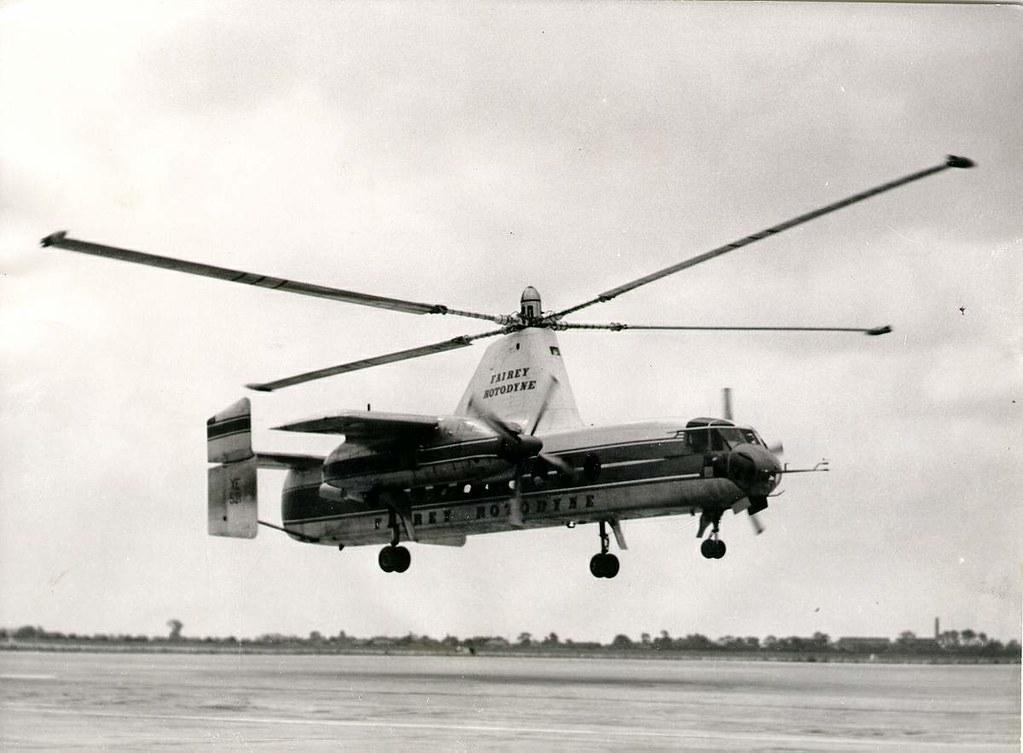
Fairey Rotodyne (Flickr)
The Fairey Rotodyne is a large compound helicopter developed in the late 1950s by the British aerospace company Fairey Aviation, aiming to combine the vertical takeoff and landing (VTOL) capabilities of a helicopter with the cruise speed and efficiency of a fixed-wing aircraft. Built as a single prototype and subjected to extensive testing, the aircraft was designed for both civilian passenger transport and military cargo roles. Technically classified as a "gyrodyne," the vehicle used jet units mounted at the rotor blade tips for takeoff and landing, while transitioning to propeller-driven flight during horizontal cruise, maintaining flight through autorotation.
Research into rotary-wing aircraft began in the 1930s and accelerated after World War II. In 1946, Fairey Aviation began work on a new type of rotary-wing aircraft intended to combine the advantages of helicopters, airplanes, and autogyros. This project was a continuation of concepts acquired from the Cierva Autogyro Company and was led by Dr. J.A.J. Bennett.
To validate the Rotodyne’s design, Fairey first produced smaller experimental aircraft. The "Gyrodyne," flown in 1947, and the later developed "Jet Gyrodyne," demonstrated the feasibility of using pressurized air-driven rotor tip jets and propeller propulsion. In the early 1950s, British European Airways (BEA) published requirements for an aircraft capable of carrying 30 to 40 passengers on short- and medium-haul routes, designated the "BEAline Bus"【1】. Fairey began developing the Rotodyne prototype under a research contract awarded by the Ministry of Supply in 1953 to meet these requirements.
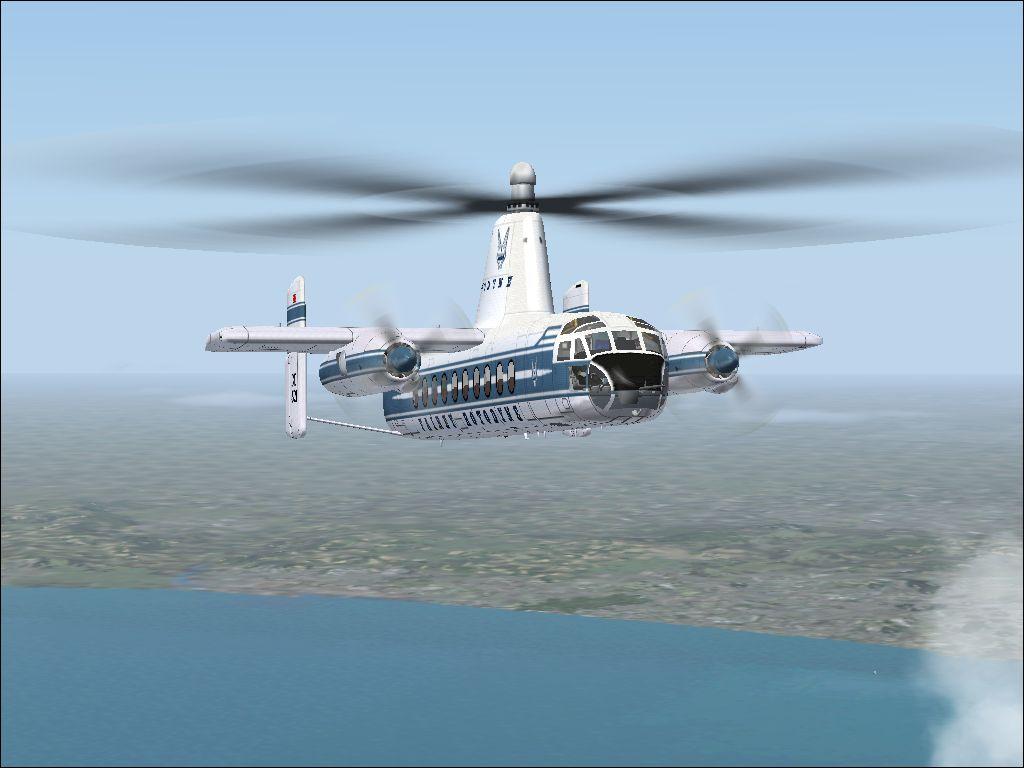
Fairey Rotodyne (Flickr)
The Rotodyne featured a large four-bladed main rotor, short fixed wings, and two Napier Eland turboprop engines mounted on the wings. Its most distinctive feature was a drive system that eliminated the need for complex gearboxes and a tail rotor. During takeoff and landing, the engines powered auxiliary compressors that delivered compressed air through the rotor blades to jet nozzles at the tips. There, the air was mixed with fuel and ignited, generating thrust to rotate the rotor and produce vertical lift. Because this system generated no torque, a conventional anti-torque tail rotor was unnecessary; directional control at low speeds was achieved by varying the pitch of the propellers.
After vertical takeoff and reaching sufficient altitude, engine power was gradually transferred from the rotor to the propellers. During cruise flight, the tip jets were shut off and the rotor entered autorotation mode. At this stage, approximately 50 percent of the lift was provided by the short wings, while forward thrust was entirely generated by the propellers. This hybrid system was designed to enable the Rotodyne to fly faster and more efficiently than conventional helicopters.
The prototype (XE521) had a maximum takeoff weight of approximately 15,000 kg (33,000 lb), a rotor diameter of 27.4 meters (90 ft), and a capacity for 40 passengers【2】. The fuselage design included enclosed rear doors, enabling the transport of vehicles and large cargo.
The Rotodyne prototype (XE521) made its first flight solely in helicopter mode on 6 November 1957. The first successful transition from vertical flight to horizontal cruise was completed on 10 April 1958【3】. During the test program, modifications were made to improve flight characteristics, including adjustments to wing angles, the addition of ailerons, and the installation of upper finlets on the tail surfaces.
The aircraft demonstrated its performance potential on 5 January 1959 by achieving an average speed of 307.2 km/h over a 100 km closed circuit, setting a world record for the "convertiplane" class. This speed was approximately 80 km/h faster than the contemporary helicopter record. In June 1959, the Rotodyne visited heliports in Brussels and Paris and made its international debut at the Paris Air Show.
However, one of the most significant issues encountered during testing was noise. When the rotor tip jets were operating, noise levels reached up to 113 decibels. Although mufflers were tested to reduce this, achieving the target noise level of 96 decibels required for urban operations proved a major engineering challenge【4】.
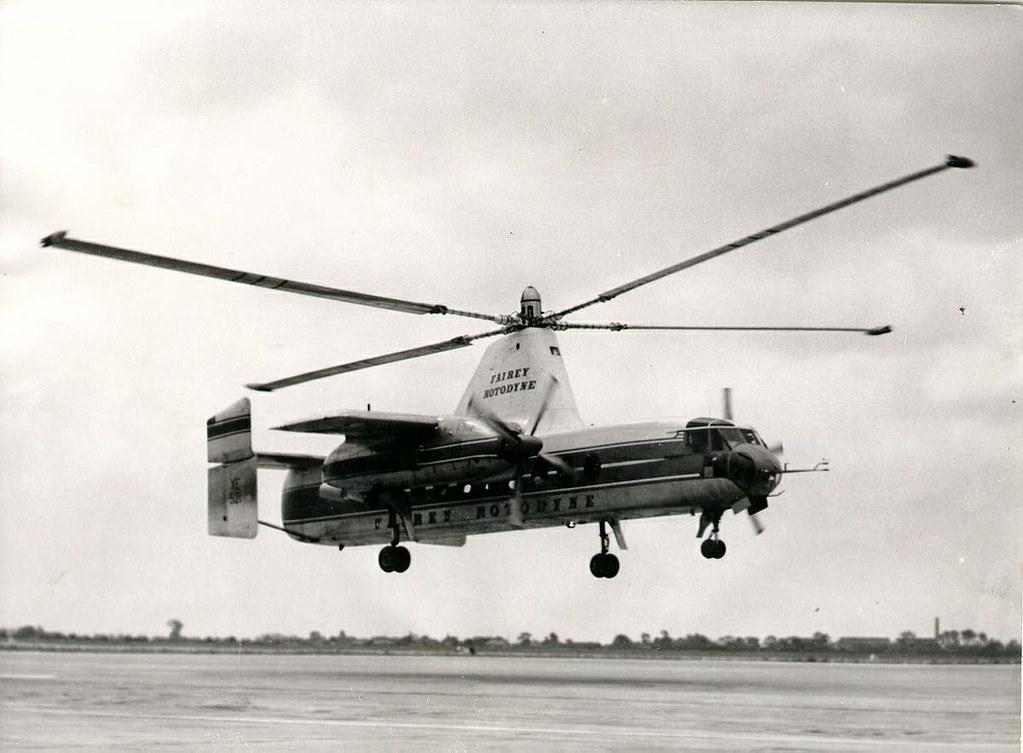
Fairey Rotodyne(Flickr)
Following the prototype’s success, Fairey planned a larger and more powerful production variant, the "Rotodyne Z" (or FA-1), designed to carry 57 to 75 passengers, powered by Rolls-Royce Tyne engines, and with a projected takeoff weight of approximately 24,000 kg【5】.
The Rotodyne attracted serious interest from both civilian and military operators. The Royal Air Force (RAF) placed an order for 12 military transport variants, while New York Airways (NYA) signed a letter of intent for five aircraft with an option for 15 more. Additionally, Japan Airlines (JAL) and Canadian operator Okanagan Helicopters expressed interest, and production and licensing agreements were made with the American company Kaman Aircraft Corporation. However, the most critical potential customer, British European Airways (BEA), despite showing interest, never placed a firm order.
Despite its technical achievements, the Rotodyne project ended due to a combination of factors. In 1960, Fairey Aviation was acquired by Westland Aircraft. Westland’s management evaluated the Rotodyne alongside its other projects but found the project’s future uncertain due to rising development costs and the lack of firm orders.
The failure to fully resolve the noise issue, BEA’s reluctance to commit to an order due to commercial risks, and the cancellation of Napier Eland engine production placed the project under severe strain. Ultimately, the British government withdrew its financial support, and the Rotodyne project was officially cancelled on 26 February 1962.
Fairey Rotodyne (British Helicopters History)
Following the cancellation decision, the sole prototype (XE521) was scrapped. However, portions of the fuselage, the rotor pylon, and rotor components were salvaged and preserved at Cranfield College. These parts were later transferred to the collection of the Helicopter Museum in Weston-super-Mare, where they are on display today. Although only one prototype was ever built, the Rotodyne occupies a unique place in aviation history as an innovative design that pushed the boundaries of VTOL technology and embodied an engineering vision far ahead of its time【6】.
Aviastar. "Fairey 'Rotodyne' helicopter - development history, photos, technical data." Accessed February 19, 2026.
British Helicopters History. "The Fairey Rotodyne (British Helicopters History)." YouTube Video. Accessed February 19, 2026.
Chatfield, Les (elsie). "Rotodyne 2." Flickr, August 24, 2009. Accessed February 19, 2026.
Kupietzky, Joshua. "Bizarre Heliplane: A Look At The Fairey Rotodyne." Simple Flying, November 17, 2023. Accessed February 19, 2026.
National Air and Space Museum. "Model, Static, Fairey Rotodyne, 1/40 scale." Smithsonian Institution. Accessed February 19, 2026.
The Helicopter Museum. "Fairey Rotodyne." Accessed February 19, 2026.
Vertipedia. "Fairey Rotodyne." The Vertical Flight Society. Accessed February 19, 2026.
Wigley, Tom (amphalon). "Fairey Rotodyne." Flickr, May 15, 2013. Accessed February 19, 2026.
https://airandspace.si.edu/collection-objects/model-static-fairey-rotodyne-140-scale/nasm_A20040020000
https://helimuseum.com/heli.php?ident=rotodyne
https://simpleflying.com/fairey-rotodyne-guide/
https://vertipedia.vtol.org/aircraft/getAircraft/aircraftID/54
https://www.aviastar.org/helicopters_eng/fairey_rotodyne.php
https://www.flickr.com/photos/amphalon/8740028081
https://www.flickr.com/photos/elsie/3853880716
https://www.youtube.com/watch?v=EA3AkvxwS_M
[1]
The Helicopter Museum. “Fairey Rotodyne.” Access date 19 February 2026.
[2]
The Helicopter Museum. “Fairey Rotodyne.” Access date 19 February 2026.
[3]
Aviastar. “Fairey ‘Rotodyne’ helicopter - development history, photos, technical data.” Access date 19 February 2026.
https://www.aviastar.org/helicopters_eng/fairey_rotodyne.php
[4]
Aviastar. “Fairey ‘Rotodyne’ helicopter - development history, photos, technical data.” Access date 19 February 2026.
https://www.aviastar.org/helicopters_eng/fairey_rotodyne.php
[5]
Aviastar. “Fairey ‘Rotodyne’ helicopter - development history, photos, technical data.” Access date 19 February 2026.
https://www.aviastar.org/helicopters_eng/fairey_rotodyne.php
[6]
Aviastar. “Fairey ‘Rotodyne’ helicopter - development history, photos, technical data.” Access date 19 February 2026.
https://www.aviastar.org/helicopters_eng/fairey_rotodyne.php


Fairey Rotodyne (Flickr)
Development Process and Historical Background
Technical Design and Engineering Features
Flight Tests and Performance
Commercial Interest and Planned Production Model
Legacy and Preserved Components