

This article was automatically translated from the original Turkish version.
+1 More
Author(s) | Stefan Zweig | ||||||||
|---|---|---|---|---|---|---|---|---|---|
Translator(s) | İlknur İgan | ||||||||
Publisher(s) | İş Bankası Kültür Yayınları | ||||||||
First Publication Year | 2015 | ||||||||
Number of Pages | 80 | ||||||||
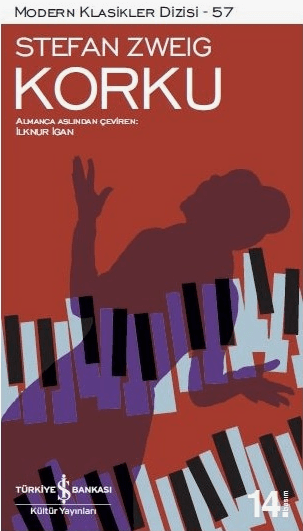
Fear (Ger. Angst), first published in 1920 by Austrian writer Stefan Zweig. Zweig, known for his significant contributions to psychological analysis, uses this novella to explore how an individual’s inner fears are shaped by social pressures and their consequences. The work particularly examines the impact of emotions such as guilt, conscience, shame, and fear on individual psychology.
The novel centers on Irene Wagner, a wealthy bourgeois woman, and the inner turmoil she experiences after having an affair with another man. Shortly after the brief relationship ends, she is blackmailed by a woman who claims to have witnessed the affair and threatens to tell her husband. This threat generates in Irene a growing sense of fear and paranoia. Throughout the narrative, Irene’s psychological disintegration deepens under the weight of the secret she strives to conceal. The way fear permeates Irene’s daily life culminates in a dramatic conclusion when her husband finally learns the truth and reacts.
Fear and Guilt Psychology: The central theme of the work is the psychological tension experienced by an individual after committing a moral transgression. Irene’s fear stems not from external threats but from an internal reckoning of conscience.
Social Appearance and Reputation: One of the key factors fueling Irene’s fear is her social status and public standing. The novel explicitly addresses the judgmental pressure exerted by society on the individual.
Female Identity and Constraint: Through the character of Irene, the novella offers insights into women’s roles within society, marital expectations, and the limits placed on their freedom.
Confession and Forgiveness: The revelation of the truth and the husband’s reaction at the end of the story prompt a critical examination of guilt, forgiveness, and the power dynamics within relationships.
The work is written in the third person and features intense interior monologues and psychological analyses. Psychological detail takes precedence in the narration. While the plot unfolds chronologically, it is enriched by frequent depictions of the protagonist’s inner world. Like Zweig’s other short narratives, Fear is characterized by a dense emotional atmosphere and a focus on the protagonist’s internal conflicts.
Irene Wagner: The protagonist of the novella. A married woman with children from the bourgeois class. The fear and guilt stemming from her extramarital affair form the core of her psychological unraveling.
Fritz Wagner: Irene’s husband. A lawyer who holds a respected position in society. His reaction at the end of the story transforms the dynamics of their relationship.
The Blackmailer: A character who sustains Irene’s fear through threats and manipulation. Her name is never revealed; she is constructed primarily as a functional presence rather than a fully developed individual.
Zweig, Stefan. Korku. (Çev. İlknur İgan). Türkiye İş Bankası Kültür Yayınları, 2015.

Author(s) | Stefan Zweig | ||||||||
|---|---|---|---|---|---|---|---|---|---|
Translator(s) | İlknur İgan | ||||||||
Publisher(s) | İş Bankası Kültür Yayınları | ||||||||
First Publication Year | 2015 | ||||||||
Number of Pages | 80 | ||||||||
Plot
Themes
Style and Structural Features
Characters