This article was automatically translated from the original Turkish version.
+1 More
Location | Istanbul Türkiye | ||||||||
|---|---|---|---|---|---|---|---|---|---|
Opening | 19 October 2005 | ||||||||
Area(s) | 980 m² | ||||||||
Purpose(s) | Display of the club's history and achievements | ||||||||
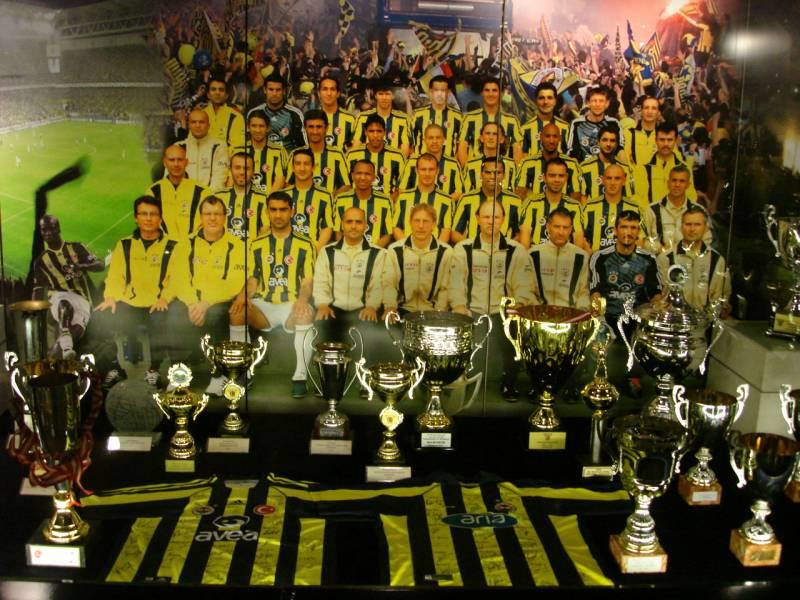
Fenerbahçe Sports Club Museum is a museum established to showcase the history, achievements, and cultural heritage of Fenerbahçe Sports Club, one of Türkiye’s most prominent and longstanding sports clubs. Located in the Kadıköy district of Istanbul, beneath the Marathon Stand of the Fenerbahçe Şükrü Saracoğlu Stadium, the museum occupies an area of approximately 980 m². It presents the club’s achievements across 35 different sports disciplines in chronological and thematic sections.

Fenerbahçe Spor Kulübü Müzesi (Fenerbahçe Sports Club)
The museum’s origins trace back to 5 June 1910, following Fenerbahçe’s victory over the famous Greek team Sturugglers of Istanbul, for which the club was awarded its first trophy adorned with silver filigree. By 1913, the number of trophies and statues had increased, and a small display case was installed in the club’s premises at Altıyol to exhibit these items. In 1914, when the club moved to a two-story wooden building in Kuşdili, a dedicated room on the second floor was allocated for the museum, and new display cases were constructed to showcase trophies and shields. As the collection grew over time, exhibition space expanded to lower floors as well.
A major fire in 1932 destroyed the club building along with more than 150 trophies and documents accumulated up to that date. Despite this loss, museum activities were not halted; after periods of war and fire, the collection was gradually rebuilt. For many years, trophies were displayed at the social facilities located at Fenerbahçe Burnu.
During the renovation of the Fenerbahçe Şükrü Saracoğlu Stadium, the board of directors under the leadership of President Aziz Yıldırım decided to establish a modern museum in line with contemporary standards. After approximately one year of preparation, the museum was officially inaugurated on 19 October 2005 under the auspices of the Museum, History and Archives Board, chaired by Sertaç Kayserilioğlu.
The museum comprises numerous specialized sections that reflect both Fenerbahçe’s history and key milestones in Turkish sports history:
In addition, trophies, shields, medals, regulations, licenses, membership cards, tickets, and other ephemera from every era of the club’s history are displayed in a chronological arrangement.
The museum’s collection includes trophies, medals, and sporting equipment from football, basketball, volleyball, athletics, boxing, sailing, and rowing, among other disciplines in which the club has been active historically and today. In addition, personal items belonging to coaches, presidents, and iconic athletes—such as uniforms, signed balls, and commemorative objects—are also exhibited.
Fenerbahçe Sports Club is distinguished not only by its sporting achievements but also by its contributions to social solidarity and the national struggle. The museum documents events such as the transportation of weapons from the club’s premises to the front during the occupation years, emphasizing that football was not merely a game but also a tool of social resistance.
The museum serves not only as an exhibition space but also as an educational center in the fields of sports history, social history, and cultural identity. Guided tours are offered to visitors, and special educational programs are organized for student groups. Additionally, projects are underway to develop digital content and provide remote access to archival documents.
The Fenerbahçe Sports Club Museum is open to visitors on specific days of the week. Entry is generally arranged through appointments or stadium tours. Visitors can reach the museum via the Marathon Stand entrance. The museum provides informational panels in Turkish and English, along with guided tour services.
Fenerbahçe Spor Kulübü. "Müze." Fenerbahçe Spor Kulübü Resmî Web Sitesi. Accessed August 16, 2025. https://www.fenerbahce.org/muze
Saltık, Zehra. “Fenerbahçe Spor Kulübü Müzesi.” Türkiye Turizm Ansiklopedisi. Accessed August 16, 2025. https://turkiyeturizmansiklopedisi.com/fenerbahce-spor-kulubu-muzesi
Turkish Ministry of Culture and Tourism. "Fenerbahçe Spor Kulübü Müzesi." Kültür Portalı. Accessed August 16, 2025. https://www.kulturportali.gov.tr/turkiye/istanbul/gezilecekyer/fenerbahce-spor-kulubu-muzesi
Location | Istanbul Türkiye | ||||||||
|---|---|---|---|---|---|---|---|---|---|
Opening | 19 October 2005 | ||||||||
Area(s) | 980 m² | ||||||||
Purpose(s) | Display of the club's history and achievements | ||||||||
No Discussion Added Yet
Start discussion for "Fenerbahçe Sports Club Museum" article
History
Exhibition Areas and Sections
Collection Contents
National Struggle and Social Memory
Educational and Cultural Role
Visit and Access Information