


This article was automatically translated from the original Turkish version.
The Fogg Behavior Model (FBM) is a psychological framework that posits that for an individual to perform a specific behavior, three essential elements must be present simultaneously. Developed in 2009 by Professor Dr. B.J. Fogg of Stanford University, the model was designed to inform the design of behavioral change strategies. Its primary purpose is to help explain why individuals perform or fail to perform certain behaviors. The FBM is frequently applied in areas such as habit formation, user experience design, and digital behavioral interventions.
The Fogg Behavior Model requires that three elements coincide simultaneously for a behavior (B – Behavior) to occur:
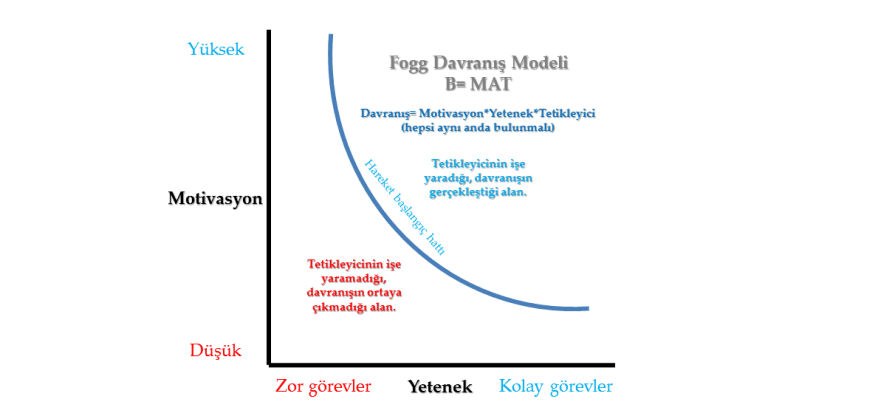
Fogg Behavior Model (dergipark)
According to the FBM, for a behavior to occur, the following three conditions must be met simultaneously:
B = M ⋅ A ⋅ T
B = M ⋅ A ⋅ T
According to this formula, if motivation (M) is low but ability (A) is high and a strong trigger (T) is present, the behavior can still occur. Similarly, if motivation is high but ability is low, a stronger or better-timed trigger is required for the behavior to take place. The model argues that behavioral interventions must focus not only on increasing motivation but also on improving ability and delivering the right triggers at the right time.
The Fogg Behavior Model is applied across many fields, particularly digital technologies. Key application areas include:
Fogg, B.J. *Fogg Behavior Model*. Stanford Behavior Design Lab. Accessed May 6, 2025. https://behaviordesign.stanford.edu/resources/fogg-behavior-model.
Güler, Emel. 2015. “Mobil Sağlık Hizmetlerinde Oyunlaştırma.” *Açıköğretim Uygulamaları ve Araştırmaları Dergisi* 1, no. 2 (August): 82–101. https://dergipark.org.tr/tr/pub/auad/issue/3029/42083.
Söğüt, Yasin. “Metaverse World and the Concept of Heterotopia.” Digital Communication Journal: 7th International Communication in the New World Congress, 2022, pp. 38–47. https://www.researchgate.net/publication/365203451.
Şahin, M., and Samur, Y. 2017. “Dijital Çağda Bir Öğretim Yöntemi: Oyunlaştırma.” _Ege Eğitim Teknolojileri Dergisi_ 1, no. 1: 1–27. https://dergipark.org.tr/en/pub/eetd/issue/29867/306559.
Components of the Model
Conditions for Behavior Occurrence
Applications
