This article was automatically translated from the original Turkish version.
Author(s) | Melih Cevdet Anday Oktay Rifat Horozcu Orhan Veli Kanık | ||||||||
|---|---|---|---|---|---|---|---|---|---|
Publisher(s) | Resimli Ay Matbaası | ||||||||
Place of Publication | İstanbul | ||||||||
Number of Pages | 64 | ||||||||
Included in the First Edition | 61 poems + 'Şiire Dair' Report | ||||||||
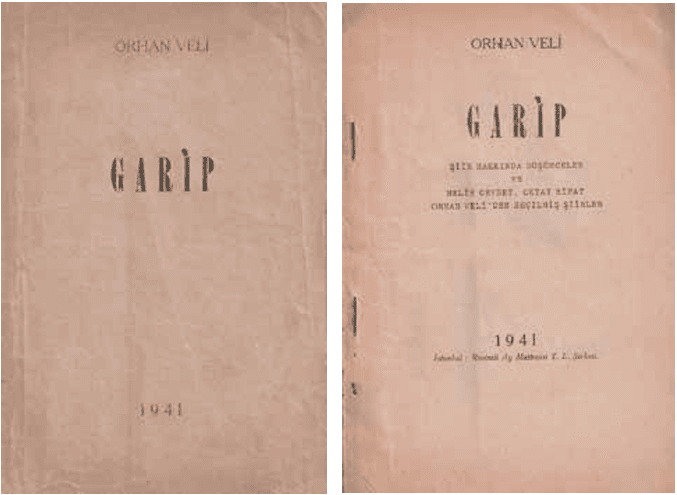
Garip is a poetry anthology published in 1941 and jointly prepared by Orhan Veli Kanık, Melih Cevdet Anday, and Oktay Rıfat Horozcu. This work initiated a fundamental transformation in Republican-era Turkish poetry, challenging traditional poetic conventions both in content and form. Recognized as the foundational text of the movement also known as "The Strange Movement", the book centers on plain language, free verse, and the ordinary individual.
The friendship between Orhan Veli, Melih Cevdet, and Oktay Rıfat, which began during their high school years, evolved into a literary collaboration grounded in their shared poetic vision. These three poets sought an alternative to the traditional poetic tradition by placing the everyday language, streets, and lives of the people at the heart of poetry. This new approach, named "Garip", was first announced in a manifesto published in the 154th issue of the Varlık magazine on December 1, 1939. In 1941, the poets compiled this manifesto along with their poems into the book titled Garip.
The first edition of the book contains a total of 61 poems: 24 by Orhan Veli, 21 by Oktay Rıfat, and 16 by Melih Cevdet. Additionally, the poems "Ağaç" and "Kış ve Bulut" are collaborative works signed by Orhan Veli and Oktay Rıfat. All poems are written in free verse and generally feature short, simple structures. Only Orhan Veli’s name appears on the cover, while all three poets are listed on the inside pages. The second edition, published in 1945, includes only Orhan Veli’s poems and a new preface titled "Garip İçin".
The preface of the Garip book was written by Orhan Veli and is regarded as a landmark manifesto in Turkish literature. In it, the traditional poetic conception is sharply criticized, and the argument is made that poetry must be liberated from rules such as meter and rhyme. Orhan Veli advocates a poetic approach that prioritizes meaning, asserting that poetry must convey sense. The poets believed that art should be created for the people and that poetry must be accessible and emotionally resonant for everyone. The preface also opposes excessive description and undue influence from other art forms.
The most significant innovation of the Garip book lies in its formal purification of poetry from ornamentation and tradition. The poets abandoned syllable and aruz meter in favor of free verse, successfully transforming the everyday language of the people into poetic language. The subjects of the poems revolve around ordinary individuals, poverty, bureaucracy, urban life, cultural differences, and the joy of living. This shift signified the removal of poetry from its status as an elite art form and its integration into the life of the public.
The Garip book generated significant反响 upon its publication, hailed as a revolutionary breakthrough by some circles while being criticized by traditional poets. Social realists, Hececiler poets, and later the Second New poets responded to this movement in various ways.
Accessed November 26, 2025.
Accessed November 26, 2025.
Anadolu Ajansı. "Garip Akımının Yıldız Şairi Orhan Veli Kanık." July 2, 2025. Accessed July 2, 2025.
Daşcıoğlu, Yılmaz - Orhan Veli. "Kanık, Orhan Veli." İslam Ansiklopedisi. Accessed July 2, 2025.
Doğan, Mehmet Can. Garip Şiiri. Türk Dil Kurumu, 2023. Accessed July 2, 2025.
Kardaş, Nurcan Ankay. "Orhan Veli’nin Hikâyelerini Garip Poetikası Üzerinden Okumak." Korkut Ata Türkiyat Araştırmaları Dergisi 10 (2023): 474-484. Accessed July 2, 2025.
Kuzu, Fatih. "Garip Şiirinin Dil Özellikleri Üzerine Genel Bir Değerlendirme." International Journal of Current Approaches in Language, Education and Social Sciences 3, no. 2 (2021): 174-186. Accessed July 2, 2025.

Author(s) | Melih Cevdet Anday Oktay Rifat Horozcu Orhan Veli Kanık | ||||||||
|---|---|---|---|---|---|---|---|---|---|
Publisher(s) | Resimli Ay Matbaası | ||||||||
Place of Publication | İstanbul | ||||||||
Number of Pages | 64 | ||||||||
Included in the First Edition | 61 poems + 'Şiire Dair' Report | ||||||||
Origin and Structure of the Book
Preface and Poetic Stance
Themes and Formal Innovations
Impact and Reactions