


This article was automatically translated from the original Turkish version.
+2 More
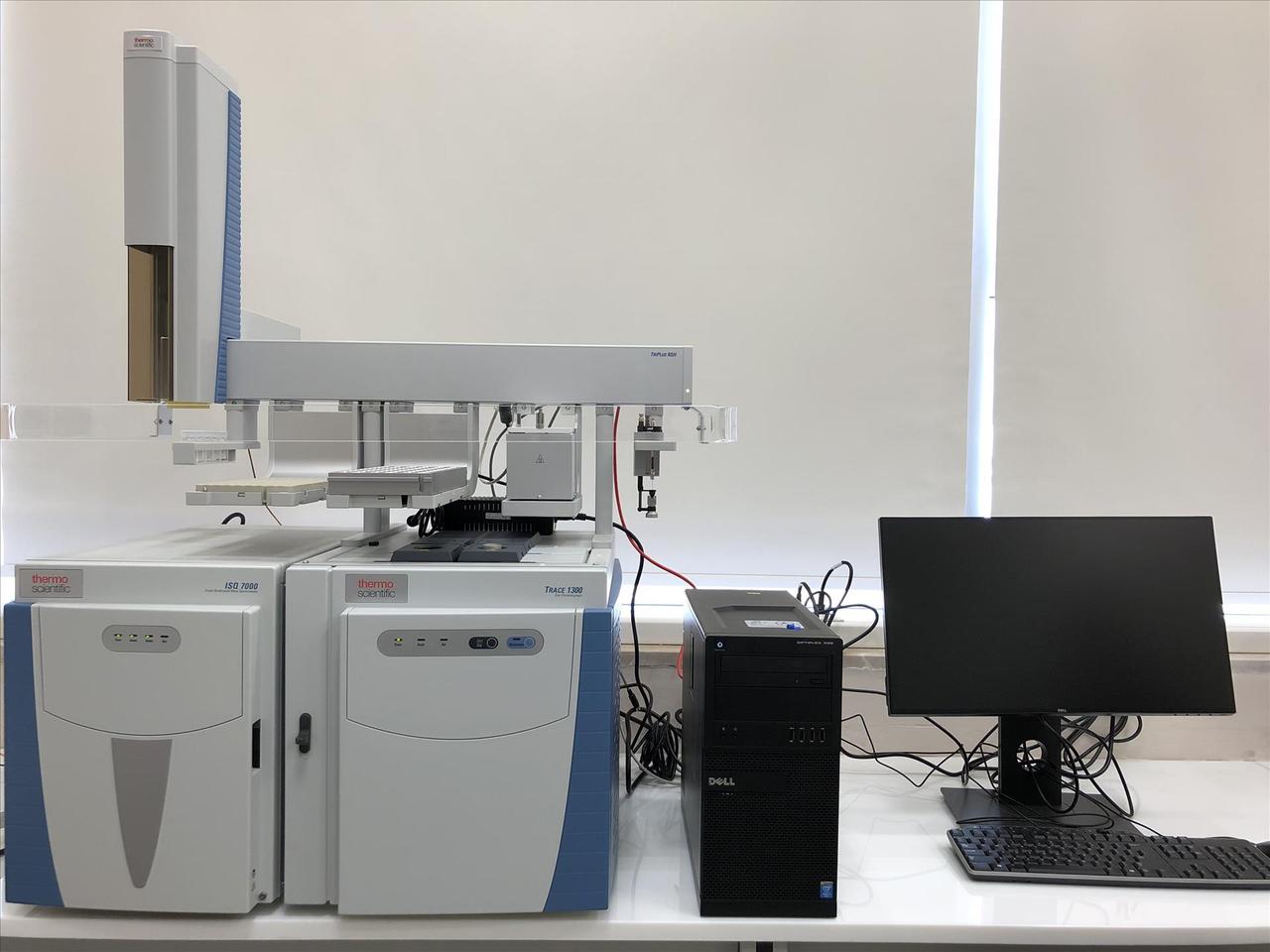
https://arum.ogu.edu.tr/Sayfa/Index/73/gaz-kromatografi-kutle-spektrometresi-gc-ms
GC-MS
Definitions | GC-MS, Separation and Identification of Volatile/Semi-Volatile Compounds | ||||||||
|---|---|---|---|---|---|---|---|---|---|
Component(s) | Carrier Gas Mass Analyzer Ion Source Capillary Column | ||||||||
Application Area(s) | Environment Petrochemical Pharmaceutical Food Forensic Science | ||||||||
Advantage(s) | Picogram-level sensitivity 95% spectrum matching accuracy | ||||||||
Limitations | Need for derivatization, high cost | ||||||||
Gas Chromatography-Mass Spectrometry (GC-MS) is a combined analytical system in which gas chromatography (GC) and mass spectrometry (MS) operate sequentially to separate identify and quantify volatile and semi-volatile compounds. This technology enables the detection of components in a mixture at parts per million (ppm) or parts per billion (ppb) levels. GC-MS stands out in analytical chemistry due to its high selectivity (90–95% mass spectrum matching accuracy), sensitivity (detection limits in the picogram range), and reliability.

GC-MS (1)
The foundations of gas chromatography were laid in 1952 by A. T. James and A. J. P. Martin through their work on liquid-gas chromatography. The first integration of GC and MS systems was achieved in 1959 by Gohlke and McLafferty. The commercial production of GC-MS instruments in the 1970s enabled widespread adoption of the system. Today, high-resolution Time-of-Flight MS (TOF-MS), triple quadrupole MS, and portable GC-MS systems represent significant advances in the evolution of this technology.
The sample is typically injected into a capillary column carried by an inert, low-viscosity carrier gas such as helium. These columns are usually 30 meters long, with an internal diameter of 0.25 mm and a film thickness of 0.25 µm, and are selected as either polar or non-polar. The injector can operate in split or splitless modes with an injection volume typically ranging from 1 to 5 µL. The separated components are sequentially transferred to the MS unit.
Ionization is most commonly performed using Electron Ionization (EI) at 70 eV energy; EI provides hard ionization while alternative methods such as Chemical Ionization (CI) offer softer ionization. In CI, reactive gases such as methane are used. Ions are separated according to their mass-to-charge (m/z) ratios by quadrupole (typical m/z range: 10–1000), ion trap, or TOF analyzers. Electron multiplier tubes (EMT) are most commonly used as detectors.

GC-MS (2)
Carrier Gas: Helium (inert, low viscosity)
Injector Unit: Split/splitless modes, volume of 1–5 µL
Capillary Column: Typically 30 m length, 0.25 mm internal diameter, 0.25 µm film thickness
Ion Source: EI (hard), CI (soft, methane reagent gas)
Mass Analyzer: Quadrupole, Ion Trap, TOF
Dector: Electron multiplier tube (EMT)
Software: Agilent ChemStation, MassHunter, Thermo Xcalibur
GC-MS has a broad range of applications:
Detection limit in the picogram range (e.g., 10 pg/mL)
High selectivity and accuracy
Identification capability via mass spectra
Capacity for both quantitative and qualitative analysis
Extensive spectral libraries (e.g., >300,000 compounds)
Non-volatile compounds may require derivatization (e.g., silylation)
Sample preparation procedures can be complex (SPE, LLE)
Instrument cost is high (approximately USD 100,000–500,000)
High energy consumption and requirement for trained operators.
GC-MS is a powerful tool in analytical chemistry for molecular-level separation and identification. Next-generation portable instruments enable rapid on-site analysis, while high-resolution systems provide greater accuracy in trace compound analysis. The use of GC-MS systems is rapidly expanding in emerging fields such as metabolomics, biomarker discovery, and isotope analysis.
American Chemical Society. (n.d.). “Landmark: Gas Chromatography-Mass Spectrometry.” Accessed July 1, 2025. https://www.acs.org/education/whatischemistry/landmarks/gas-chromatography-mass-spectrometry.html
Artuklu Üniversitesi. (n.d.). “Gaz Kromatografisi-Kütle Spektrometresi.” Accessed July 1, 2025. https://www.artuklu.edu.tr/merkezi-arastirma-laboratuari/gaz-kromotografisi-kutle-spektrometresi-gc-ms
Eskişehir Osmangazi Üniversitesi ARUM. (n.d.). “Gaz Kromatografi-Kütle Spektrometresi (GC-MS).” Accessed July 1, 2025. https://arum.ogu.edu.tr/Sayfa/Index/73/gaz-kromatografi-kutle-spektrometresi-gc-ms
Sandıkçıoğlu, Sibel. “Gaz Kromatografi-Kütle Spektrometresi (GC-MS) ve Kullanım Alanları.” Balıkesir Üniversitesi, 2017. Accessed July 1, 2025. https://kimya.balikesir.edu.tr/Seminerler/dokuman/201710105004SibelSandikcioglu.pdf

https://arum.ogu.edu.tr/Sayfa/Index/73/gaz-kromatografi-kutle-spektrometresi-gc-ms
GC-MS
Definitions | GC-MS, Separation and Identification of Volatile/Semi-Volatile Compounds | ||||||||
|---|---|---|---|---|---|---|---|---|---|
Component(s) | Carrier Gas Mass Analyzer Ion Source Capillary Column | ||||||||
Application Area(s) | Environment Petrochemical Pharmaceutical Food Forensic Science | ||||||||
Advantage(s) | Picogram-level sensitivity 95% spectrum matching accuracy | ||||||||
Limitations | Need for derivatization, high cost | ||||||||
No Discussion Added Yet
Start discussion for "Gas Chromatography-Mass Spectrometry (GC-MS)" article
History and Development
Working Principle
GC Unit
MS Unit
Components and Units
Applications
Advantages
Limitations
Conclusion and Future Perspectives