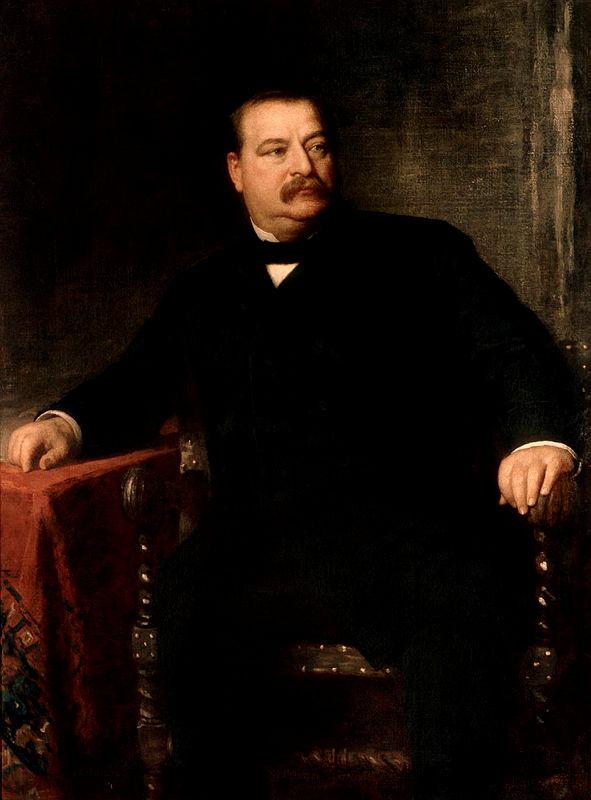
Doğum tarihi | 1837-03-18 | ||||||||
|---|---|---|---|---|---|---|---|---|---|
Eş | Frances Clara Folsom Cleveland (m. 1886 – d. 1908) | ||||||||
Place of Birth | Caldwell, New Jersey, USA | ||||||||
Ölüm tarihi | 1908-06-24 | ||||||||
Place of Death | Princeton, New Jersey, USA | ||||||||
Parents | Richard Falley Cleveland, Ann Neal Cleveland | ||||||||
Presidential Order | 22nd and 24th President of the United States (1885–1889, 1893–1897) | ||||||||
Stephen Grover Cleveland was born on March 18, 1837, in Caldwell, New Jersey. He was the fifth of nine children in a family whose father, Richard Cleveland, was a clergyman. The family moved to central New York in 1841. Following his father’s death in 1853, Grover Cleveland abandoned his aspirations for higher education and began working to support his family. He first worked as a teacher at the New York Institute for the Blind and later took a clerkship at a law office in Buffalo. Despite lacking formal legal training, he was admitted to the New York Bar in 1859. Cleveland began practicing law in Buffalo in the early 1860s and was appointed assistant district attorney for Erie County in 1863. During the American Civil War, instead of joining the military, he paid a substitute to fulfill his conscription obligations under the Conscription Act, a decision that later became a point of criticism from political opponents. In 1870 he was elected sheriff of Erie County, where he personally supervised the executions of two convicts. After completing his term, he returned to law practice and quickly rose in political prominence.
Cleveland began his political career in 1881 when he was elected mayor of Buffalo. In this role, he fought corruption and implemented principles of transparency and fiscal discipline in public service. His effectiveness led to his nomination and election as Governor of New York in 1882. During his governorship, he clashed with political interest groups by vetoing legislation he deemed financially irresponsible. In the 1884 election, he was nominated by the Democratic Party and defeated his Republican rival James G. Blaine, becoming the first Democratic president elected after the Civil War.
During his first term as president, Cleveland vetoed numerous bills aimed at limiting state expenditures and reducing the federal government’s role in the economy. In 1887 he rejected a relief package for Texas farmers, arguing that it would expand the paternalistic role of the state toward individuals. He also took an active stance on transportation and tariff reform, signing the Interstate Commerce Act, which initiated federal oversight of railroad monopolies. His insistence on tariff reductions contributed to his defeat in the 1888 election by Benjamin Harrison.
Cleveland was nominated again in the 1892 election and defeated Harrison, returning to office for a second term. His second term was marked by the economic depression of 1893. He repealed the Sherman Silver Purchase Act to restore the gold standard, but the deflationary policies and rising unemployment that followed drew public backlash. In 1894, during the Pullman Strike, he deployed federal troops to suppress the strike, damaging his relationship with labor unions and eroding his political support. In 1896 the Democratic Party nominated William Jennings Bryan instead of Cleveland.
When Grover Cleveland assumed the presidency, he was unmarried. In 1886 he married Frances Folsom, the daughter of his former law partner, in a ceremony held at the White House. This wedding became the first presidential marriage to take place in the White House. Frances Cleveland became one of the most popular First Ladies of her era. After leaving office, Cleveland retired to Princeton, New Jersey, where he served on the board of trustees of Princeton University and participated in efforts to regulate the insurance industry. He died in 1908 from heart failure and was buried in Princeton Cemetery. Cleveland remains the only U.S. president to serve two nonconsecutive terms and is remembered in American political history for his limited view of executive power and his opposition to government economic intervention.
American Battlefield Trust. “Grover Cleveland.” American Battlefield Trust. Accessed August 4, 2025. https://www.battlefields.org/learn/biographies/grover-cleveland
George W. Bush White House Archives. “Grover Cleveland.” The White House: President George W. Bush. Accessed August 4, 2025. https://georgewbush-whitehouse.archives.gov/history/presidents/gc2224.html
Library of Congress. “Grover Cleveland: A Resource Guide.” Library of Congress. Accessed August 4, 2025. https://www.loc.gov/rr/program/bib/presidents/cleveland/
Miller Center. Graff, Henry F. “Grover Cleveland: Life Before the Presidency.” *Miller Center, University of Virginia*. Accessed August 4, 2025. https://millercenter.org/president/cleveland/life-before-the-presidency
President Cleveland Foundation. “President Cleveland’s Biography.” The Grover Cleveland Birthplace Memorial Association. Accessed August 4, 2025. https://presidentcleveland.org/president-clevelands-biography/president-clevelands-biography-2/
Searles, Harry. “Stephen Grover Cleveland.” *American History Central*. Accessed August 4, 2025. https://www.americanhistorycentral.com/entries/stephen-grover-cleveland/
The American Presidency Project. “Grover Cleveland.” The American Presidency Project, UC Santa Barbara. Accessed August 4, 2025. https://www.presidency.ucsb.edu/people/president/grover-cleveland
The White House Historical Association. “Grover Cleveland.” *White House History*. Accessed August 4, 2025. https://www.whitehousehistory.org/bios/grover-cleveland

Doğum tarihi | 1837-03-18 | ||||||||
|---|---|---|---|---|---|---|---|---|---|
Eş | Frances Clara Folsom Cleveland (m. 1886 – d. 1908) | ||||||||
Place of Birth | Caldwell, New Jersey, USA | ||||||||
Ölüm tarihi | 1908-06-24 | ||||||||
Place of Death | Princeton, New Jersey, USA | ||||||||
Parents | Richard Falley Cleveland, Ann Neal Cleveland | ||||||||
Presidential Order | 22nd and 24th President of the United States (1885–1889, 1893–1897) | ||||||||
Political Career and Presidential Terms
Personal Life, Retirement Years, and Legacy