+2 More

Birth | 1946 | ||||||||
|---|---|---|---|---|---|---|---|---|---|
Education | Istanbul State Academy of Fine Arts (1969 Bedri Rahmi Eyüboğlu Studio) | ||||||||
Art Fields | Painting, installation, video, film | ||||||||
Collections | Istanbul Modern, Ankara Museum of Painting and Sculpture, İMOGA | ||||||||
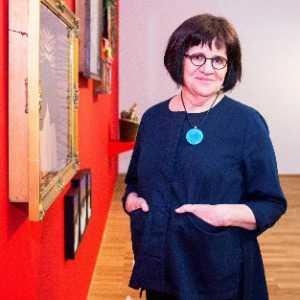
Gülsün Karamustafa, born in 1946 in Ankara and currently residing in Istanbul, is a prominent Turkish artist. Her father is radio announcer Hikmet Münir Ebcioğlu. In her art, she explores themes of identity, migration, gender, borders and collective memory.
She received painting instruction during her high school years at Ankara College, where her teachers included Eşref Üren, Turgut Zaim and Selva Tamkan. In 1962 she held her first exhibition in school halls and had a work accepted into the State Painting Exhibition that same year. After graduating in 1969 from the Istanbul State Academy of Fine Arts in Bedri Rahmi Eyüboğlu’s workshop, she served as a faculty member at Marmara University Faculty of Fine Arts (formerly the Applied Fine Arts High School) between 1975 and 1981. She chose not to continue her academic career and instead turned toward independent production. She has also held teaching positions at the Munich Academy of Fine Arts, Boğaziçi University and Hannover International Women’s University.
In her work, themes of migration, gender, nation-state mechanisms and invisible social traumas frequently emerge. Political events she witnessed in Istanbul in the late 1960s, including left-right conflicts, feminist debates and discussions on racism, shaped her artistic production. Using film, painting, sculpture and installation techniques, she constructs local narratives on a universal scale. She addresses the social and spatial cultural impacts of internal migration, particularly as reflected in Istanbul’s visual fabric, through figurative representations.
The artist supported student actions while teaching at the academy. She married Sadık Karamustafa, who participated in the 1970 Academy occupation; following the March 12 Memorandum, she was arrested alongside her husband and received a prison sentence. She reflected on this period in her work titled “A Promised Exhibition”.
She held her first solo exhibition in 1978 at the Istanbul Taksim Art Gallery. In the 1980s she participated in the series “Contemporary Artists”, “New Trends” and “Pioneering Turkish Art”. Her first international solo exhibition took place in Montreal in 1994, followed by collaborative projects at the Shedhalle in Zurich. Retrospective exhibitions were organized at Istanbul SALT Beyoğlu in 2013 and at Berlin’s Hamburger Bahnhof in 2016.
In 1984 Karamustafa served as art director for the film “A Sip of Love”. In 1990 she co-directed the film “My Cinemas” with Füruzan, which won awards at various festivals.
“The Memory of the Square (As Seen from Within)” (2005) is a dual-screen video installation. The work, which examines the relationship between public and private space from a historical perspective, is presented with a subtle musical score in the aesthetic of silent film. It is part of the Istanbul Modern Collection. Her work titled “B-0064-Melek” is also held at the Ankara Museum of Painting and Sculpture.
Since 1981 she has produced original prints in her own studio, and since 1984 at Çamlıca Art House.
Ankara Resim ve Heykel Müzesi. "Gülsün Karamustafa (1946–…)." Ankara Resim ve Heykel Müzesi Sanatçılar Sayfası. Accessed August 16, 2025. https://arhm.ktb.gov.tr/artists/detail/2914/gulsun-karamustafa-1946-…
İstanbul Grafik Sanatlar Müzesi. “Gülsün Karamustafa.” Istanbul Grafik Sanatlar Müzesi Koleksiyonu. Accessed August 16, 2025. https://www.imoga.org/tr/collection/artists/gulsum-karamustafa

Birth | 1946 | ||||||||
|---|---|---|---|---|---|---|---|---|---|
Education | Istanbul State Academy of Fine Arts (1969 Bedri Rahmi Eyüboğlu Studio) | ||||||||
Art Fields | Painting, installation, video, film | ||||||||
Collections | Istanbul Modern, Ankara Museum of Painting and Sculpture, İMOGA | ||||||||
Education and Academic Career
Artistic Approach and Themes
Activism and Political Context
Exhibitions and International Projects
Key Works