This article was automatically translated from the original Turkish version.
+1 More
Gümüşhane Şiran Çakırkaya Church
Location | Gümüşhane Province Kozağaç Locality Çakırkaya Village Şiran District | ||||||||
|---|---|---|---|---|---|---|---|---|---|
Distance | 12 km from Şiran 100 km from Gümüşhane center | ||||||||
Architectural and Technical Features | Rock carving technique | ||||||||
Height(s) | 65 meters | ||||||||
Environmental Context | Rock mass containing dominant surroundings and tafoni natural formations | ||||||||
The Çakırkaya Monastery was carved into a massive rock formation rising approximately 65 m above ground level within the boundaries of Çakırkaya Village (Kozağaç locality), Şiran District, Gümüşhane Province. It is located approximately 100 km from Gümüşhane city center and 12 km from Şiran district center. It lies along the Tomara Waterfall route and is accessible via a gentle climb up a wide dirt path, about 100 m from the main road.
No definitive record exists regarding the construction date of the structure. Based on its architectural features, it is dated to the 13th–15th centuries. Sources indicate that in 1848, Bishop Jeremias Georgiades reorganized the structure as a monastery.

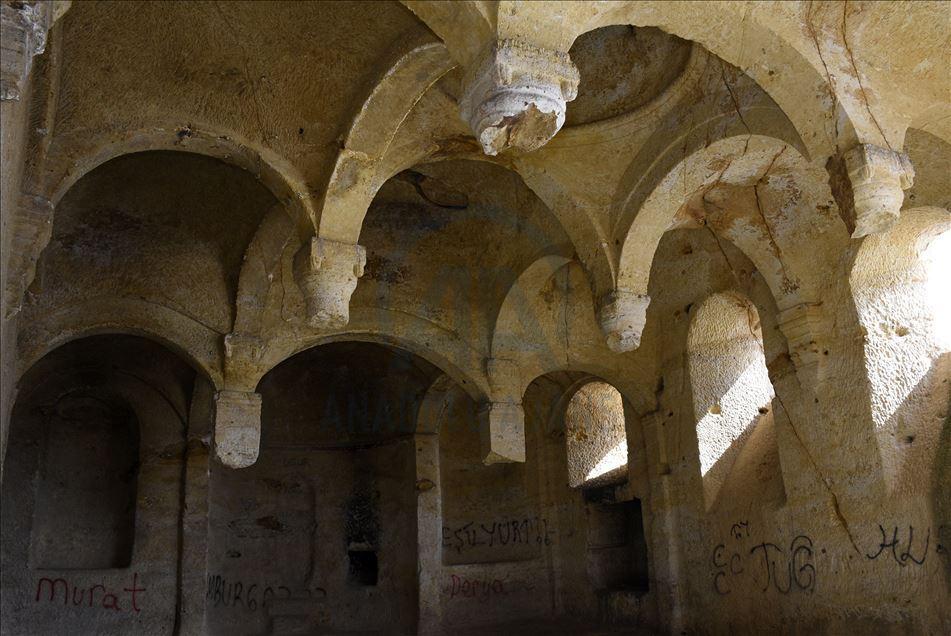
Çakırkaya ChurchAnadolu Agency)
The complex consists of the main church, a rock chapel located to its west, several small spaces carved into the cliffs, and service rooms at ground level on the southern side, all of approximately equal dimensions. These service rooms have not survived to the present day.
The rocky mass on which the complex is situated dominates the surrounding topography. Natural tafoni formations are also visible on the rock surface.
Unlike other rock-cut structures in the region, the Çakırkaya Monastery stands out due to its three-aisled domed basilica plan. The western rock chapel reflects the typical characteristics of single-nave chapels; its lack of frescoes and refined craftsmanship distinguish it (Özkan, 2010, p. 81). The reorganization of the structure as a monastery in 1848 demonstrates that this medieval construction continued to be used in the late period.
Olgun, Oğuzhan. 2019. “Çakırkaya Manastırı.” In *Online Türkiye Turizm Ansiklopedisi*, edited by Kozak, N. Accessed August 16, 2025. https://turkiyeturizmansiklopedisi.com/cakirkaya-manastiri.
T. C. Ministry of Culture and Tourism. t.y. “Şiran Kozağaç Köyü Çakırkaya Kilise.” Accessed August 16, 2025. https://gumushane.ktb.gov.tr/TR-232374/siran-kozagac-koyu-cakirkaya-kilise.html.
Özkan, Hasan. 2010. “Gümüşhane ve Çevresinde Kilise ve Şapeller.” *Journal of Social Sciences* 10, no. 45 (2010): 67–87. Accessed August 16, 2025. https://dergipark.org.tr/tr/download/article-file/451483.

Gümüşhane Şiran Çakırkaya Church
Location | Gümüşhane Province Kozağaç Locality Çakırkaya Village Şiran District | ||||||||
|---|---|---|---|---|---|---|---|---|---|
Distance | 12 km from Şiran 100 km from Gümüşhane center | ||||||||
Architectural and Technical Features | Rock carving technique | ||||||||
Height(s) | 65 meters | ||||||||
Environmental Context | Rock mass containing dominant surroundings and tafoni natural formations | ||||||||
No Discussion Added Yet
Start discussion for "Gümüşhane Şiran Çakırkaya Church" article
History
General Layout
Church
Rock Chapel (Western Chapel)
Access and Environmental Context