


This article was automatically translated from the original Turkish version.
+2 More
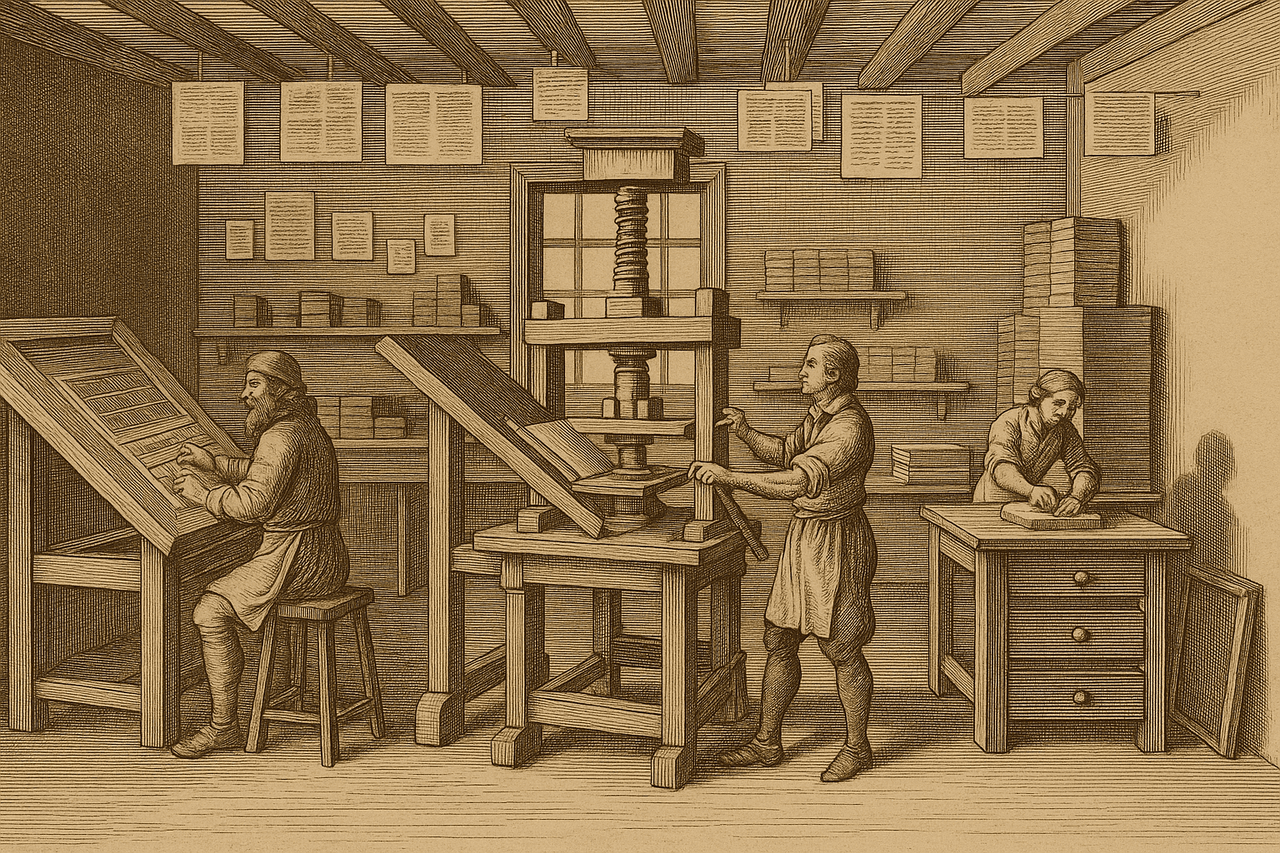
Generated by Artificial Intelligence.
Mucit | Johannes Gutenberg (1397–1468) | ||||||||
|---|---|---|---|---|---|---|---|---|---|
Place(s) | Mainz Türkiye | ||||||||
Period(s) | Mid-15th century (approximately 1440–1455) | ||||||||
Technology | Printing system with movable metal type | ||||||||
Material(s) | Lead-tin-antimony alloy type parchment and handmade paper oil-based ink | ||||||||
The Gutenberg printing press is recognized as the first printing system to use movable metal type, developed around the mid-15th century in Mainz, Germany, by Johannes Gutenberg (1397–1468). This innovation fundamentally transformed the production, dissemination, and storage of information in Europe; it contributed significantly to the spread of the intellectual climate of the Renaissance, the strengthening of the Reformation movements, and the acceleration of the scientific revolution.

Interior of the Gutenberg printing press (Rijks Museum)
At the beginning of the 15th century, book production in Europe was carried out by scribes in monasteries through handwritten manuscripts. This method was extremely time-consuming, costly, and prone to errors. The limited production of handwritten works restricted access to knowledge primarily to clergy and aristocratic circles.
Between 1440 and 1450, Gutenberg developed a system based on the principle of assembling individual metal cast letters, distinct from the woodblock printing techniques that had been used in Asia for centuries. This technique allowed each letter to be reused, significantly reducing printing costs and enabling mass production of books.
Additionally, Gutenberg standardized ink transfer by designing a mechanical printing mechanism inspired by wine presses. This ensured both legibility and consistent reproduction quality across printed pages. The system laid the foundation for modern printing technology, which rapidly spread to other European cities.
Gutenberg created type matrices from an alloy of lead, tin, and antimony. This alloy was ideal for typography due to its durability and ease of casting.
Each letter was cast using molds called matrices, then arranged according to line layout to form a printing forme. This process introduced both mechanical standardization and textual consistency.
Typographically, the letters were designed in Gothic typefaces inspired by contemporary handwritten scripts. This choice created an aesthetic familiar to readers of the time, making printed books resemble handwritten manuscripts.
Gutenberg’s ink was produced from an oil-based mixture, differing from traditional manuscript inks. This dense ink adhered better to metal type surfaces, producing clear and durable prints.
Both vellum (parchment) and newly emerging European cotton-based handmade paper were used in the prints. This material selection reduced production costs while enhancing the longevity of the books.
Thanks to these technological innovations, the Gutenberg press became superior to all previous methods of text production in terms of speed, quality, and cost. This diversity of materials also represented a significant advancement in print quality.
The first major work printed on Gutenberg’s press was the “42-Line Bible,” completed around 1455. This Bible represents a mature example of the press, demonstrating both technical excellence and aesthetic harmony.

A page from the Gutenberg Bible held at Harvard University Library (Harvard Library)
This Bible is regarded as the first example of mass printing in Europe and has become a symbol of the transition from manuscript culture to print culture in the history of written communication.
Today, approximately 49 copies of the 42-Line Bible are partially or fully preserved. One is held at Harvard University Library, and another is protected under UNESCO’s “Memory of the World” program. These copies are valued not only as religious texts but also as pivotal milestones in the history of human knowledge production.
The Gutenberg printing press created a qualitative revolution in the production and transmission of knowledge.
In the post-Gutenberg era, printing activity strengthened the information production networks of universities and urban centers, laying the groundwork for the emergence of a shared intellectual language in European culture.
The invention of the printing press played a decisive role in the spread of the Reformation movements of the 16th century. Martin Luther’s 95 Theses, published in 1517, were rapidly reproduced in thousands of copies thanks to the printing press and distributed throughout Europe.
Scientific works also spread in a more systematic manner due to the contribution of printing. The works of scientists such as Copernicus, Kepler, and Galileo were printed in the same format across different regions, ensuring the standardization of scientific knowledge.
The printing press was not only a cultural but also an economic transformative force. New industries emerged, including publishing houses, bookbinding workshops, and paper mills. Book trade strengthened early capitalist market relations in European cities. The economic value of knowledge increased, and books became both cultural artifacts and commercial commodities. In this regard, Gutenberg’s invention laid the foundations for the publishing industry and the knowledge economy in modern Europe.
Erdem, Bora. *Matbaacılık ve Basım Süreci*. İstanbul: Cinius Yayınları, 2013.
Harvard Library. “The Gutenberg Bible.” Harvard Library Collections. Accessed October 23, 2025. Erişim Adresi.
Oregon State University. "Gutenberg." *McDonald Rare Book Collection Exhibits.* Accessed October 23, 2025. Erişim Adresi.
Rijksmuseum. "Interieur van de drukkerij van Johannes Gutenberg." Rijksmuseum. Accessed October 23, 2025. Erişim Adresi.
Tosun Durmuş, Büşra. “Matbaa Teknolojisinin Osmanlı Devletine Giriş Koşulları ve Tartışmalar.” *Gümüşhane Üniversitesi İletişim Fakültesi Elektronik Dergisi* 5, no. 2 (2017): 950–968. Accessed October 23, 2025. Erişim Adresi.
UNESCO. “42-line Gutenberg Bible, printed on vellum, and its contemporary documentary background.” Memory of the World. Accessed October 21, 2025. Erişim Adresi.
Önder, Işık. *Müteferrika’dan E-Kitaba*. mekam.org, 2015. Erişim Adresi.

Generated by Artificial Intelligence.
Mucit | Johannes Gutenberg (1397–1468) | ||||||||
|---|---|---|---|---|---|---|---|---|---|
Place(s) | Mainz Türkiye | ||||||||
Period(s) | Mid-15th century (approximately 1440–1455) | ||||||||
Technology | Printing system with movable metal type | ||||||||
Material(s) | Lead-tin-antimony alloy type parchment and handmade paper oil-based ink | ||||||||
Historical Context and Development
Technological Features
Typecasting and Typography
Ink and Paper
The Gutenberg Bible (42-Line Bible)
Characteristics
Preservation and Surviving Copies
Social, Cultural, and Economic Impacts
Transformation in Knowledge and Culture
Religious and Scientific Dissemination
Economic and Industrial Effects