This article was automatically translated from the original Turkish version.
+1 More
Location | Kayseri Türkiye | ||||||||
|---|---|---|---|---|---|---|---|---|---|
Year of Establishment | 1990 | ||||||||
Elevation(s) | 1350 m | ||||||||
Area(s) | 165–208 km² | ||||||||
Population | Approximately 20,896 (2022) | ||||||||
District Governor | Cüneyt CANER | ||||||||
Mayor(s) | Bilal ÖZDOĞAN | ||||||||
The foundations of Hacılar district were laid by the Hacılar Oymağı, a clan belonging to the Ağcalı community of the Kayı branch of the Oghuz Turks. Following their migration from Turkistan toward Anatolia, this clan first settled in the Çukurova region and used the Taurus Mountains as seasonal pastures until the 15th century. With increasing population density and the north-south development of trade routes, the area around Mount Erciyes was adopted as a new seasonal pasture. In the 16th century, due to disputes among members of the clan residing in the Adana region, they relocated to the Dört Kuyular site within the present-day boundaries of Kayseri province; later, due to water shortages and external pressures, they moved to the current location of Hacılar.
In Ottoman tax registers, Hacılar village is recorded as a settlement under the jurisdiction of the Cebel-i Erciyes Nahiye. The village was assigned as a vakıf (endowment) property, while its state lands were allocated as timars; it was exempt from the Avarız tax. This status reflects the importance of the settlement within the Ottoman administrative system.
After the proclamation of the Republic, Hacılar continued its development: it became a municipality in 1930 and a nahiye in 1931. It attained district status under Law No. 3647 dated 16 May 1990 and officially began operations on 9 September 1991. As of 1 January 2005, it was incorporated into the boundaries of Kayseri Metropolitan Municipality and became one of the city’s five central districts.
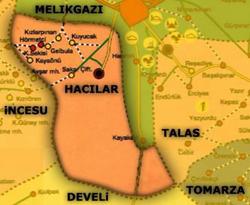
Hacılar is located south of the city center of Kayseri, at the foothills of Mount Erciyes. The district is bordered by Melikgazi to the north and east, Develi to the south, and İncesu to the west. Hacılar lies at an elevation of approximately 1350 meters and has an area ranging between 165 and 208 km². The district’s terrain consists largely of volcanic rock formations and hills, with small-scale agricultural fields and orchards surrounding the settlements.
In the neighborhoods of Hacılar, traditional stone houses coexist with concrete residential buildings constructed in recent years. The neighborhoods of Beğendik, Akdam, and Yediağaç stand out for their vineyards and gardens. The local population continues the tradition of summering in these areas. The district has social infrastructure including health centers, social facilities, and housing cooperatives. Additionally, social and sporting activities are supported through mountain climbing and winter sports clubs.
While agriculture, animal husbandry, and weaving were once dominant, industry and trade now shape the district’s economic structure. Numerous industrial enterprises operate in Hacılar, specializing in home textiles, furniture, and cable production; major companies such as HES Kablo and Has Çelik are pioneers of Hacılar’s industrial sector. The Hacılar Special Organized Industrial Zone, integrated with the Kayseri OSB, has contributed significantly to regional industrialization.
Due to its location at the foothills of Mount Erciyes, the district has high potential for winter and nature tourism. Hacılar attracts visitors year-round with its ski slopes, hiking trails, highland pastures, vineyard houses, clean air, and scenic landscapes.
Hacılar Belediyesi. “Tarihi ve Coğrafi Bilgiler.” Hacılar Belediyesi Resmî Web Sitesi. Accessed June 26, 2025. https://www.hacilar.bel.tr/sehir/tarihi-ve-cografi-bilgiler/1/.
Hacılar District Mufti's Office. "Müftülüğümüz." T.C. Diyanet İşleri Başkanlığı Kayseri Hacılar İlçe Müftülüğü. Accessed June 26, 2025. https://kayseri.diyanet.gov.tr/hacilar/Sayfalar/contentdetail.aspx?MenuCategory=Kurumsal2&ContentId=muftulugumuz.
Hacılar District National Education Directorate. "İlçemiz Hakkında." T.C. Millî Eğitim Bakanlığı Hacılar İlçe Müdürlüğü. Accessed June 26, 2025. https://hacilar.meb.gov.tr/www/ilcemiz-hakkinda/icerik/12#gallery-1.
Hacılar Kaymakamlığı. "Tarihçe." Hacılar Kaymakamlığı Resmî Web Sitesi. Accessed June 26, 2025. http://www.hacilar.gov.tr/tarihce.
Kayseri Valiliği. “Hacılar.” Kayseri Valiliği Resmî Web Sitesi. Accessed June 26, 2025. http://www.kayseri.gov.tr/hacilar.
Turkish Ministry of Culture and Tourism. “Hacılar.” *Kayseri İl Kültür veTurizm Müdürlüğü. Accessed June 26, 2025. https://kayseri.ktb.gov.tr/TR-54990/hacilar.html.

Location | Kayseri Türkiye | ||||||||
|---|---|---|---|---|---|---|---|---|---|
Year of Establishment | 1990 | ||||||||
Elevation(s) | 1350 m | ||||||||
Area(s) | 165–208 km² | ||||||||
Population | Approximately 20,896 (2022) | ||||||||
District Governor | Cüneyt CANER | ||||||||
Mayor(s) | Bilal ÖZDOĞAN | ||||||||
Ottoman Period
Republican Period and District Status
Geographical Structure
Social and Cultural Structure
Economy
Tourism and Natural Beauty