This article was automatically translated from the original Turkish version.
+2 More
İncesu (District)
Province(s) | Kayseri | ||||||||
|---|---|---|---|---|---|---|---|---|---|
Coordinate(s) | 35° East longitude 38° North latitude | ||||||||
Area(s) | 872 km² | ||||||||
Elevation(s) | 330 meters 065 and 1 Between 1 | ||||||||
Population | 29,120 (2022 TÜİK data) | ||||||||
District Governor | Ömer Said Karakaş | ||||||||
Mayor(s) | Mustafa İlmek | ||||||||
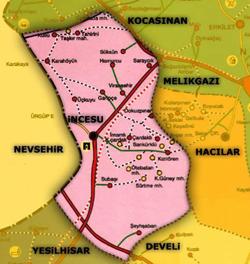
İncesu is a district of Kayseri in Türkiye. It is located in the southwest of Kayseri, on the southern and southwest slopes of Mount Erciyes, along the Kayseri-Niğde State Highway. The district center is approximately 30–33 km from the city center of Kayseri and has an elevation ranging between 1,065 and 1,330 meters. Its precise geographic coordinates are 35° east longitude and 38° north latitude. It is bordered by Kocasinan to the north and east, Hacılar to the east, Ürgüp district of Nevşehir to the west, Develi to the southeast, and Yeşilhisar district to the southwest.
The history of İncesu extends back to antiquity, when it was known as “Sadoora.” Settlement in the area dates to prehistoric times, with evidence including caves, rock-cut tombs, and carved motifs. A significant turning point in the district’s development occurred in the 17th century, particularly during 1660–1661, when Merzifonlu Kara Mustafa Pasha established his military headquarters here during his Baghdad campaign and commissioned a külliye to revitalize the region. This külliye included a mosque, caravanserai, bathhouse, and bazaar. In the 19th century, İncesu served as a bucak center and gained district status under Kayseri in 1901. Following the population exchange after the Treaty of Lausanne between 1925 and 1930, the Greek population of the district migrated to Greece, and Turkish migrants from Thessaloniki and surrounding areas settled in their place. Throughout the 20th century, population growth and economic activity remained limited; however, beginning in the 1990s, İncesu experienced outward migration due to Kayseri’s industrialization process, leading to significant social and economic transformation.
Although İncesu is located near the Cappadocia region, it has not fully benefited from tourism. The district contains several historically and culturally significant structures, including the külliye built by Merzifonlu Kara Mustafa Pasha—comprising a caravanserai, mosque, bathhouse, madrasa, fountain, oven, and shops—as well as an 18th-century church and traditional stone buildings. Additionally, the Tekgöz Bridge, a historical structure built by Mimar Sinan over the Kızılırmak River, is located in the district. There are 92 registered cultural assets in İncesu. Restoration work on the Kara Mustafa Pasha Külliyesi is ongoing, with the aim of preserving the district’s historical identity and enhancing its tourism potential. Furthermore, the annual İncesu Grape Festival, traditionally held on the first Saturday of September, is an important event both economically and socially.
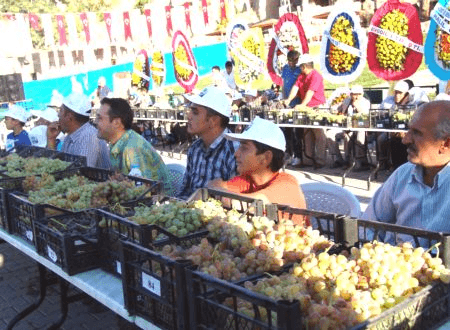
İncesu Grape Festival (District Governorship of İncesu, Republic of Türkiye)
The district features a undulating terrain between Mount Erciyes and Tekke Mountain (approximately 1,800 m). The İncesu Creek, which originates in the Aksu Vineyards, serves as a vital water source for the region. Covering an area of approximately 872 km² (78,195 hectares), İncesu has a balanced distribution of agricultural land, pastures and meadows, forests, and settlement zones. A continental climate prevails in İncesu. Winters are cold and snowy, with temperatures dropping as low as -20°C. Summers are short and hot, with an average temperature of about 22°C. Annual precipitation ranges between 300 and 400 mm. Snowfall typically lasts an average of 12 days, with snow depth reaching up to 41 cm. Due to its distance from the sea, the district exhibits semi-arid characteristics. Forest areas are limited, with pine and oak trees predominantly found on the slopes of Mount Erciyes and Tekke Mountain.
According to 2022 TÜİK data, the population of İncesu district is approximately 29,120. The administrative structure of the district was updated following Law No. 5216 issued in 2004 on Metropolitan Municipalities and Law No. 6360 adopted in 2014, which converted several villages into neighborhoods. The district currently has 31 neighborhoods, with municipal administrations in the center, Kızılören, and Süksün. Nine villages—including Dokuzpınar, Sarıkürklü, Örenşehir, and Çardaklı—have been granted neighborhood status. Public institutions in the district include the District Governorship, Gendarmerie, Police Directorate, National Education Directorate, Health Directorate, Ministry of Food Agriculture and Livestock, and Land Registry Directorate. Professional organizations such as the Chamber of Tradesmen and Artisans, Chamber of Agriculture, and transport cooperatives are also present.
The economy of İncesu is primarily based on agriculture and animal husbandry. Approximately 85% of the agricultural land in the district is dry farmland, with the remainder consisting of irrigated land, vineyards, and pastures. Major agricultural products include wheat, barley, rye, oats, sugar beet, potatoes, sunflower, alfalfa, various vegetables (watermelon, melon, squash, tomato, pepper), and fruits. Grape cultivation is particularly significant as a source of income, with annual grape production reaching approximately 5,000 tons. Animal husbandry also plays an important role in the local economy. The district is home to a total of 6,060 head of large livestock (cattle and buffalo) and 37,000 head of small livestock (sheep and goats). Daily milk production averages around 7 tons. Animal products such as cheese, yogurt, butter, and wool are widely produced and marketed in Kayseri and surrounding areas. Industrially, İncesu is an emerging district. The Kayseri-İncesu Organized Industrial Zone has been established within district boundaries, hosting factories engaged in textile production, fruit concentrate manufacturing, gas filling facilities, and PVC production.
Kayseri Valiliği. Accessed July 18, 2025. https://kayseri.gov.tr/incesu
Kayseri İl Directorate of Culture and Tourism. Accessed July 18, 2025. https://kayseri.ktb.gov.tr/TR-54991/incesu.html
{'Organization Name': 'Türkiye İstatistik Kurumu (TÜİK).', 'Title': '"Türkiye İstatistikleri 2022."', 'Website': 'TÜİK Resmi Web Sitesi', 'Date': 'June 2023.', 'Accessed': 'Accessed July 18, 2025.'}
İncesu Kaymakamlığı. Accessed July 18, 2025. http://www.incesu.gov.tr/genel-bilgiler
İncesu Kaymakamlığı. Accessed July 18, 2025. http://www.incesu.gov.tr/incesu-uzum-festivali

İncesu (District)
Province(s) | Kayseri | ||||||||
|---|---|---|---|---|---|---|---|---|---|
Coordinate(s) | 35° East longitude 38° North latitude | ||||||||
Area(s) | 872 km² | ||||||||
Elevation(s) | 330 meters 065 and 1 Between 1 | ||||||||
Population | 29,120 (2022 TÜİK data) | ||||||||
District Governor | Ömer Said Karakaş | ||||||||
Mayor(s) | Mustafa İlmek | ||||||||
History
Culture and Tourism
Geography and Climate
Population and Administrative Structure
Economy