


This article was automatically translated from the original Turkish version.
The Hall–Petch relationship is a fundamental principle in materials science and metallurgy that describes an inverse correlation between grain size and mechanical strength. This relationship states that as the average crystal grain size of a material decreases, its yield strength (or hardness) increases. This phenomenon was independently discovered in the early 1950s by E. O. Hall and N. J. Petch through separate investigations and is named after these two scientists. Hall (1951) established the connection between grain boundaries and yield strength in soft steels, while Petch (1953) demonstrated that in ferritic steels, the resistance to brittle fracture increases as grain size decreases.

Here, σy represents the yield strength of the material and d denotes the average grain diameter, while σ0 is a material constant that reflects the resistance of the crystal lattice to dislocation motion. The parameter ky is the Hall–Petch coefficient, a material-specific constant that quantifies the effectiveness of grain boundary strengthening. The equation indicates that as grain size decreases, σy increases with d-1/2 (i.e. 1/
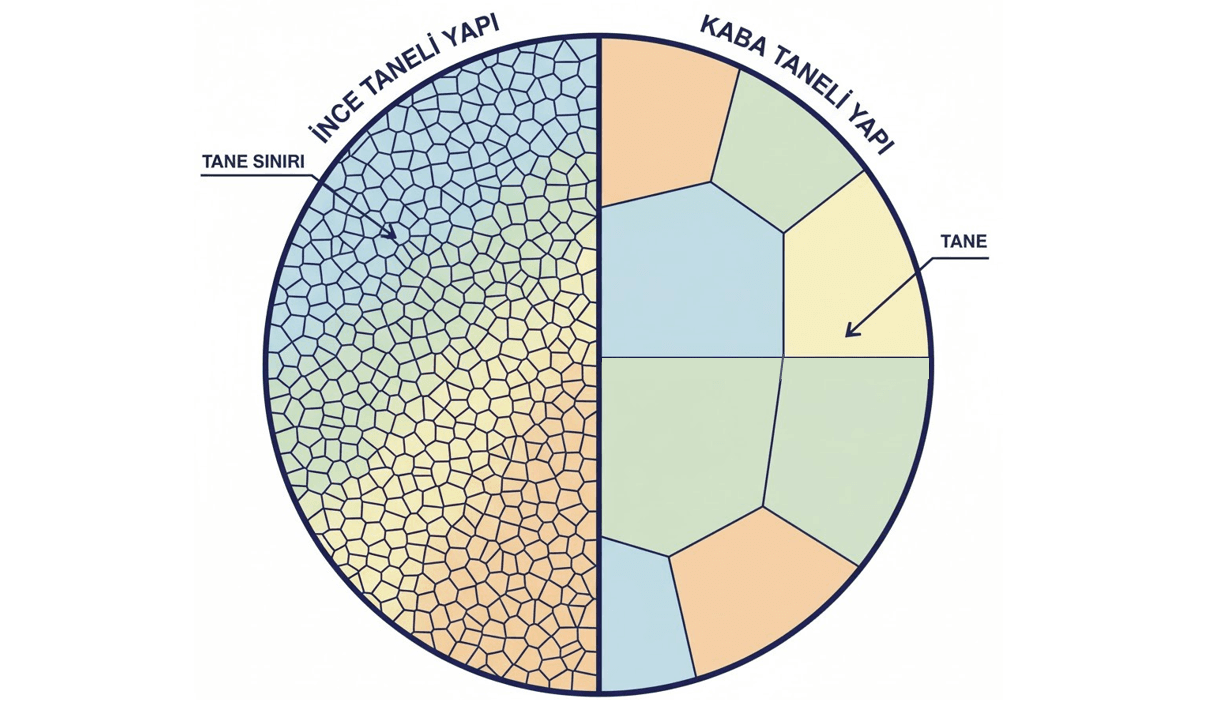
Fine-grained and coarse-grained microstructures (Generated by Artificial Intelligence.)
The physical interpretation of the Hall–Petch mechanism is based on the obstruction of dislocation motion by grain boundaries. Grain boundaries act as barriers that impede the free movement of dislocations. Dislocations moving within a grain accumulate at the boundary, making it difficult for them to transfer to adjacent grains. In a fine-grained structure, there are more grain boundaries per unit volume, and the distance over which dislocations can accumulate is reduced. Consequently, a higher stress is required to initiate plastic deformation, resulting in higher yield strength. This is why reducing grain size—for example, through appropriate heat treatments—is an effective method for strengthening materials. In engineering applications, steels and alloys with fine-grained microstructures exhibit higher strength and toughness. For instance, grain size can be refined through forging and controlled heat treatment to achieve desired mechanical properties.
The Hall–Petch relationship holds true when grain sizes are reduced to the micrometer scale. However, as grain sizes approach the nanometer range (< ~100 nm), this relationship no longer consistently applies. Specifically, for grain sizes smaller than a critical threshold (approximately 10–15 nm), the increase in strength ceases and further grain refinement can lead to softening—a reduction in strength. This phenomenon is known in the literature as the inverse Hall–Petch effect. The primary cause of inverse Hall–Petch behavior is a change in the deformation mechanism: instead of strengthening via dislocation pile-up, mechanisms such as grain boundary sliding and grain boundary diffusion become dominant. As a result, grains smaller than ~10 nm may exhibit lower strength than expected when further refined.

Grain Size – Yield Strength Relationship (Generated by Artificial Intelligence.)
Cordero, Z. C., B. E. Knight, and C. A. Schuh. “Six decades of the Hall–Petch effect – a survey of grain-size strengthening studies on pure metals.” *International Materials Reviews* 61, no. 8 (2016): 495–512. https://doi.org/10.1080/09506608.2016.1191808
Hall, E. O. “The Deformation and Ageing of Mild Steel: III Discussion of Results.” *Proceedings of the Physical Society, Section B* 64, no. 9 (1951): 747–753. https://doi.org/10.1088/0370-1301/64/9/303
Morris, J. W. “The Influence of Grain Size on the Mechanical Properties.”, 2001. https://www.osti.gov/servlets/purl/861397
Zhang, Huijun, Feng Liu, Goran Ungar, Zhongyu Zheng, Qingping Sun, and Yilong Han. “A Regime beyond the Hall–Petch and Inverse Hall–Petch Regimes in Ultrafine-Grained Solids.” *Communications Physics* 5 (2022): 329. https://doi.org/10.1038/s42005-022-01107-7

No Discussion Added Yet
Start discussion for "Hall-Petch Relationship" article
Mathematical Expression
Physical Mechanism
Inverse Hall–Petch Effect