This article was automatically translated from the original Turkish version.
+2 More
Registration Number | 1563 | ||||||||
|---|---|---|---|---|---|---|---|---|---|
Registration Date | 25.03.2024 | ||||||||
Application Number | C2020/095 | ||||||||
Application Date | 08.04.2020 | ||||||||
Name of the Geographical Indication | Hanak Tel Cheese | ||||||||
Product / Product Group(s) | Cheese / Cheeses | ||||||||
Type of Geographical Indication | Place of origin | ||||||||
Registered Owner | Ardahan Chamber of Commerce and Industry | ||||||||
Geographical Boundary | Hanak district of Ardahan province | ||||||||
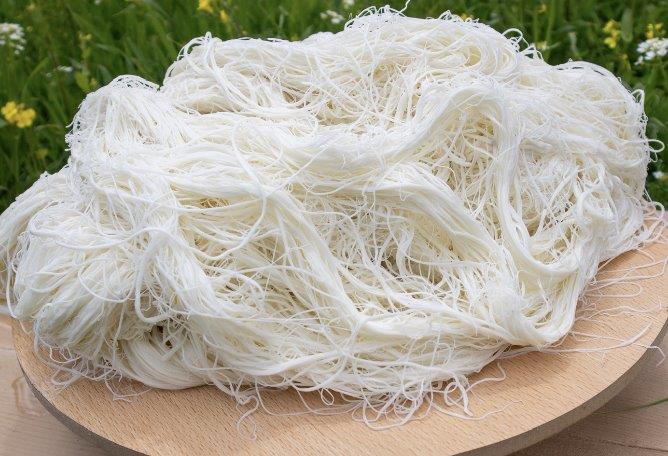
Hanak tel cheese is a geographical indication cheese variety produced exclusively in the Hanak district of Ardahan Province, Türkiye, during the months of June to September. It is made from milk obtained from Anatolian Brown cows, which are hybrids of the East Anatolian Red and Montafon breeds, grazed on natural pastures. The product consists of thin, long, shiny, pale yellow filamentous strands formed by kneading the cheese curd in warm whey. Each filament has a thickness of 0.6–3.8 mm, does not stick together, and possesses high flexibility and extensibility.
Hanak district is located in northeastern Türkiye and exhibits a harsh continental climate. The annual average temperature is 4 °C, with the lowest average temperature at -12 °C and the highest average temperature around 17 °C in July. Annual precipitation averages 600–700 mm. The pastures and highland meadows in the district extend between 1,800 and 2,700 meters in elevation and are divided into four vegetation zones: forested areas, depression zones, highland steppe, and mountain meadows. The native plant species growing in these regions play a fundamental role in animal nutrition and directly influence the quality of the milk produced.
The milk used in the production of Hanak tel cheese comes from Anatolian Brown cows, a hybrid of East Anatolian Red (EAR) and Montafon breeds. This milk is used exclusively during the period between June and September, when the animals are grazed on natural pastures within the designated geographical boundary. Cheese produced from milk obtained outside this period does not develop the characteristic filamentous structure and is not recognized as Hanak tel cheese.
During this period, the milk contains palmitic acid at 22.01–31.35%, stearic acid at 14.63–24.36%, oleic acid at 39.65–51.99%, and linoleic acid at 1.80–3.32%. Additionally, the dry matter content ranges from 11.9–12.7%, fat content from 3.0–3.4%, protein content from 3.1–3.4%, lactose from 3.8–4.5%, and mineral content from 0.68–0.73%. These values play a decisive role in determining the cheese’s aromatic profile and textural structure.
The natural flora affecting milk yield and quality includes numerous local plant species such as Anthemis montana (chamomile), Bromus japanicus (Japanese brome), Centaurea depressa (knapweed), Cephaleria sp. (pelemir), Filipendula vulgaris (meadowsweet), Trifolium pratense (red clover), Medicago varia (wild alfalfa), Lotus corniculatus (bird’s-foot trefoil), and Thymus fallax (thyme). These plants are consumed fresh only during the June–September period, which limits production to these months.
After milking, the milk is filtered and left at ambient temperature for 24 hours. Fresh milk is added to the soured milk in a 1:1 ratio. When the temperature reaches 35 °C, 0.05% white cheese starter culture is introduced and the mixture is heated until it forms a curd. The resulting cheese curd is processed in containers suitable for food contact.
The prepared cheese curd is repeatedly kneaded in whey maintained at 45–55 °C. During this process, interactions between beta-casein and serum proteins enhance the cheese’s elasticity and extensibility. At the end of kneading, the curd is immersed in cold water to halt these interactions.
Each curd is divided into portions averaging 2 kg. These portions are again immersed in whey at 45–55 °C, shaped into rings, and rotated until the filaments are sufficiently thinned. The final product takes the form of non-sticking, flexible filaments with a thickness of 0.6–3.8 mm.
The processed cheese is placed in brine at 10–15 °C. The brine is prepared exclusively with rock salt and allowed to rest for 10 days. Prepared at a ratio of 20–25 g of rock salt per liter of water, the brine contributes to cheese preservation and extends shelf life. Hanak tel cheese stored in brine is kept in airtight containers at temperatures below 15 °C. Its shelf life is two years.
Food-safe packaging materials such as PP (polypropylene) and PET (polyethylene terephthalate) containers are preferred. For fresh consumption, the cheese must be stored in brine for at least five days.
The geographical indication protection of the product is managed by the Ardahan Chamber of Commerce and Industry. The production process, component compliance, and adherence to physical and microbiological standards are inspected at least once annually. The inspection team consists of representatives from the relevant chamber, Hanak Municipality, Ardahan Provincial Directorate of Agriculture and Forestry, and the Department of Food Engineering at Ardahan University.
Turk Patent and Trademark Office. "Hanak Tel Peyniri." Turk Patent and Trademark Office. Accessed July 17, 2025. https://ci.turkpatent.gov.tr/Files/GeographicalSigns/c2374b1a-aced-48e3-b8d2-c9b366701b9e.pdf.
Türk Patent ve Marka Kurumu. "Hanak Tel Peyniri." Accessed July 17, 2025.

Registration Number | 1563 | ||||||||
|---|---|---|---|---|---|---|---|---|---|
Registration Date | 25.03.2024 | ||||||||
Application Number | C2020/095 | ||||||||
Application Date | 08.04.2020 | ||||||||
Name of the Geographical Indication | Hanak Tel Cheese | ||||||||
Product / Product Group(s) | Cheese / Cheeses | ||||||||
Type of Geographical Indication | Place of origin | ||||||||
Registered Owner | Ardahan Chamber of Commerce and Industry | ||||||||
Geographical Boundary | Hanak district of Ardahan province | ||||||||
Geographical and Ecological Context
Animal Breed and Milk Source
Vegetation and Feeding
Production Method
Curd Preparation
Kneading and Shaping
Brining and Packaging
Physical, Chemical, and Microbiological Properties
Physical Properties
Physicochemical Properties
Microbiological Properties
Monitoring and Geographical Indication Protection