

This article was automatically translated from the original Turkish version.
+2 More
Type of Geographical İndication | Mahreç Sign | ||||||||
|---|---|---|---|---|---|---|---|---|---|
Registration Number | 1584 | ||||||||
Product / Product Group(s) | Meals and Soups | ||||||||
Applicant/Registrant(s) | Hatay Governorate | ||||||||
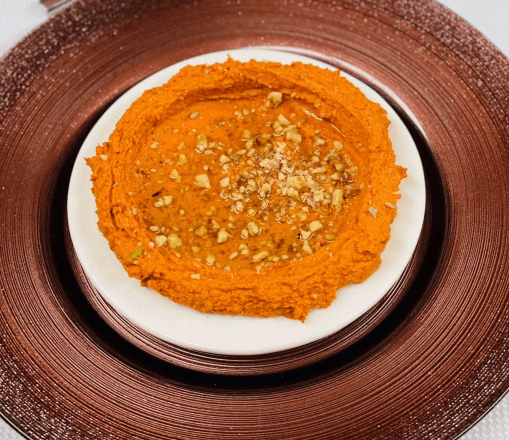
Hatay Walnut Pepper, also known as Hatay Muhammara, is a traditional meze originating from Hatay province, prepared by combining red pepper, walnut kernels, tahini, olive oil, and various auxiliary ingredients. Its preparation technique, ingredient ratios, and serving style place it among the distinctive products of Hatay culinary culture. Due to its strong association with Hatay province, the product has been registered under the geographical indication by the Turkish Patent and Trademark Office.
Hatay Walnut Pepper/Hatay Muhammara is protected under Law No. 6769 on Industrial Property. The registration aims to safeguard the product’s regional identity, traditional production knowledge, and its direct link to Hatay province.
Hatay Walnut Pepper/Hatay Muhammara is a meze prepared using red pepper, tahini, walnut kernels, olive oil, bread or bread crumbs, garlic or dried onion, pomegranate molasses, salt, powdered sugar, and various spices. The primary use of red pepper imparts a distinctive color and flavor profile to the product. One of its distinguishing features is its dense and homogeneous consistency. The proportions of ingredients and the mixing technique are fundamental elements that determine the textural integrity of Hatay Walnut Pepper. The preparation process requires skill, making it a key differentiator from similar mezes.
The color of Hatay Walnut Pepper varies from deep red to reddish-brown tones depending on the quality of the red pepper used. It acquires a glossy and uniform appearance due to the contribution of olive oil and walnut kernels. The flavor profile is shaped by the prominent aroma of red pepper, the richness of walnut and tahini, the mild tartness of pomegranate molasses, and the balanced effect of spices. In terms of texture, it exhibits a spreadable, dense, and smooth structure.
Hatay Walnut Pepper/Hatay Muhammara is consumed as part of daily meals in Hatay province and is also served on special occasions such as welcoming guests, weddings, holidays, banquets, and festivals. In this sense, it is regarded not merely as a meze but as an integral part of the culture of social sharing and communal consumption. Its preparation and presentation are recognized as expressions of culinary knowledge and local craftsmanship passed down through generations.
In the production of Hatay Walnut Pepper/Hatay Muhammara, red peppers are preferably roasted or baked. For optimal flavor and consistency, the seeds, veins, stems, and skins of the peppers are removed. The peppers are then mashed or blended into a purée. Olive oil, tahini, walnut kernels, bread or bread crumbs, pomegranate molasses, and spices are added to the prepared pepper purée. The mixture is kneaded or stirred until a homogeneous and thick consistency is achieved. Optionally, the mixture may be strained through a sieve to obtain a smoother texture. During serving, the meze is placed on a dish, topped with walnut kernels, and drizzled with olive oil. It is recommended to serve it chilled or at room temperature.
All production, processing, and serving stages of Hatay Walnut Pepper/Hatay Muhammara must be carried out within the boundaries of Hatay province. The product’s reputation linked to Hatay is directly tied to ingredient selection, production method, and the skilled preparation process. This relationship forms the fundamental basis for its geographical indication registration.
Monitoring of the product is conducted by a supervisory body composed of representatives from the Hatay Provincial Directorate and the Hatay Provincial Directorate of Agriculture and Forestry, under the coordination of the Hatay Provincial Government. Inspections are carried out at least once a year to verify the suitability of ingredients, the accuracy of production and serving procedures, and the correct use of the geographical indication label.
Turk Patent and Trademark Office. "Coğrafi İşaret Sicil Belgesi." Coğrafi İşaretler Portalı. Accessed December 20, 2025. https://ci.turkpatent.gov.tr/Files/GeographicalSigns/64a55bec-9379-435a-a668-115e2d3a481e.pdf
Turk Patent and Trademark Office. "Hatay Cevizli Biber / Hatay Muhammarası (Coğrafi İşaret Tescil Kaydı)." Coğrafi İşaretler Portalı. Accessed December 20, 2025.
Type of Geographical İndication | Mahreç Sign | ||||||||
|---|---|---|---|---|---|---|---|---|---|
Registration Number | 1584 | ||||||||
Product / Product Group(s) | Meals and Soups | ||||||||
Applicant/Registrant(s) | Hatay Governorate | ||||||||
No Discussion Added Yet
Start discussion for "Hatay Walnut Pepper / Hatay Muhammara" article
Geographical Indication Details
Distinctive Characteristics
Physical and Sensory Properties
Cultural and Social Context
Production Method
Geographical Boundaries and Production Conditions
Monitoring and Protection