This article was automatically translated from the original Turkish version.
+2 More
Type of Geographical İndication | Mahreç Sign | ||||||||
|---|---|---|---|---|---|---|---|---|---|
Registration Number | 1775 | ||||||||
Registration Date | 16.09.2025 | ||||||||
Product / Product Group(s) | Other products | ||||||||
Province(s) | Hatay | ||||||||
Applicant/Registrant(s) | Hatay Mustafa Kemal University Hatay Governorate | ||||||||
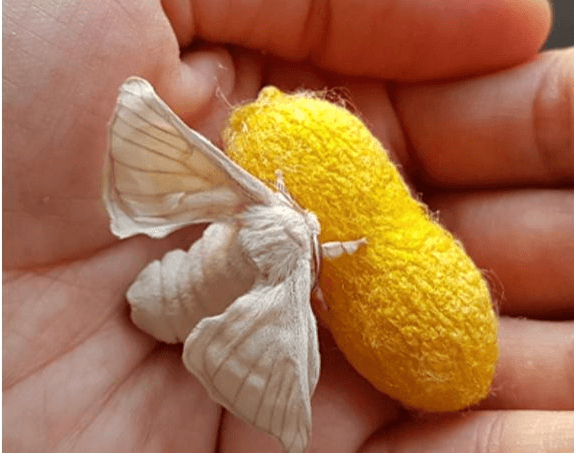
Hatay Sarısı İpeği is a natural fiber obtained from the cocoons of the Bombyx mori L. silkworm, which is fed exclusively on mulberry leaves (Morus alba L.). It is distinguished by its natural yellow color, which is achieved without any dyeing process. It was officially registered as a geographical indication on 16 September 2025. The registering authority is the Hatay Provincial Government (Directorate of Investment Monitoring and Coordination).
Hatay Sarısı İpeği is a natural silk fiber produced from the cocoons of the Bombyx mori L. silkworm, fed on mulberry leaves. Its most distinctive feature is its natural yellow hue, which requires no additional dyeing. Due to this natural coloration, it is also referred to as “golden thread.”
The production process consists of two main stages: sericulture (cocoon production) and silk reeling (yarn production). The feeding of silkworms is made possible by the abundance of mulberry trees in Hatay Province. The leaves of these trees serve as the primary food source for the silkworms. The cocoons obtained from the silkworms are processed using a device known as “haspela.” In this method, the cocoons are dissolved in boiling water to separate the fibers, which are then spun into yarn.
The entire production process of Hatay Sarısı İpeği, including sericulture and silk reeling, is carried out within the boundaries of Hatay Province. Compliance with the geographical indication registration requirements is monitored under the coordination of the Hatay Provincial Government (Directorate of Investment Monitoring and Coordination).
The oversight body comprises representatives from the Hatay Provincial Government, Mustafa Kemal University (Faculty of Agriculture, Department of Biosystems Engineering), İskenderun Technical University (Faculty of Engineering and Natural Sciences), and the Antakya Chamber of Commerce and Industry. Inspections are conducted at least once annually to verify compliance with the criteria specified in the registration certificate.
T.C. Communication Presidency. "‘Hatay Sarısı İpeği Coğrafi İşaret Tescili Aldı.’" Yerel Basın Haberleri. Accessed October 22, 2025. https://www.iletisim.gov.tr/turkce/yerel_basin/detay/hatay-sarisi-ipegi-cografi-isaret-tescili-aldi.
Turk Patent and Trademark Office. "Hatay Sarısı İpeği Sicil Belgesi." Turk Patent and Trademark Office. Accessed October 22, 2025. https://ci.turkpatent.gov.tr/Files/GeographicalSigns/ee03262d-57a8-46b6-a86e-11cdd98bbb57.pdf
Turkish Patent and Trademark Office. "Hatay Sarısı İpeği." Turkish Patent and Trademark Office. Accessed October 22, 2025. https://ci.turkpatent.gov.tr/cografi-isaretler/detay/9542

Type of Geographical İndication | Mahreç Sign | ||||||||
|---|---|---|---|---|---|---|---|---|---|
Registration Number | 1775 | ||||||||
Registration Date | 16.09.2025 | ||||||||
Product / Product Group(s) | Other products | ||||||||
Province(s) | Hatay | ||||||||
Applicant/Registrant(s) | Hatay Mustafa Kemal University Hatay Governorate | ||||||||
Product Description and Distinctive Characteristics
Production and Cultivation Conditions
Geographical Boundary and Oversight