

This article was automatically translated from the original Turkish version.
Location | Artvin | ||||||||
|---|---|---|---|---|---|---|---|---|---|
Year of Establishment | 1994 | ||||||||
Area(s) | 16.988 hectares | ||||||||
Elevation Range | 160 m – 3.224 m | ||||||||
Ecosystem Types | alpine steppe vegetation shrub rock stream Forest | ||||||||
Number of Plant Species | 530–1349 | ||||||||
Number of Endemic Species | 85 relic-endemic / 125 endemic | ||||||||
Important Geomorphological Features | canyons waterfalls slope faults V-shaped young valley | ||||||||
Hatila Valley National Park is a protected natural area located in northeastern Türkiye, within the Eastern Black Sea Region, and under the administrative boundaries of Artvin province. Declared a national park in 1994, the area covers 16,988 hectares. The highest point of the valley is Kurt Dağı at 3,224 meters, while the lowest point is the Çoruh River at 160 meters. The national park is approximately 10 kilometers from the center of Artvin city; of this distance, 5.5 kilometers are paved asphalt road and 1.5 kilometers are natural stone-paved path.

Hatila Vadisi Millî Parkı (AA)
Hatila Valley has a V-shaped, narrow-based, and youthful valley structure. The general character of the valley is defined by slope discontinuities formed due to lithological differences and the waterfalls they generate. The erosive action of the river has caused slope gradients in some sections to reach up to 100 percent. The valley hosts a hydrological system composed of Hatila Stream and 19 tributary streams. These features stand out as key contributors to both geomorphological diversity and landscape value.
The majority of rock formations observed along the valley originate from deep-seated volcanism. Prismatic basalt cliffs are among the most striking geological features in the region and significantly enhance the visual coherence of the valley.
Hatila Valley National Park lies within the Kolşik subdivision of the Euro-Siberian floristic region of the Holarctic floristic zone and possesses a remarkably rich vegetation cover. Between 530 and 1,349 plant species have been identified in the area. Of these, 85 are relict-endemic and 125 are endemic species. Approximately 50 plant species possess medicinal or aromatic properties. Tree species in the flora include linden, fir, yellow pine, beech, oak, chestnut, and lime. Shrub and herbaceous species include forest rose, blackberry, bearberry, strawberry, fern, and thyme.
Five main vegetation types occur within the national park: forest, stream, rock, shrub, and alpine steppe vegetation. These distinct vegetation zones are observed at elevations ranging from 400 to 3,000 meters. Visual assessment studies have determined that forest and stream vegetation exhibit particularly high visual quality.
Hatila Valley is also notable for its rich diversity of animal species. Mammals observed in the region include bear, wild goat, wild boar, fox, wolf, and badger. Bird species include mountain grouse, partridge, eagle, goshawk, and falcon. Reptiles include lizards, snakes, and turtles. Additionally, freshwater fish such as trout inhabit the valley’s waterways.
Within the boundaries of the national park lie the villages of Taşlıca (formerly Hatila) and Fıstıklı. Agriculture, animal husbandry, and especially beekeeping are practiced in these villages. Hatila Honey is a significant local product and received a geographical indication in 2021 under its place of origin. This product is produced by bees that feed on the endemic flora of the national park. The honey filtering and packaging facility located in Taşlıca Village has an annual production capacity of approximately 100 tons.
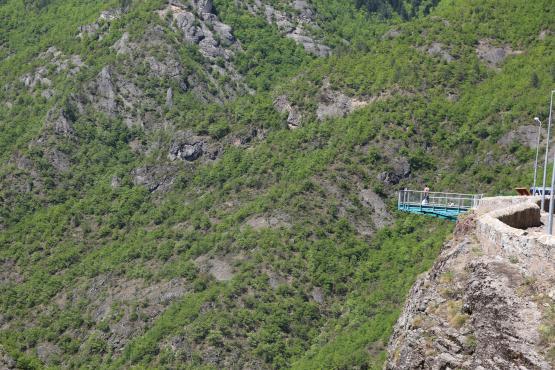
The national park offers opportunities for various nature-based recreational activities including hiking, camping, cycling, and photography. Particularly notable is the glass observation deck constructed in 2015, situated at an elevation of approximately 220 meters, which provides a panoramic view of the valley’s natural landscape. The deck features a 50-square-meter glass surface and has a capacity to accommodate 25 people and a load of 35 tons. The area around the deck also includes a restaurant and tea house selling local products.
Hatila Valley National Park offers a structure suitable for both scientific research and sustainable nature-based tourism due to its ecological, geological, and visual values. According to fractal analysis and visual quality assessments, vegetation diversity, topographic structure, and water elements are the primary factors enhancing landscape aesthetics. These characteristics are taken into account in landscape planning, management, and conservation efforts.
Anadolu Ajansı. “Türkiye'nin En Yüksek Cam Seyir Terasına Yoğun İlgi.” aa.com.tr. Accessed July 15, 2025. https://www.aa.com.tr/tr/turkiye/turkiyenin-en-yuksek-cam-seyir-terasina-yogun-ilgi/811805
Artvin İl Directorate of Culture and Tourism. "Hatila Vadisi National Park." T.C. Kültür veTurizm Bakanlığı. Accessed July 15, 2025. https://artvin.ktb.gov.tr/TR-55913/hatila-vadisi-milli-parki.html
Karaşah, Banu, and Derya Sarı. “Hatila Vadisi Milli Parkı’nda (Artvin) yer alan farklı vejetasyon tiplerinin görsel değerlendirmesi üzerine bir çalışma.” *Turkish Journal of Forestry* 16, no. 1 (2015): 65–74. Accessed July 15, 2025. https://dergipark.org.tr/tr/download/article-file/195876
Keskin, Mehmet Ali. “Bir Turizm ve Kültürel Miras Alanı Olarak Hatila Vadisi.” *Hars Akademi* 6, no. 1 (2023): 33–44. Accessed July 15, 2025. https://dergipark.org.tr/tr/download/article-file/3160969
Ministry of Culture and Tourism of the Republic of Türkiye. "Hatila Vadisi National Park." *Culture Portal – Tourism Activities*. Accessed July 15, 2025. https://kulturportali.gov.tr/turkiye/artvin/TurizmAktiviteleri/hatila-vadisi-milli-parki
Ministry of Culture and Tourism of the Republic of Türkiye. "Hatila Vadisi National Park." *Culture Portal*. Accessed July 15, 2025. https://www.kulturportali.gov.tr/turkiye/artvin/gezilecekyer/hatila-vadisi-milli-parki

Location | Artvin | ||||||||
|---|---|---|---|---|---|---|---|---|---|
Year of Establishment | 1994 | ||||||||
Area(s) | 16.988 hectares | ||||||||
Elevation Range | 160 m – 3.224 m | ||||||||
Ecosystem Types | alpine steppe vegetation shrub rock stream Forest | ||||||||
Number of Plant Species | 530–1349 | ||||||||
Number of Endemic Species | 85 relic-endemic / 125 endemic | ||||||||
Important Geomorphological Features | canyons waterfalls slope faults V-shaped young valley | ||||||||
No Discussion Added Yet
Start discussion for "Hatila Valley National Park" article
Geomorphology and Hydrography
Geology and Rock Formations
Flora
Vegetation Types
Fauna
Cultural Heritage and Settlement
Recreational Areas and Visit Points
Conservation and Planning