

This article was automatically translated from the original Turkish version.
Hüyük Strawberry is a fruit cultivated within the administrative boundaries of Hüyük district in Konya Province, distinguished by its regional characteristics and granted geographical indication status. The product is protected under Turkish law, specifically under Law No. 6769 on Industrial Property, as a geographical indication registered by the Turkish Patent and Trademark Office.
The application for geographical indication of Hüyük Strawberry was submitted by the Hüyük District Directorate of Agriculture and Forestry on 5 April 2020. Following the evaluation process, the product was granted protection under registration number 722 on 13 April 2021. This registration applies to the category of “Processed and unprocessed fruits and vegetables and mushrooms”.
The geographical boundaries of the product encompass the administrative limits of Hüyük district in Konya Province.
Climate Influence: Hüyük is located at the northern edge of the Mediterranean Region and within the Lake District, resulting in a transitional climate that exhibits characteristics of both Mediterranean and Central Anatolian climates. The unique microclimate created by the surrounding Beyşehir Lake, Anamas Mountain, Şarkıkaraağaç Mountains, and Sultandağları provides optimal conditions of humidity, temperature, and chilling for strawberry cultivation. Particularly, the humidity level rarely dropping below 60% during summer months prevents excessive water loss during fruit ripening, thereby preserving quality.
Soil Characteristics: The soils of Hüyük district are generally medium-textured, easy to till, with high water retention capacity and adequate drainage. They contain a balanced mixture of sand, clay, and silt. Nutrient levels are sufficient in potassium, copper, and manganese. Organic matter content ranges between 1.16% and 2.53%, and these soils are observed to be calcareous or highly calcareous. The low levels of heavy metals and minimal environmental pollutants in the region ensure that the strawberries contain no significant heavy metal residues, creating a key quality distinction.
Hüyük Strawberry is produced from varieties such as Albion, San Andreas, Sweden, and Portola.
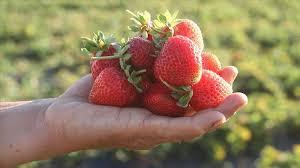
Physical Structure: The fruits are uniformly shaped, medium to large in size, and have a medium firmness. Their weight ranges from 20 to 26 grams, with dimensions of 20 to 40 millimeters in diameter and height.
Taste and Chemical Composition: The product stands out due to its distinctive aroma and flavor. A key factor in its balanced profile is an acidity level of approximately 0.91 g/100 g and a sugar-to-acid ratio of around 8.5. This equilibrium imparts a juicy, optimally firm texture with a slightly sweet and refreshing taste.
Biochemically, Hüyük Strawberry:
The quality of Hüyük Strawberry is maintained through a combination of traditional and scientific methods.
Monitoring to ensure compliance with geographical indication requirements is coordinated by the Hüyük District Directorate of Agriculture and Forestry. The monitoring body is a three-member commission composed of experts from the Directorate and the Hüyük Strawberry Producers Association. Inspections are conducted at least three times annually, with particular emphasis on the peak harvest and export period from June to September. Controls include verification of approved varieties, adherence to production methods, compliance with physical product standards, and correct use of the geographical indication. In cases of complaint, chemical analysis of the product may be performed.

Registration and Legal Status
Geographical Area of Production
Distinctive Characteristics
Production Methods
Monitoring Procedure