


This article was automatically translated from the original Turkish version.
+2 More
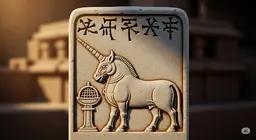
İndus Vadisi Uygarlığı (Yapay Zeka ile Oluşturulmuştur.)
Indus Valley Civilization (IVC) is a civilization dated to the 3000s BCE and recognized as one of the four great ancient civilizations of the ancient world. This civilization dominated the Punjab and Sindh regions within the boundaries of modern-day Pakistan and was contemporary with ancient Egypt and Mesopotamia. Its undeciphered writing system and evidence suggesting a stateless society are among the features that distinguish it from other ancient civilizations.
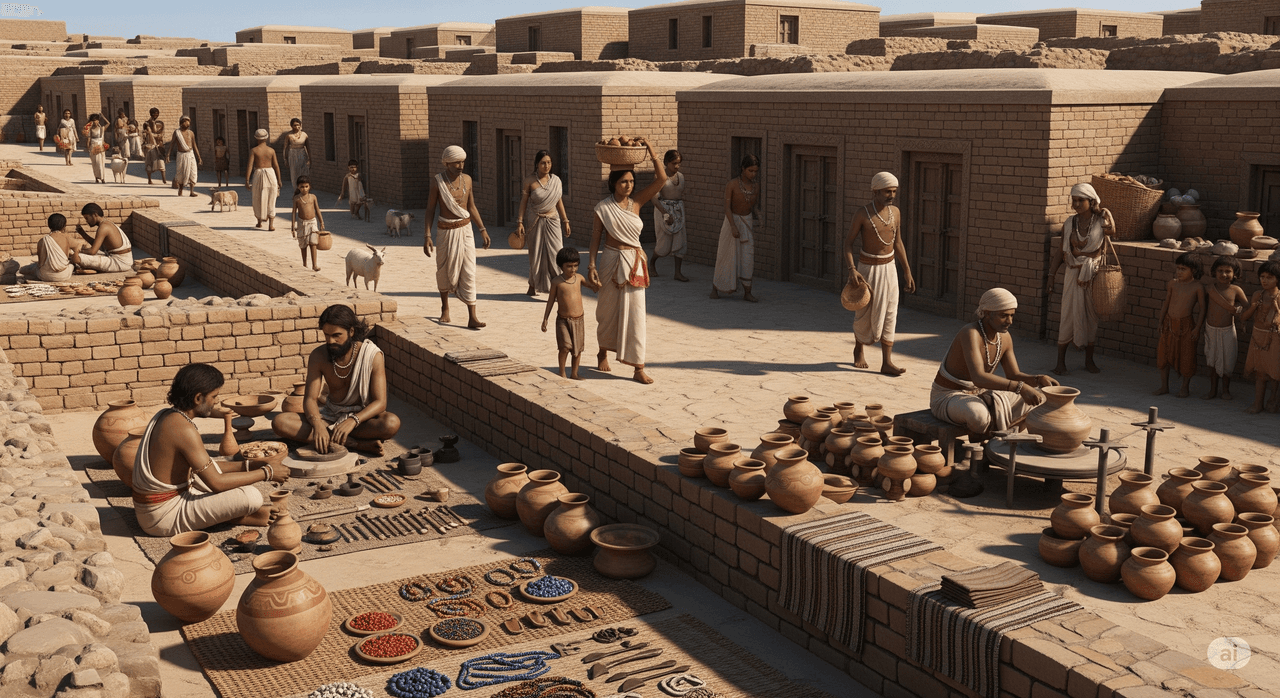
Everyday Life and Trade in the Indus Valley (Generated by Artificial Intelligence)
Knowledge of the remains of the Indus Valley Civilization extends back to the 19th century. The traveler Charles Masson accidentally discovered the ruins at Harappa in the late 1820s and published his observations in a book. About forty years later, Sir Alexander Cunningham conducted excavations in the region and uncovered seals belonging to the Indus civilization. However, its entry into archaeological records occurred only when Sir John Marshall initiated systematic archaeological work at Harappa in 1924. Marshall had already increased interest in the region in 1920 by announcing his findings regarding Harappa and Mohenjo-Daro in the Illustrated London News.
A year later, in 1921, excavations at Harappa began in a planned manner. Approximately 650 kilometers to the south, in the Sindh region, a larger settlement known as Mohenjo-Daro was discovered. The most recent comprehensive excavations at Mohenjo-Daro were carried out by Dr. George F. Dales between 1964 and 1965. In the 1980s, Pakistani archaeologists and conservators played a role in preserving the region’s heritage. During the same period, UNESCO recognized Mohenjo-Daro as a World Cultural Heritage site in 1980.
The Indus Valley Civilization spread over an area exceeding one million square kilometers, extending from Sutkagen-dor in the west to Daimabad in present-day India in the east, from the Arabian Sea in the south to the Simla hills at the foothills of the Himalayas in the north. The civilization developed in the fertile plains watered by the Indus and Ghaggar-Hakra rivers. Like Egypt and Mesopotamia, the IVC was a riverine civilization; rivers played a fundamental role in sustaining large settlements by supporting agricultural development.
The two best-known major centers of the civilization are Harappa in the north, in Punjab, and Mohenjo-Daro in the south, in Sindh. In addition to these two centers, more than a hundred smaller towns and settlements such as Ganweriwala, Dholavira, and Lothal have been uncovered.
The developmental process of the Harappa culture is studied by archaeologists through distinct phases, which are used to describe the civilization’s long-term and cumulative cultural evolution.
This period, also known as the Neolithic, marks the first use of native plants and animals in the Indus Valley.
This phase encompasses regional cultural developments. Dispersed agricultural-pastoral settlements emerged during this time and gradually evolved from small villages into larger towns.
This period is most commonly associated with the term Indus Valley Civilization. It is characterized by the emergence of numerous urban centers and smaller towns. The widespread use of a writing system, standardized cubic stone weights, and similar pottery styles are features of this era. This period is also known as the “Mature Harappa” phase and spans approximately 2500–1700 BCE.
During this stage, significant transformations occurred in the socio-economic and political structures of cities and regional settlements. The disappearance of the Indus script and standardized weights are among the most notable changes of this period.
Indus cities, particularly Harappa and Mohenjo-Daro, are notable for their remarkable regularity in urban planning. Mohenjo-Daro exemplifies three key features of Indus urban life: a grid-pattern layout, advanced water and drainage systems, and the absence of monumental structures such as palaces, grand temples, or pyramids.
Main streets run north-south or east-west, forming a “grid pattern.” Cities were built on raised brick platforms to protect against flooding from the Indus River. Building materials typically consisted of standardized baked and sun-dried bricks.
One of the most striking features of Indus cities is their water and drainage systems. Nearly every house had a system for sewage and wastewater disposal. In bathrooms, sloped floors directed water through wall pipes into covered drainage channels connected to the street.
No large palaces, grand temples, monumental tombs, or pyramids have been found in Mohenjo-Daro or other Indus cities. This absence has supported the view that Indus society may have been stateless. However, structures such as the “Great Bath” in Mohenjo-Daro may indicate social stratification and the existence of an elite class. The Great Bath is a brick-built pool measuring 12 meters in length, 7 meters in width, and 2.5 meters in depth, with its surface coated in a bitumen-like material to ensure waterproofing. It is believed to have been used for religious rituals or special ceremonies.
Large structures known as “Granaries” were also present in cities for storing grain. These buildings were constructed on elevated platforms to ensure ventilation.
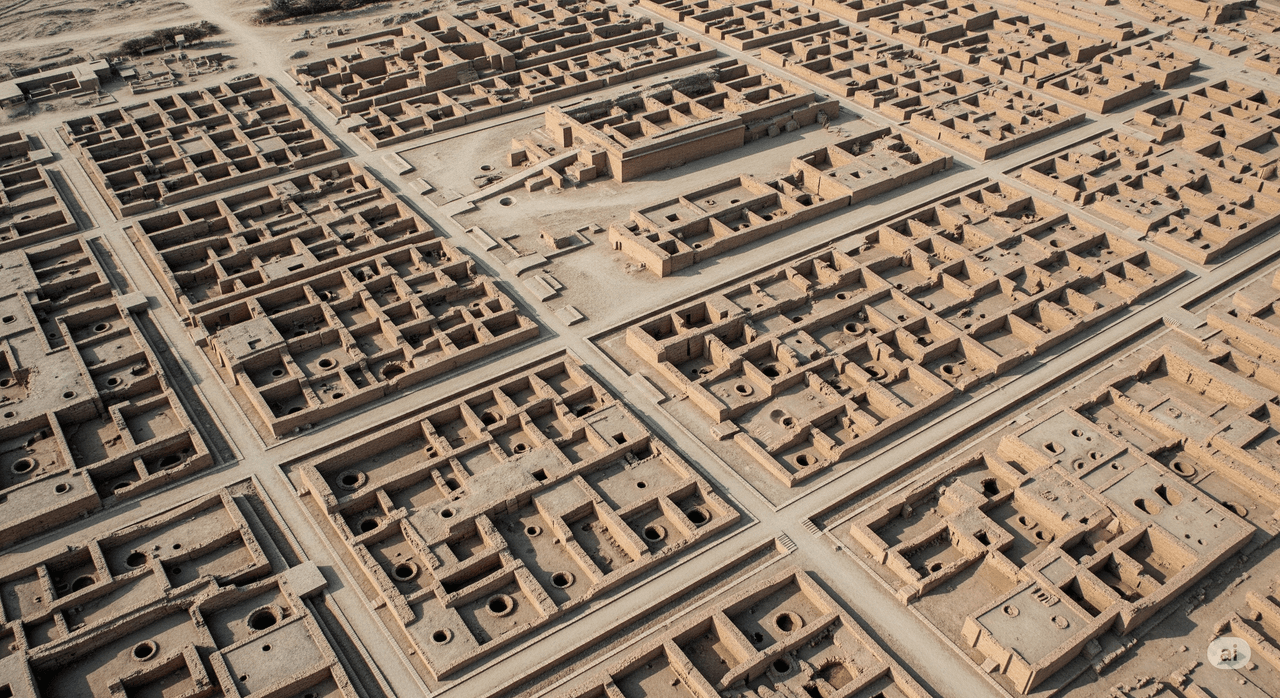
Mohenjo-Daro’s Grid-Plan Urban Layout (Generated by Artificial Intelligence)
The absence of a clear administrative mechanism or large monumental structures in Indus cities has led to the hypothesis that the civilization was governed without a centralized state authority. This suggests that the Indus people had a social and political structure distinct from their contemporaries in Mesopotamia and Egypt. A stateless societal model may explain why the Indus civilization showed no signs of conquest or expansion.
However, this does not imply the absence of social control or class distinctions. The regularity of urban planning, standardized weights and measures, and organized craft production indicate the existence of some form of socio-political organization. Burial findings, the distribution of ornaments, and variations in house sizes suggest a hierarchy within society. This elite class is thought to have consisted of merchants, landowners, or religious leaders.
The economy of the Harappa civilization was based on agriculture, animal husbandry, craft production, and trade. Agricultural surplus and manufactured goods were used in both internal and external trade.
Within the civilization, raw materials and finished products were distributed through an extensive network. Raw materials such as copper, stone, seashells, carnelian, and ivory were transported from distant regions and processed in urban workshops. Centers like Mehrgarh produced pottery, steatite seals, metal tools, and beads. Artisans manufactured various ornaments, including bracelets from seashells and beads from lapis lazuli and turquoise. The production and distribution of these goods indicate an organized economic structure. Oxen-drawn two-wheeled carts were used for overland transport.
The Harappa civilization established intensive commercial relations with Mesopotamia, a region across the sea. Texts from the time of the Akkadian king Sargon (2334–2279 BCE) provide evidence that the region referred to as “Meluhha” corresponds to the Indus Valley. According to these texts, ships from Meluhha, along with those from Magan (likely Oman) and Dilmun (likely Bahrain), arrived at Akkadian ports.
Exports to Mesopotamia included wood, copper, gold, silver, carnelian, lapis lazuli, ivory, and various ornaments. In contrast, Mesopotamian artifacts found in Harappa regions are relatively scarce. This may suggest that Indus culture exerted greater influence on other societies than it received.
Evidence of this trade includes Harappan-style seals, beads, and ceramic fragments discovered in Mesopotamian cities such as Ur, Kish, and Akkad. Particularly distinctive are square seals bearing the motif of a one-horned animal, which are among the clearest indicators of this interaction. Trade occurred via sea routes across the Persian Gulf and overland routes through the Iranian plateau. Lothal in Gujarat played a key role as the civilization’s only known port city in maritime trade.
The Indus script is a pictographic system that has not yet been fully deciphered. It is estimated to contain several hundred characters. Scholars generally agree that the system is likely “logo-syllabic” rather than alphabetic or syllabic. Inscriptions are typically found on seals, tablets, and pottery and are very short, usually consisting of a single line, though some examples extend up to seven lines.
Various theories have been proposed regarding the decipherment of the script. Asko Parpola of the University of Helsinki argues that the Indus script derives from an early form of the Dravidian language family. Parpola has attempted to interpret certain symbols based on the Dravidian word “min,” which means both “fish” and “star.” In contrast, researchers Steve Farmer and colleagues argue that the brevity of the inscriptions and their limited contexts suggest these symbols do not encode a language but instead represent a symbolic system【1】.
If this writing system does not represent a language, the Indus Valley Civilization may have been one of the world’s largest literate societies.
The decline and disappearance of the Indus Valley Civilization around 1900 BCE remains an unresolved issue. Numerous theories have been proposed:
Archaeological records indicate that the collapse was not due to a single cause but rather a gradual “transformation.” After the Mature Harappa phase, while major urban centers were abandoned, rural settlements continued for some time. Consequently, theories regarding the civilization’s decline remain open to debate.
Can, H. Derya, and Yalçın Kayalı. “Tarihin Güney Asya’daki (Pakistan-Hindistan) Başlangıcına Tanıklık Etmiş Bir Uygarlık: İndus Vadisi Medeniyeti.” *Türkiye'de Pakistan Çalışmaları - I*, pp. 1–34. Ankara: Ankara Üniversitesi Yayınları, 2023. Accessed October 19, 2025. https://apam.ankara.edu.tr/wp-content/uploads/sites/485/2023/07/Turkiyede-Pakistan-Calismalari-I.pdf.
Ceyhan, Kadriye Leyla. “Harappa ve Mezopotamya Medeniyetleri Arasındaki Ticarete Dair Kanıtlar.” *OANNES - International Journal of Ancient History* 1, no. 1 (March 2019): 1–19. Accessed October 19, 2025. https://dergipark.org.tr/en/pub/oannes/article/635722.
Javonillo, Charise Joy. “Indus Valley Civilization: Enigmatic, Exemplary, and Undeciphered.” *ESSAI* 8, no. 1 (2010): 21. Accessed October 19, 2025. https://dc.cod.edu/cgi/viewcontent.cgi?article=1315&context=essai.
Kayalı, Yalçın. “Anlaşılmaz, İbret Verici ve Deşifre Edilmemiş Yönleriyle İndus Vadisi Medeniyeti.” *Iğdır Üniversitesi Sosyal Bilimler Dergisi* 7 (2015): 191–206. Accessed October 19, 2025. https://dergipark.org.tr/en/pub/igdirsosbilder/issue/66812/1044896.
[1]
Yalçın Kayalı, “Anlaşılmaz, İbret Verici ve Deşifre Edilmemiş Yönleriyle İndus Vadisi Medeniyeti,” Iğdır Üniversitesi Sosyal Bilimler Dergisi 7 (2015): 201, erişim 19 Ekim 2025, https://dergipark.org.tr/en/pub/igdirsosbilder/issue/66812/1044896
[2]
H. Derya Can ve Yalçın Kayalı, “Tarihin Güney Asya’daki (Pakistan-Hindistan) Başlangıcına Tanıklık Etmiş Bir Uygarlık: İndus Vadisi Medeniyeti,” in Türkiye’de Pakistan Çalışmaları-I, (Ankara: Ankara Üniversitesi Yayınları, 2023), 23, erişim 19 Ekim 2025, https://apam.ankara.edu.tr/wp-content/uploads/sites/485/2023/07/Turkiyede-Pakistan-Calismalari-I.pdf
Kayalı, “Anlaşılmaz … İndus Vadisi Medeniyeti,” 203.

İndus Vadisi Uygarlığı (Yapay Zeka ile Oluşturulmuştur.)
No Discussion Added Yet
Start discussion for "Indus Valley Civilization (Harappa Civilization)" article
Discovery and Archaeological Investigations
Geographical Extent and Settlement
Chronology
Early Food Production Stage (c. 7000–5500 BCE)
Regionalization Stage (c. 5500–2600 BCE)
Integration Stage (c. 2600–1900 BCE)
Localisation Stage (c. 1900–1300 BCE)
Urban Planning and Architecture
Social and Political Structure
Economy and Trade
Internal Trade and Craft Production
External Trade
Writing System
Decline