


This article was automatically translated from the original Turkish version.
+1 More

Information Processing Theory
(Generated by Artificial Intelligence)
Information Processing Theory
Field | Cognitive Psychology Educational Sciences | ||||||||
|---|---|---|---|---|---|---|---|---|---|
Related Concept(s) | Memory Models Cognitive Development Learning Theories | ||||||||
Definition(s) | Learning Models Problem Solving Cognitive Processes Retrieval Storage (Short-term and Long-term Memory) Encoding Attention Perception | ||||||||
Basic Metaphor | Human mind = Computer | ||||||||
Information Processing Theory is a theory within cognitive psychology that examines how information is acquired, stored, retrieved, and used by the mind. This approach treats the human mind as a complex information processor and analogizes it to the operational principles of a computer. The central focus of the theory is the transformation of information from its entry as a stimulus from the external world through its transition from one memory stage to another. Cognitive learning is defined as the changes that occur in an individual’s mental structures as a result of these processes.【1】
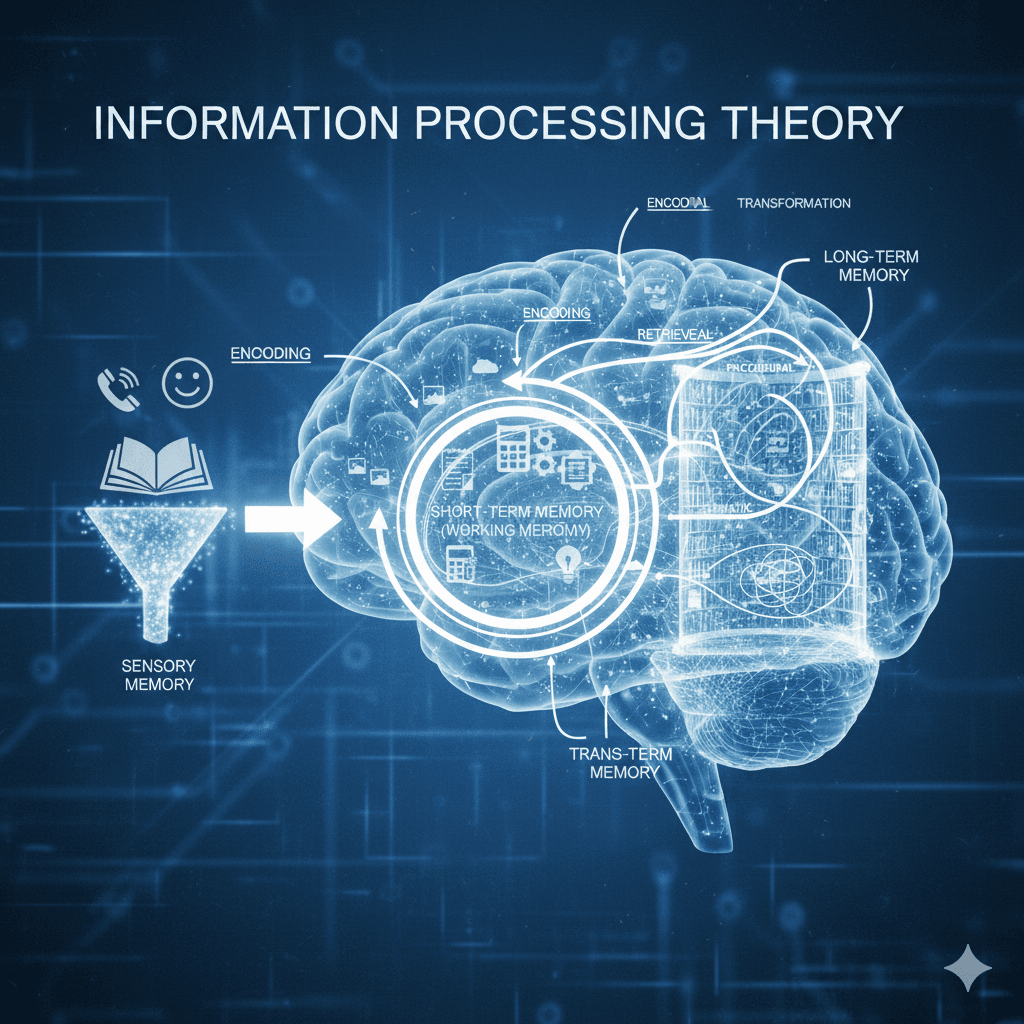
Information Processing Theory Schema
(Generated by Artificial Intelligence)
The scientific foundations of the theory date back to the 1950s, particularly to the work of cognitive psychologist and computer scientist George Miller. Miller is regarded as a pioneer of the theory following his 1956 article titled "The Magical Number Seven, Plus or Minus Two," which demonstrated the limited capacity of short-term memory.
The information processing approach gained academic momentum with a 1956 symposium held at MIT, attended by figures such as Noam Chomsky, Jerome Bruner, Allen Newell, and Herbert Simon. In 1967, Ulric Neisser expanded the field by defining cognition as the totality of processes through which sensory inputs are transformed, reduced, stored, and utilized. The development of the theory emerged as part of the " Cognitive Revolution," a reaction against behaviorist approaches that ignored mental processes.
The information processing model is built on three core assumptions: that cognition can be analyzed as a sequence of discrete stages, that each stage performs unique operations on information, and that each stage uses the output of the preceding stage as its input.
Within this framework, the theory proposes three distinct types of processing:
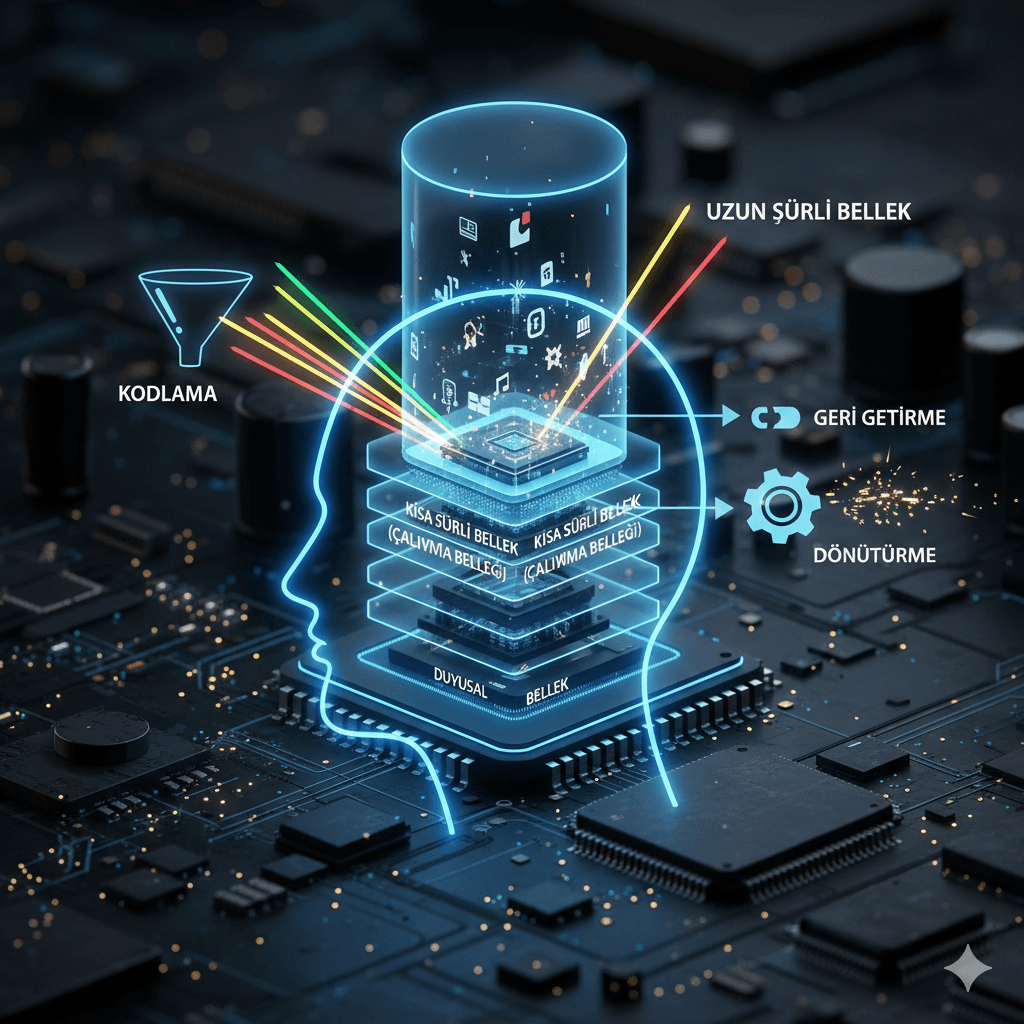
Mental Processes and Memory Structures According to Information Processing Theory
(Generated by Artificial Intelligence)
The theory identifies three primary memory stores that manage the flow of information:
Sensory Memory (Sensory Register): The stage at which stimuli from the environment are first received and held for a very brief duration. Information here is transferred to the next stage through attention and perception processes.
Short-Term Memory (Working Memory): The area where information is temporarily held with limited capacity and duration, and where active operations are performed. The retention of information in this stage can be extended through mental rehearsal and chunking techniques.
Long-Term Memory: The structure in which information is stored permanently with virtually unlimited capacity. This structure comprises episodic, semantic, and procedural memory subsystems.
The acquisition and permanent retention of information occur through four key stages:
Encoding: The interpretation of sensory inputs from the environment and the formation of mental representations. In this stage, new information is linked to existing knowledge in long-term memory to make it meaningful.
Storage: The retention of processed information in memory systems for future use.
Retrieval: The process of accessing stored information when needed and recalling it into working memory.
Transformation: The adaptation of information into more useful forms for tasks such as problem solving or reasoning.
Information Processing Theory, despite offering a robust model for understanding cognitive processes, has faced several criticisms. The most fundamental critique is that it analogizes the human mind to a computer, presenting an overly mechanistic model that overlooks human emotional and creative dimensions. It is also argued that the proposed stages of information processing are too simplistic and fail to fully capture the complexity of real-world learning processes. Nevertheless, the theory continues to serve as a fundamental reference point in the development of educational practices and the design of problem-solving techniques.
Accessed February 18, 2026.
Akbağ, M. 2014. “Öğrenmede Bilişsel Yaklaşım: Bilgiyi İşleme Modeli.” In Eğitim Psikolojisi, edited by A. Bakioğlu. Ankara: Nobel Yayın Dağıtım. Accessed February 18, 2026. https://avesis.marmara.edu.tr/yayin/1bc010a3-d1e9-4ddf-8f53-10f8d89a2b37/egitim-psikolojisi
Ankara Üniversitesi. "Bilişsel Psikoloji ve Bilgi İşleme Modeli." Ankara Üniversitesi Açık Ders Malzemeleri.
Wixted, John T. 2023. “Atkinson and Shiffrin’s (1968) Influential Model in Human Memory.” *Journal of Memory and Language* 137: 104471. Accessed February 18, 2026. https://doi.org/10.1016/j.jml.2023.104471
Xiong, A. 2018. “Information Processing: The Language and Analytical Tools in Cognitive Psychology.” National Center for Biotechnology Information (PMC). Accessed February 18, 2026. https://www.ncbi.nlm.nih.gov/pmc/articles/PMC6092626/
https://acikders.ankara.edu.tr/pluginfile.php/19291/mod_resource/content/1/1.%20BİLİŞSEL%20PSİYOLOJİ%20VE%20BİLGİ%20İŞLEME%20MODELİ.pdf
Öztürk, B., and İ. Kısaç. 2018. “Bilgiyi İşleme Modeli.” In *Eğitim Psikolojisi Gelişim‑Öğrenme‑Öğretim*, edited by B. Yeşilyaprak. Ankara: Pegema Yayıncılık. Accessed February 18, 2026. https://avesis.gazi.edu.tr/yayin/760c276d-be92-44f2-ae75-afc2e9bf7095/egitim-psikolojisi-gelisim-ogrenme-ogretim
[1]
Halise Kader Zengin, "Information Processing Theory," Ankara University, access date 18 February 2026, https://acikders.ankara.edu.tr/pluginfile.php/357/mod_resource/content/2/12._hafta-Bilgiyi_Isleme_Kurami.pdf.

Information Processing Theory
(Generated by Artificial Intelligence)
Information Processing Theory
Field | Cognitive Psychology Educational Sciences | ||||||||
|---|---|---|---|---|---|---|---|---|---|
Related Concept(s) | Memory Models Cognitive Development Learning Theories | ||||||||
Definition(s) | Learning Models Problem Solving Cognitive Processes Retrieval Storage (Short-term and Long-term Memory) Encoding Attention Perception | ||||||||
Basic Metaphor | Human mind = Computer | ||||||||
No Discussion Added Yet
Start discussion for "Information Processing Theory" article
Historical Development and Theoretical Origins
Core Assumptions and Types of Information Processing
Structures Where Information Is Stored: Memory Stores
Stages of the Information Processing Process
Critiques and Limitations