


This article was automatically translated from the original Turkish version.
+2 More
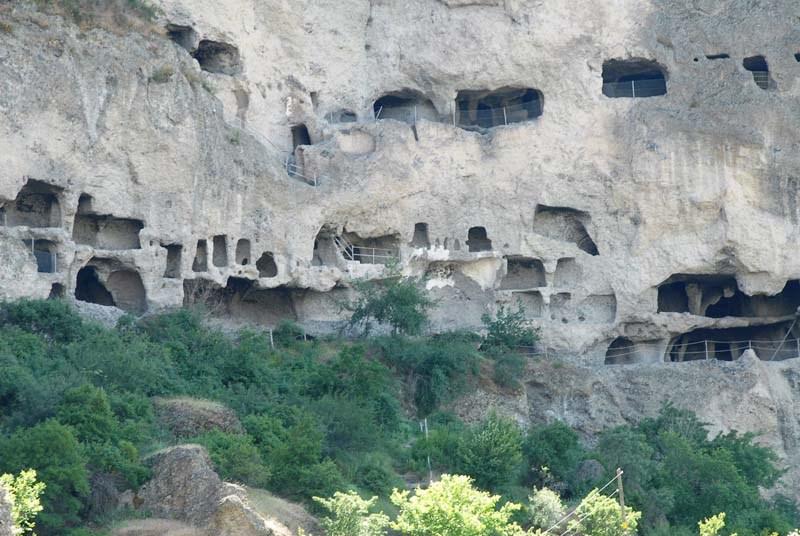
İnönü Caves
Location | Güdül - Ankara / Türkiye | ||||||||
|---|---|---|---|---|---|---|---|---|---|
Type(s) | cave settlement Archaeological and natural heritage site | ||||||||
Historical Periods | Roman and Byzantine periods 8th century BCE (Phrygian) 2000 BCE (Hattian/Eti) | ||||||||
Architectural Feature(s) | fairy chimney-like formations central church-like plan carved staircases Multi-level cave structure | ||||||||
Protection Status | First-Degree Archaeological and Natural Heritage Site Strictly Protected Sensitive Area | ||||||||
Inönü Caves is a multi-layered historical settlement carved into volcanic rock formations along the Kirmir Çayı Valley within the boundaries of Güdül district, Ankara. These caves, resembling the cave dwellings of Cappadocia in their geological structure and architectural layout, have been used by various civilizations since the 3rd millennium BCE. Structures known to have served as places of worship and shelter during the Roman and Byzantine periods have been designated as a first-degree archaeological and natural heritage site due to their historical and natural significance.

Inönü Caves (Güdül District Governorship, Republic of Türkiye)
The caves exhibit architectural similarities to the cave settlements in Nevşehir’s Ürgüp-Göreme region of Central Anatolia. Observations suggest that the settlement pattern clusters around a central church. However, due to the limited archaeological evidence concerning the remains of this church structure, this interpretation is based on local observation. Nevertheless, the planning of multi-tiered rooms and passageways indicates long-term human habitation in the region.
Traces of human settlement in the area date back to the 3rd millennium BCE. It is believed that during this period, the Hattian (Hittite) culture was dominant in the region and that rock-carved caves began to be used. In the 8th century BCE, the region came under Phrygian control. During the Roman Empire, it is presumed that the Inönü Caves were used for worship and shelter as Christianity spread across Anatolia. Cross markings found at cave entrances are remnants from this era. Archaeological remains and usage traces confirm that the settlement continued into the subsequent Byzantine period.
The circular erosion of the volcanic rock formations by Kirmir Çayı has created steep slopes that make access to the caves difficult but provide natural protection, resulting in a unique topography. The area possesses a geomorphological appearance rarely found elsewhere. Additionally, fairy chimney-like formations are present. This geological richness renders the site valuable not only archaeologically but also visually and in terms of natural landscape.

Kirmir Çayı (Subgovernorship of Güdül, Republic of Türkiye)
The Inönü Caves are not only historically significant but also an important area for biodiversity. The site hosts species classified by the International Union for Conservation of Nature (IUCN) as Critically Endangered (CR), Endangered (EN), and Vulnerable (VU). In addition, numerous endemic plant species thrive in the area. The ecosystem services, continuity of biotopes, and balance of natural flora and fauna provide a favorable environment for scientific research.
The Inönü Caves have been officially registered as a first-degree archaeological and natural heritage site by the Ankara Council for the Protection of Cultural and Natural Heritage, under the Ministry of Culture and Tourism. Furthermore, by Presidential Decree No. 2457 dated 20 April 2020, a 3.82-hectare portion of the area has been granted the status of “Strictly Protected Sensitive Area.”
The site is being made accessible through environmental improvement and restoration projects carried out by the Ankara Investment Monitoring and Coordination Presidency (YİKOB). As part of these projects, glass terraces, walking paths, and viewing platforms have been constructed. These structures ensure safe visitor access to the area while supporting the sustainability of the natural and cultural landscape.
Güdül Belediyesi. "İnönü Mağaraları." Güdül Municipality Official Website. Accessed June 19, 2025. https://www.gudul.bel.tr/HOME/INDEX/GUDUL/ILCEREHBER/70.
T.C.Güdül Kaymakamlığı Governorship. "İnönü Mağaraları." Güdül District Governorship Official Website. Accessed June 19, 2025. http://www.gudul.gov.tr/inonu-magaralari.
T.C.Güdül Kaymakamlığı Governorship. "İnönü Mağaraları." Güdül District Governorship Official Website. Accessed June 19, 2025. http://www.gudul.gov.tr/inonu-magaralarii.

İnönü Caves
Location | Güdül - Ankara / Türkiye | ||||||||
|---|---|---|---|---|---|---|---|---|---|
Type(s) | cave settlement Archaeological and natural heritage site | ||||||||
Historical Periods | Roman and Byzantine periods 8th century BCE (Phrygian) 2000 BCE (Hattian/Eti) | ||||||||
Architectural Feature(s) | fairy chimney-like formations central church-like plan carved staircases Multi-level cave structure | ||||||||
Protection Status | First-Degree Archaeological and Natural Heritage Site Strictly Protected Sensitive Area | ||||||||
Architectural Structure and Similarities
Historical Development and Use
Geomorphology and Natural Features
Biodiversity
Protection Status and Restoration Efforts
Restoration and Visitor Infrastructure