

This article was automatically translated from the original Turkish version.
+2 More
Location | Yakup Çelebi Street Bursa İznik | ||||||||
|---|---|---|---|---|---|---|---|---|---|
Construction Date(s) | 6th century AD | ||||||||
Cultural Period | Eastern Roman (Byzantine) | ||||||||
Original Function | Baptistery | ||||||||
Subsequent Function | Ayazma (Sacred Water Area) | ||||||||
Building Material | Rubble stone, brick, lime-sand mortar | ||||||||
Inscriptions | Greek and Hebrew inscriptions | ||||||||
Böcek Ayazma is a Byzantine-era structure located on Yakup Çelebi Street in the İznik district of Bursa Province, approximately 50 metres east of the Koimesis Kilisesi. Originally constructed as a baptistery (baptisterium), the structure was later used as a holy water source, known as an ayazma.
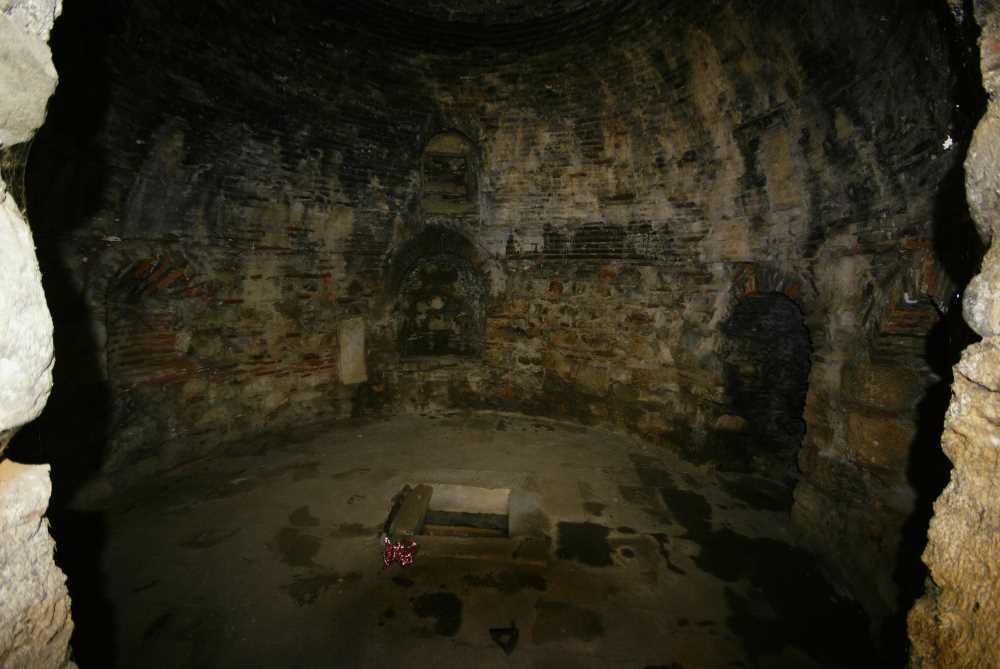
The structure is situated several metres below the road level and is enclosed by a stone wall and iron railings. Today, its dome is covered with a concrete layer and the surrounding area is filled with rubble. Access to the circular-plan building is via an L-shaped staircase with eleven steps on the western facade. The entrance section is 2.55 metres high and is topped by an architrave and a brick arched lintel above it. From this entrance, one enters a room with a diameter of 4.5 metres and a height of 3.8 metres, whose dome is constructed of brick. The floor is paved with stone slabs, while the walls are built in a mixed pattern of rubble stone, brick, and lime-sand mortar.
At the centre of the structure is a square-plan water well approximately one metre deep. Various niches are present on the walls; it is reported that on either side of the eastern niche, marble slabs bear carved crosses and geometric decorations. One of the marble threshold stones of the cistern bears a Greek inscription reading “Christian Emperor, the Exalted King Michael,” while another contains a Hebrew inscription interpreted as a quotation from the Torah: “He gives good to every flesh, for His mercy is eternal.”
The exact construction date of the structure cannot be determined with certainty, but its plan characteristics and material usage indicate that Böcek Ayazma was built during the Byzantine Empire in the 6th century AD. Originally serving as a baptistery, the structure was converted into an ayazma in the early 20th century. During the Byzantine period, it functioned as an important religious centre where baptismal rites with holy water were performed.
The term “ayazma” derives from the Greek words “hagios” (holy) and “ma” (water), meaning “holy water.”【1】 In this context, Böcek Ayazma is a structure reflecting the Christian belief in purification and cleansing through holy water. During the period when İznik served as the capital of the Byzantine Empire, Böcek Ayazma was used for baptismal ceremonies and religious rituals.
Böcek Ayazma is spatially directly connected to Koimesis Kilisesi. Both structures belong to the same period and are considered parts of a shared religious function. According to tradition, Böcek Ayazma was constructed as part of the monastic complex of Koimesis Kilisesi. The name “Koimesis,” meaning “the Dormition or Assumption of the Virgin Mary,” suggests that Böcek Ayazma may also be associated with the cult of holy water linked to Mary.【2】
No archaeological excavations have been conducted at the site of the structure, but the Byzantine-era stonework and brickwork techniques remain largely intact. Although it has been hypothesized that Böcek Ayazma was originally part of an asklepion (a healing temple dedicated to the god Asclepius), this hypothesis is not supported by archaeological evidence. Today, the upper part of the structure has been sealed with modern materials, but its original architectural features are largely preserved.
Ministry of Culture and Tourism of the Republic of Türkiye. "Böcek Ayazma Kilisesi - Bursa." *Türkiye Kültür Portalı*. Accessed October 20, 2025. https://www.kulturportali.gov.tr/turkiye/bursa/kulturenvanteri/bocek-ayazma-kilisesi Kültür Portali
Ministry of Culture and Tourism of the Republic of Türkiye. "Böcek Ayazma Kilisesi - Bursa." *Türkiye Kültür Portalı.* Accessed October 20, 2025. https://www.kulturportali.gov.tr/turkiye/bursa/gezilecekyer/bocek-ayazma-kilisesi
Şahin, Mustafa. “İznik Koimesis Kilisesi ve Böcek Ayazma Üzerine.” *Bursa’da Zaman*, no. 10 (April 2014): 102–104. Accessed October 20, 2025. https://uludag.edu.tr/dosyalar/arkeoloji/mustafa/bursada_zaman_iznik_koimesis.pdf
[1]
Mustafa Şahin, “İznik Koimesis Kilisesi ve Böcek Ayazma Üzerine,” Bursa’da Zaman, no. 10 (Nisan 2014): syf. 102, https://uludag.edu.tr/dosyalar/arkeoloji/mustafa/bursada_zaman_iznik_koimesis.pdf
[2]
Mustafa Şahin, “İznik Koimesis Kilisesi ve Böcek Ayazma Üzerine,” Bursa’da Zaman, no. 10 (Nisan 2014): syf. 103, https://uludag.edu.tr/dosyalar/arkeoloji/mustafa/bursada_zaman_iznik_koimesis.pdf

Location | Yakup Çelebi Street Bursa İznik | ||||||||
|---|---|---|---|---|---|---|---|---|---|
Construction Date(s) | 6th century AD | ||||||||
Cultural Period | Eastern Roman (Byzantine) | ||||||||
Original Function | Baptistery | ||||||||
Subsequent Function | Ayazma (Sacred Water Area) | ||||||||
Building Material | Rubble stone, brick, lime-sand mortar | ||||||||
Inscriptions | Greek and Hebrew inscriptions | ||||||||
Location and General Features
Architecture and Inscriptions
History and Use
Cultural and Religious Significance
Relationship with Koimesis Kilisesi
Archaeological Value and Current Condition